 Home
Home
The Story of
The Donora Smog of 1948
MyHistoryStone Archive
October 27, 1948
Donora, Pennsylvania, United States
Location
The Monongahela Valley
In motion
3 photographs
The photographs on this page, brought to life.
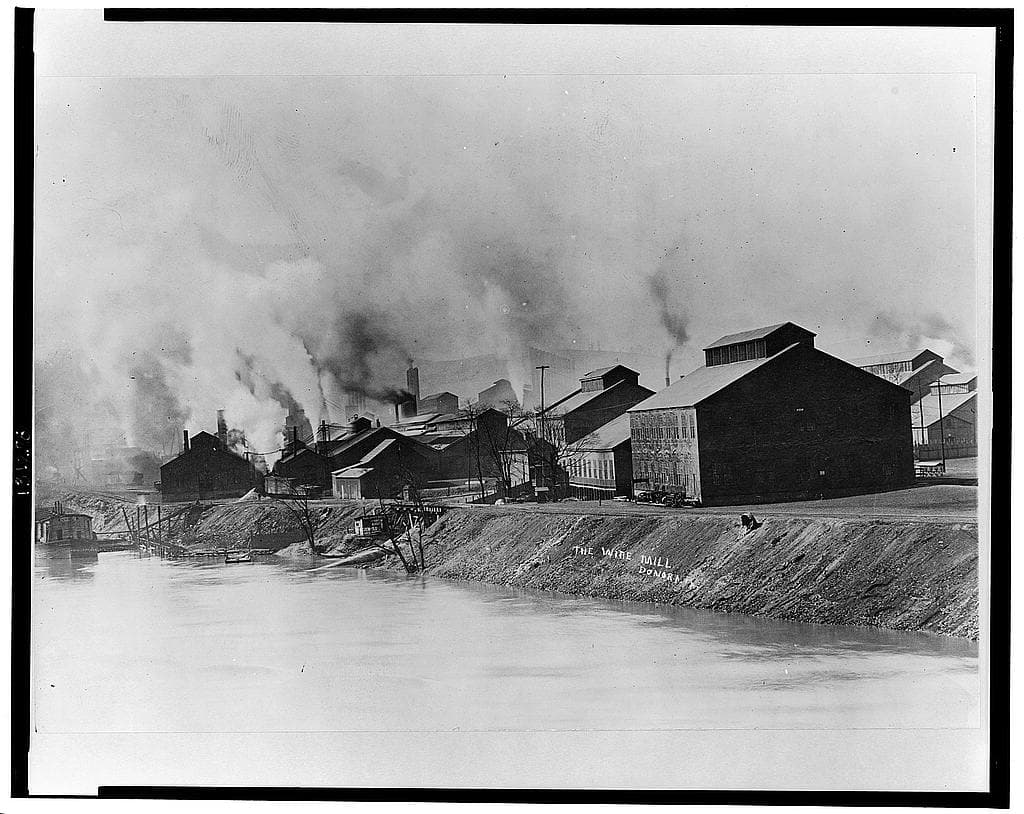
The wire mill at Donora about 1910. The Library filed it under air pollution thirty-eight years early. Library of Congress, Prints and Photographs Division
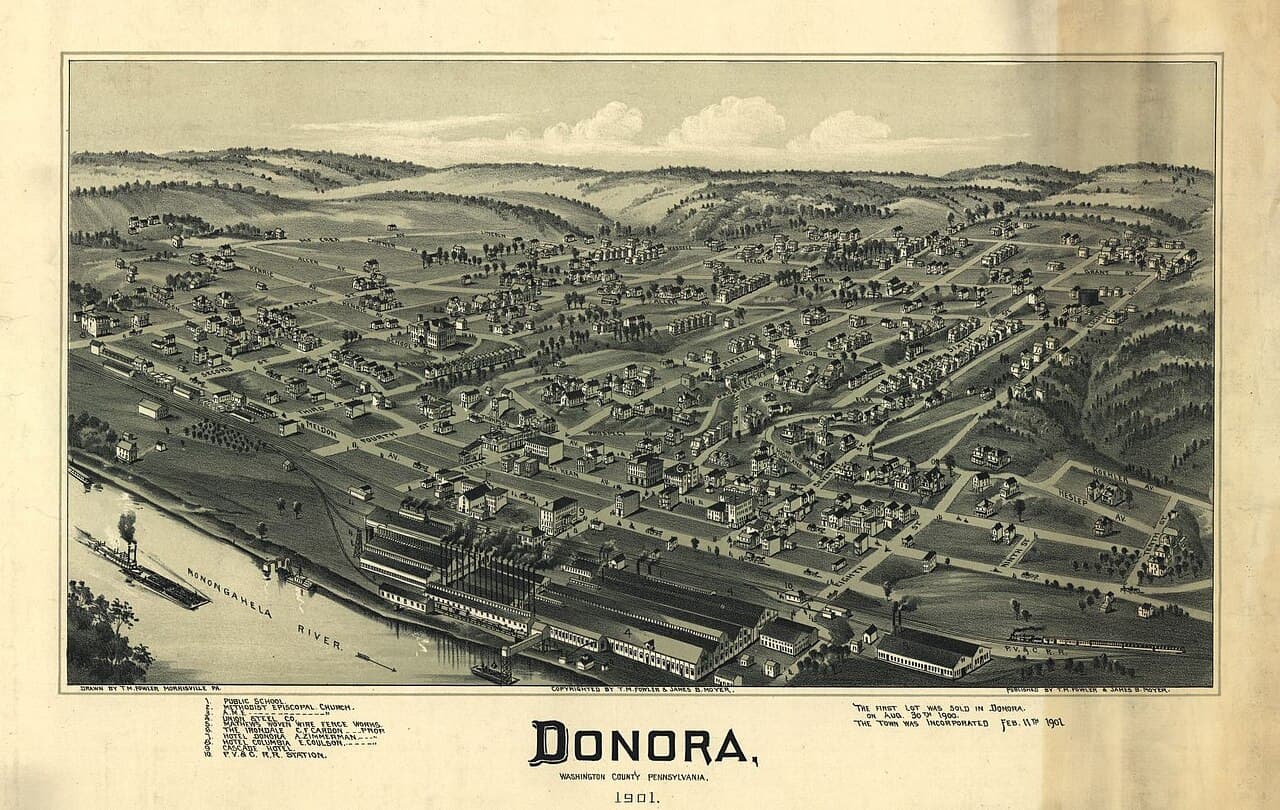
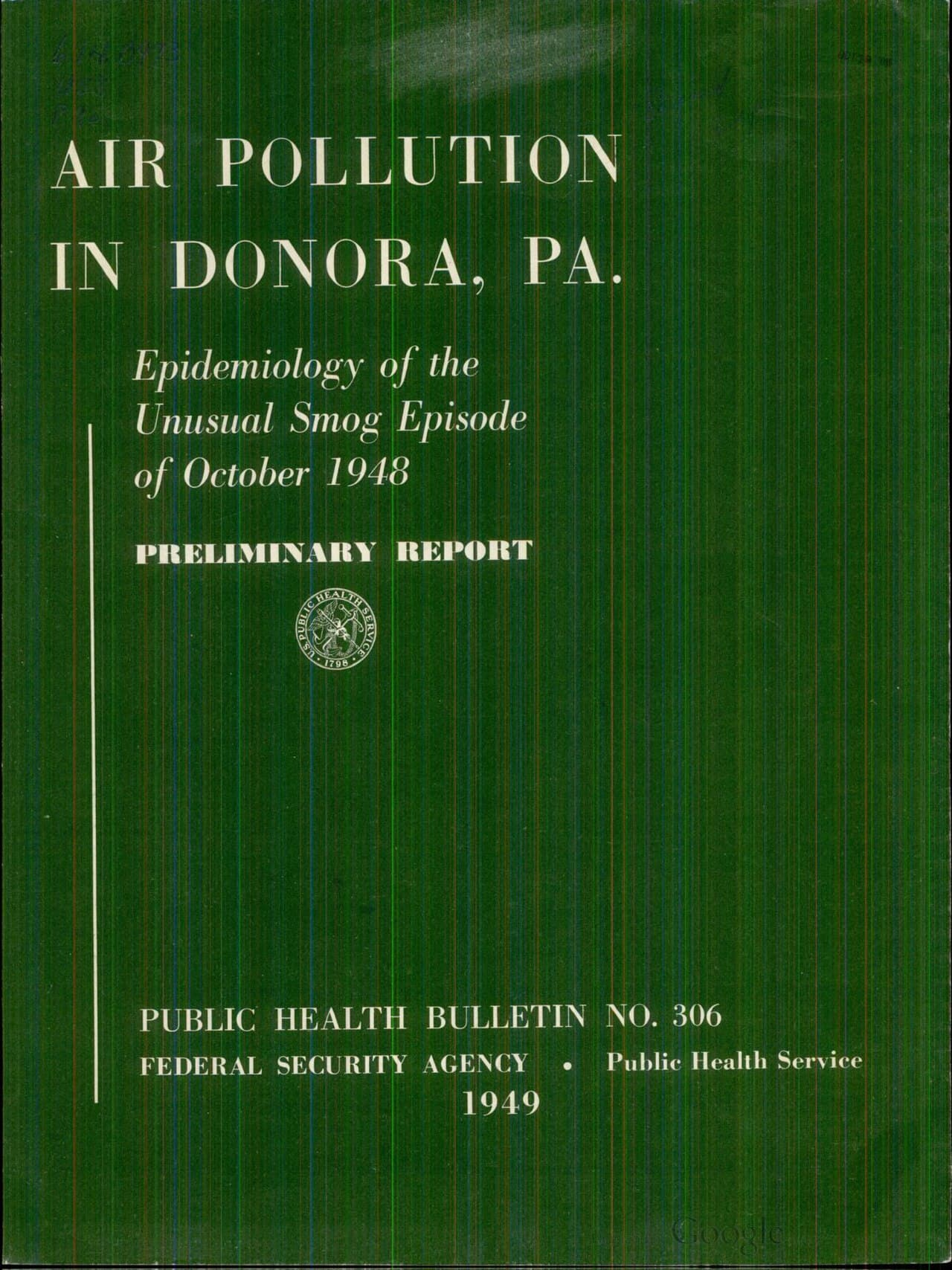
For five days at the end of October 1948, the air in a mill town in the Monongahela Valley killed twenty people, and the football game went ahead anyway because nobody understood yet what was happening. Donora sits about twenty-four miles southeast of Pittsburgh, on a bend in the river with hills on both sides. In 1948 fourteen thousand people lived there. The two plants were the Donora Zinc Works and the American Steel and Wire plant, both owned by United States Steel. Carnegie Steel had put a mill there by 1902 and the zinc works started up in 1915. The company paid its first air pollution fine in 1918, which tells you this was not a surprise. In September 1948, one month before, plans to upgrade the furnaces were abandoned as economically unfeasible. The smog began on Wednesday 27 October. A temperature inversion put a lid of warm air over the valley and trapped everything underneath it in the cold air near the ground. What was trapped down there, according to the record, included hydrogen fluoride, sulphur dioxide, sulphuric acid, nitrogen dioxide and fluorine gas. For the first two days it was mostly strange. The Halloween parade went ahead, with people squinting at figures that were nearly invisible in the smoke. The Donora Dragons played their football game and ran the ball instead of throwing it, because nobody could see far enough to pass. The first death came at about two in the morning on Saturday 30 October. Nineteen more followed. Dr. William Rongaus walked ahead of the ambulance carrying a lantern, because the streets could not be driven otherwise. The funeral homes ran out of caskets and the florists ran out of flowers. The zinc works did not shut down its furnaces until 31 October, hours before the rain finally came and washed the air clean. The death toll is one of those numbers that will not resolve. Twenty is the figure everyone gives for the days of the smog itself. A further fifty are recorded as dying within the month, in one account only, and we could not find that corroborated anywhere else. The historical marker on Meldon Avenue says "about 20 people dead and thousands ill," and the word "about" is the marker's own. For the sick, the range runs from one third to one half of fourteen thousand people, given elsewhere as more than five thousand with moderate to severe symptoms. A separate memorial stone put up in 2008 names twenty-seven people, and we have read the names off it: Ivan Ceh, Barbara Chinchar, Taylor Circle, John Cunningham, Clifford DeVore, Bernardo Disanzi, Mike Dorincz, Susan Gnora, William Gardner, Milton E. Hall, Emma Hobbs, Ignace Hollowiti, Ruth Jones, Jeannie Kirkwood, Marcel Kraska, Andrew Odelga, Ida Orr, Steve Faulchak, John Poklemba, Mary Pozik, Thomas Short, Peter Stancovich, Perry Stevens, Sawka Trubolis, Alice Ward, George Weisdock and John West. Dr. Rongaus said afterwards that if the fog had not lifted when it did the casualty list would have been a thousand instead of twenty. That is a doctor's estimate of something that did not happen, and we print it as that rather than as a count. Clarence A. Mills of the University of Cincinnati said much the same. A follow-up study in 1961 found raised rates of cancer and cardiovascular death in Donora across the years 1948 to 1957. The public health researcher Devra Davis later described the victims' lung X-rays as looking like those of survivors of poison gas warfare. The company said it was an act of God. In court it blamed a freak weather condition and pointed at "smog coming from the homes, railroads, the steamboats, and the exhaust from automobiles." United States Steel settled in 1951 for $235,000 shared among eighty plaintiffs, and American Steel and Wire settled a hundred and thirty damage suits for about five percent of the $4.6 million claimed, without accepting blame. Both plants had closed by 1966. Property values in the town fell nearly ten percent within a year. The journalist Berton Roueché wrote it up for the New Yorker in 1950 under the title "The Fog," and won the Lasker award for medical journalism for it. What Donora is usually credited with is the Clean Air Act, and the line is worth drawing carefully. The most direct statement we found says the event "is often credited for helping to trigger the clean-air movement in the United States, whose crowning achievement was the Clean Air Act of 1963," and the hedge is in the sentence. President Truman convened the first national conference on air pollution in 1950. The first federal air pollution legislation was the Air Pollution Control Act of 1955. The Environmental Protection Agency's own history of the Clean Air Act begins with that 1955 Act and does not mention Donora anywhere. So the connection people assert between this town and that law is real in the sense that everyone in the field draws it, and it is not something the responsible agency has ever written down. The town's own marker is less cautious and has more standing to be: "Major federal clean air laws became a legacy of this environmental disaster that focused national attention on air pollution." The Donora Smog Museum opened on 20 October 2008 at 595 McKean Avenue. Its motto is four words long and it is the best summary of this page anyone has managed: "Clean Air Started Here." Fewer than six thousand people live in Donora now. If your family was there that week, we would like to hear what they said about it afterwards. Twenty-seven names are on a stone in the middle of town and the official figure is twenty. Compiled by MyHistoryStone from published accounts of the 1948 Donora smog, Smithsonian Magazine's history of the event, the Environmental Protection Agency's published history of the Clean Air Act, and the historical marker at the Donora Public Library and the 2008 memorial at Chestnut Street and McKean Avenue.
Share a memory
Leave a memory or a message for the family. What you write appears right away, and the family can remove any entry.
Loading messages...