 Home
Home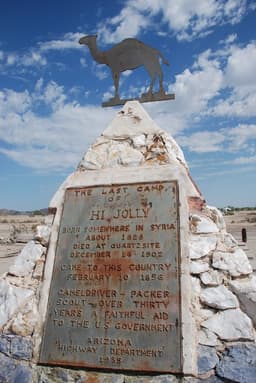
A Tribute to
The United States Camel Corps
MyHistoryStone Archive
1855 – 1866
Quartzsite, Arizona, United States · 11 years
Hometown
Camp Verde, Texas
Location
The thirty-fifth parallel
In motion
5 photographs
The photographs on this page, brought to life.
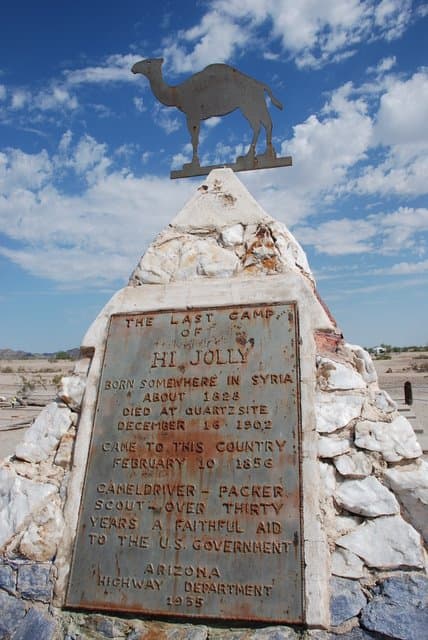
Hi Jolly's grave at Quartzsite, Arizona: a stone pyramid topped with a copper camel. Jeremy Butler, via Wikimedia Commons (CC BY-SA 3.0)
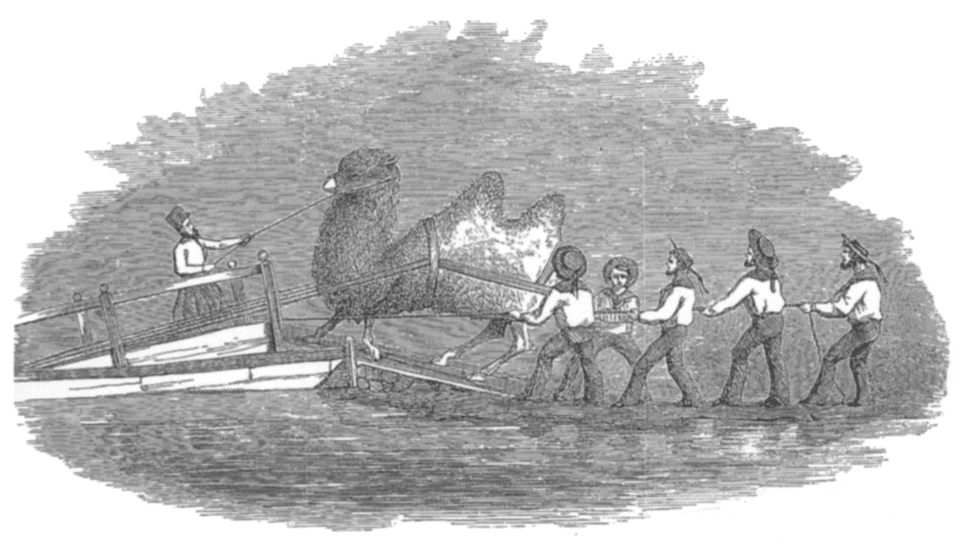
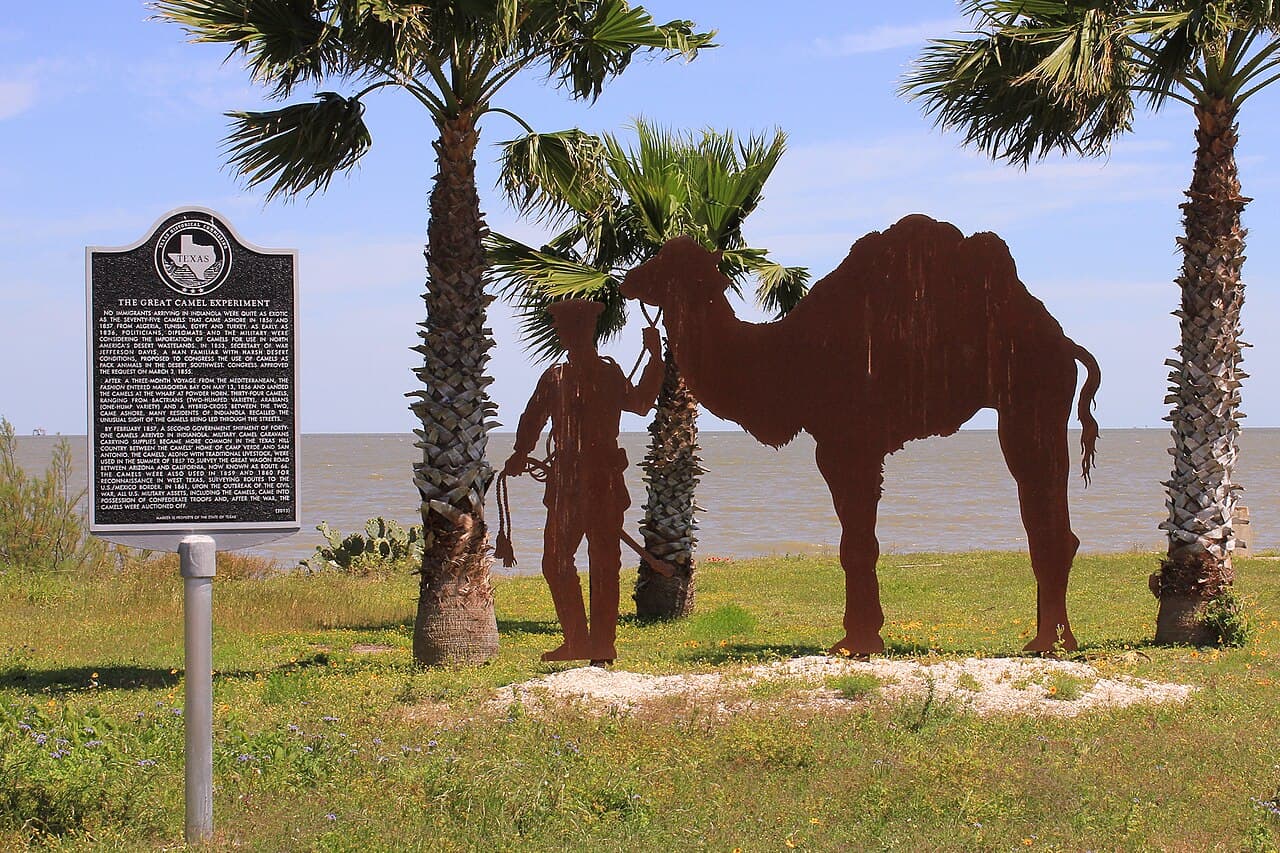
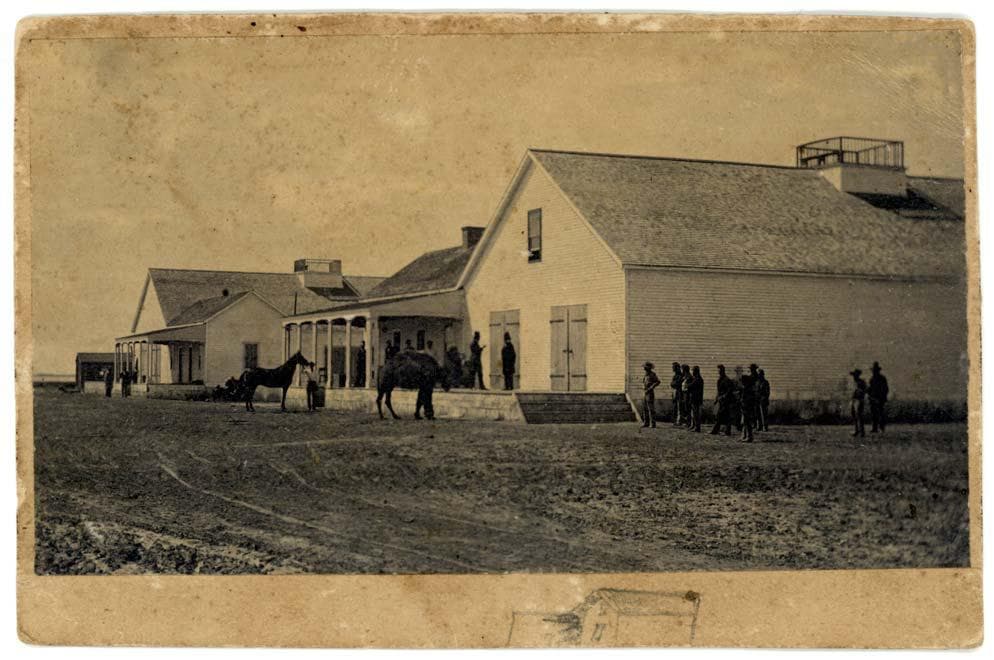
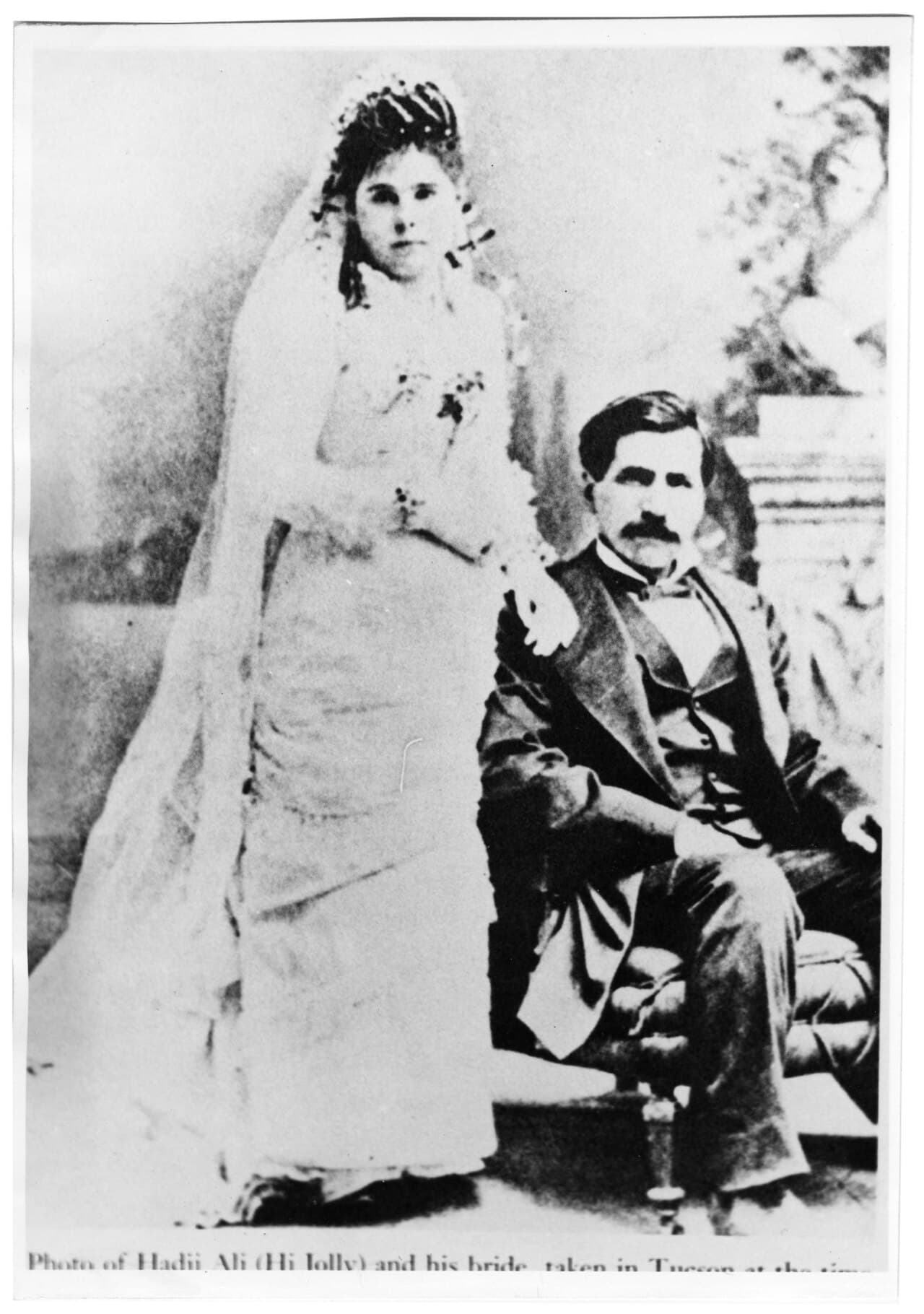
In 1855 the United States Congress appropriated thirty thousand dollars to buy camels, and for about ten years the United States Army had a camel corps in Texas. The idea was older than the money. Major George H. Crosman had urged it on the War Department in 1836, on the strength of what he had seen in the Florida wars. Major Henry C. Wayne studied it properly around 1848 and recommended importing them. What it needed was a Secretary of War who would push it, and in 1853 it got one: Jefferson Davis, who wrote in his annual report of 1854, "I again invite attention to the advantages to be anticipated from the use of camels and dromedaries for military and other purposes." Congress appropriated the money on 3 March 1855. The USS Supply sailed from New York on 4 June 1855 under Lieutenant David Dixon Porter, with Major Wayne doing the buying, and worked its way through Tunisia, Malta, Greece, Turkey and Egypt. They came back with thirty-three animals: nineteen females and fourteen males, two Bactrians, twenty-nine dromedaries, a dromedary calf and one cross-bred booghdee. One male died at sea and two calves were born, so thirty-four came ashore at Indianola, Texas. When they landed is disputed: the published account says 14 May 1856 and the historical marker at Quartzsite says 10 February 1856. A second voyage brought forty-one more in February 1857. They went to Camp Verde, on the north bank of Verde Creek three miles outside Bandera Pass in Kerr County, a post established on 8 July 1855. How many were there depends on who is counting: about seventy by one account, about forty by the Handbook of Texas. The men who came with them are the part of this story worth slowing down for. Five drivers were hired on the first voyage and nine men and a boy on the second, and one of them became the most famous camel driver in American history under a name the soldiers made up for him. He was born about 1828 at Smyrna in the Ottoman Empire, to a Greek mother and a Syrian Christian Arab father, and his birth name is given as Philip Tedro. He converted to Islam, made the pilgrimage to Mecca, and was therefore Hadji Ali. He had bred and trained camels in Syria and served with the French army in Algiers. The soldiers at Indianola heard Hadji Ali and called him Hi Jolly, and that is the name on his grave. He took camels round trip from Texas to California. He was discharged from the Quartermaster Department at Fort McDowell in 1870, ran a freight service with camels between the Colorado River and the mines that failed, and turned his animals loose in the desert near Gila Bend. He became a citizen in 1880, married Gertrudis Serna in Tucson and had two children, and was hired back by the Army in 1885 to work pack mules under General Crook during the Geronimo campaign. He died at Quartzsite, Arizona on 16 December 1902. His monument there is a stone pyramid topped with a copper camel, dedicated in 1935 by the governor of Arizona, Benjamin Moeur. The marker beside it is worth reading for its honesty about what it does not know. It calls him "Haiji Ali whose Arabic name was promptly changed to 'Hi Jolly' by the soldiers," and then, on the question of who he actually was, prints this: "His Greek (?) name was Philip Tedro." The question mark is on the sign. A second marker at the same place says he was "Born somewhere in Syria about 1828." Somewhere. The other drivers are worse served. Georgios Caralambo, whom the soldiers called Greek George, is named in the record and nothing else about him could be reached at all: not where he was born, not what became of him. He is a name in a list. The animals themselves did well, which is the frustrating part. In 1857 Edward Fitzgerald Beale took twenty-five of them from San Antonio on 25 June to survey a wagon road along the thirty-fifth parallel, each carrying six hundred pounds, reaching the Colorado River on 26 October. Beale said he would rather have one camel than four mules. In 1859 Lieutenant Hartz ran them eighty-five miles at four miles an hour and reported they showed no interest in water; he concluded that "the superiority of the camel for military purposes in the badly-watered sections of the country seems to be well established." One was bitten by a rattlesnake and recovered. In 1860 Robert E. Lee, then temporarily commanding the Department of Texas, ordered a reconnaissance that lost three mules and no camels, and reported to the Adjutant General on the animals "whose endurance, docility and sagacity will not fail to attract attention of the Secretary of War, and but for whose reliable services the reconnaissance would have failed." Secretary Floyd recommended buying a thousand more. Congress did nothing. Why it ended is a list rather than a reason. Jefferson Davis, the programme's champion, left to be president of the Confederacy. The Army is described as a horse and mule organisation whose soldiers had no idea how to handle the animals. Horses and mules panicked around them. The war interrupted everything. A camel mail route between Fort Mohave and New San Pedro was killed by the objections of both post commanders. The coming of the railroads is often cited and we could not find a single source that actually says it. Camp Verde was surrendered to the Confederacy in 1861, and the receipt the Confederate commander wrote out lists "12 mules, 80 camels, 2 Egyptian camel drivers." Two men, itemised between the livestock. The Union came back in 1865 and in 1866 the government rounded up sixty-six camels and sold them to a man named Bethel Coopwood. One male kept at Fort Tejon was killed by another in rutting season, and Lieutenant Sylvester Mowry sent the bones to the Smithsonian. The rest were let go, and that is where the folklore starts. From 1883 there were reports in Arizona of a huge red camel, and the story that grew around it was that a dead man was lashed to its back. A woman was said to have been trampled near Eagle Creek with red hair found at the scene. A cowboy who tried to rope it said he saw a skeleton on it. Two explanations circulated for the body: a prospector dying of thirst who tied himself on hoping the animal would find water, or a soldier learning to ride who was bolted away with. The account that carries the legend is careful with itself: the creature is "alleged to have roamed" and "said to have been," and "the verifiability of some parts of the legend remains questionable, as some records are missing or have been lost over time." What is told flatly, without hedging, is the end of it: in 1893 a farmer named Mizoo Hastings shot it once while it was eating in his yard, and it was confirmed to be a camel from the abandoned corps. The straps on its back had been on so long they had scarred it. The last recorded sighting near Camp Verde was 1875, and the record says simply that the animal's fate is unknown. The Quartzsite marker ends with a verdict we would not improve on: "Officially the camel experiment was a failure, but both Lt. Beale and Major Wayne were enthusiastic in praise of the animals. A fair trial might have resulted in complete success." If your family has anything from Camp Verde, or from the men who came over with the animals, we would like to hear it. Two of them are on a Confederate receipt and one of them has a question mark on his own monument. Compiled by MyHistoryStone from the Handbook of Texas, published accounts of the United States Camel Corps, Hi Jolly and Edward Fitzgerald Beale, and the historical marker inscriptions at Quartzsite, Arizona and Camp Verde, Texas.
Share a memory
Leave a memory or a message for the family. What you write appears right away, and the family can remove any entry.
Loading messages...