 Home
Home
The Story of
The Tuskegee Study
MyHistoryStone Archive
1932 – 1972
Tuskegee, Alabama, United States · 40 years
Location
Macon County, Alabama
In motion
5 photographs
The photographs on this page, brought to life.
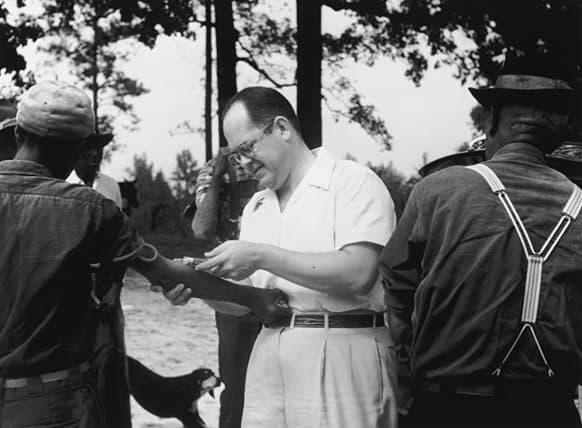
A doctor examining a subject of the study. The record names no one in this photograph. Public domain, U.S. government material, via Wikimedia Commons
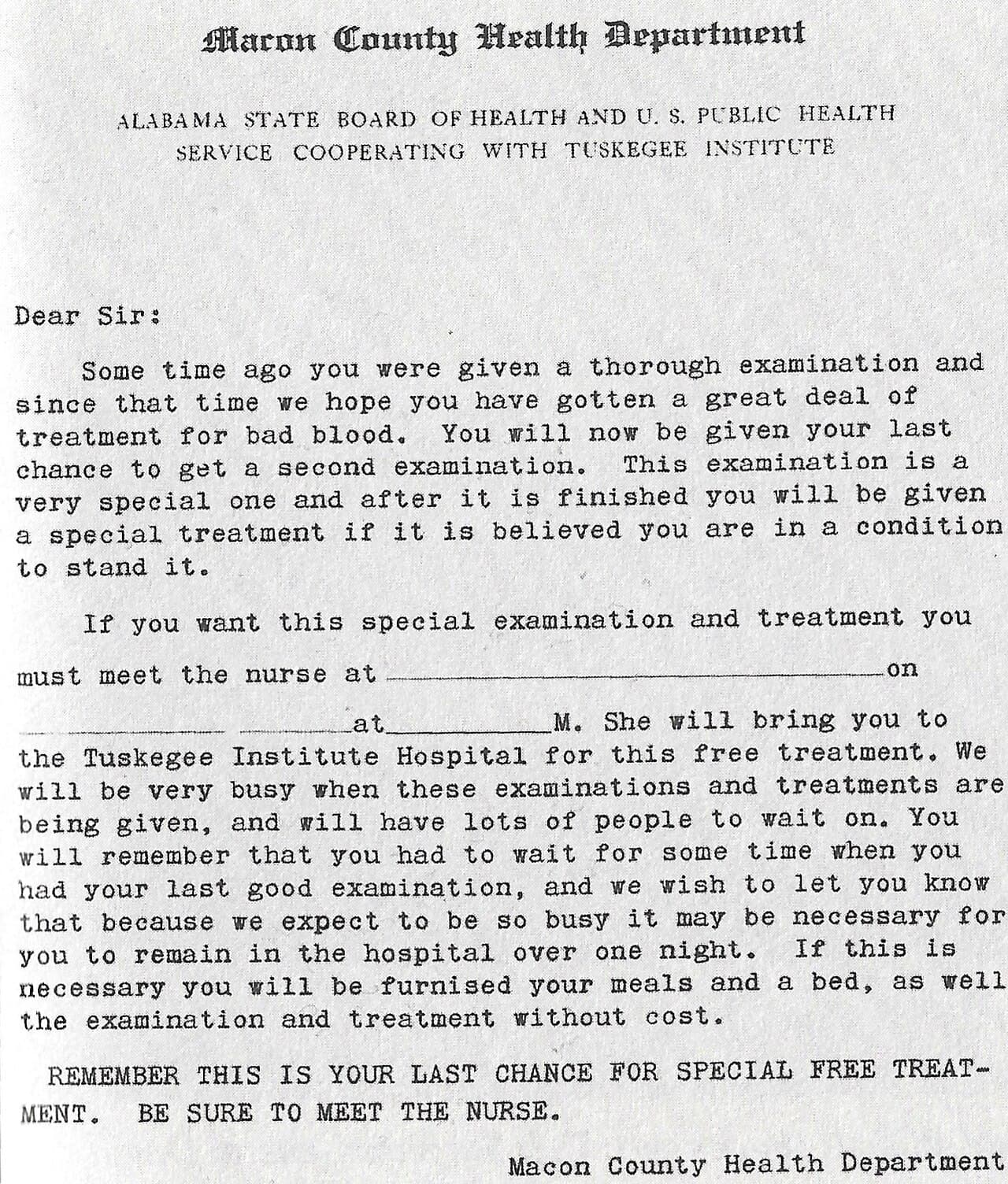
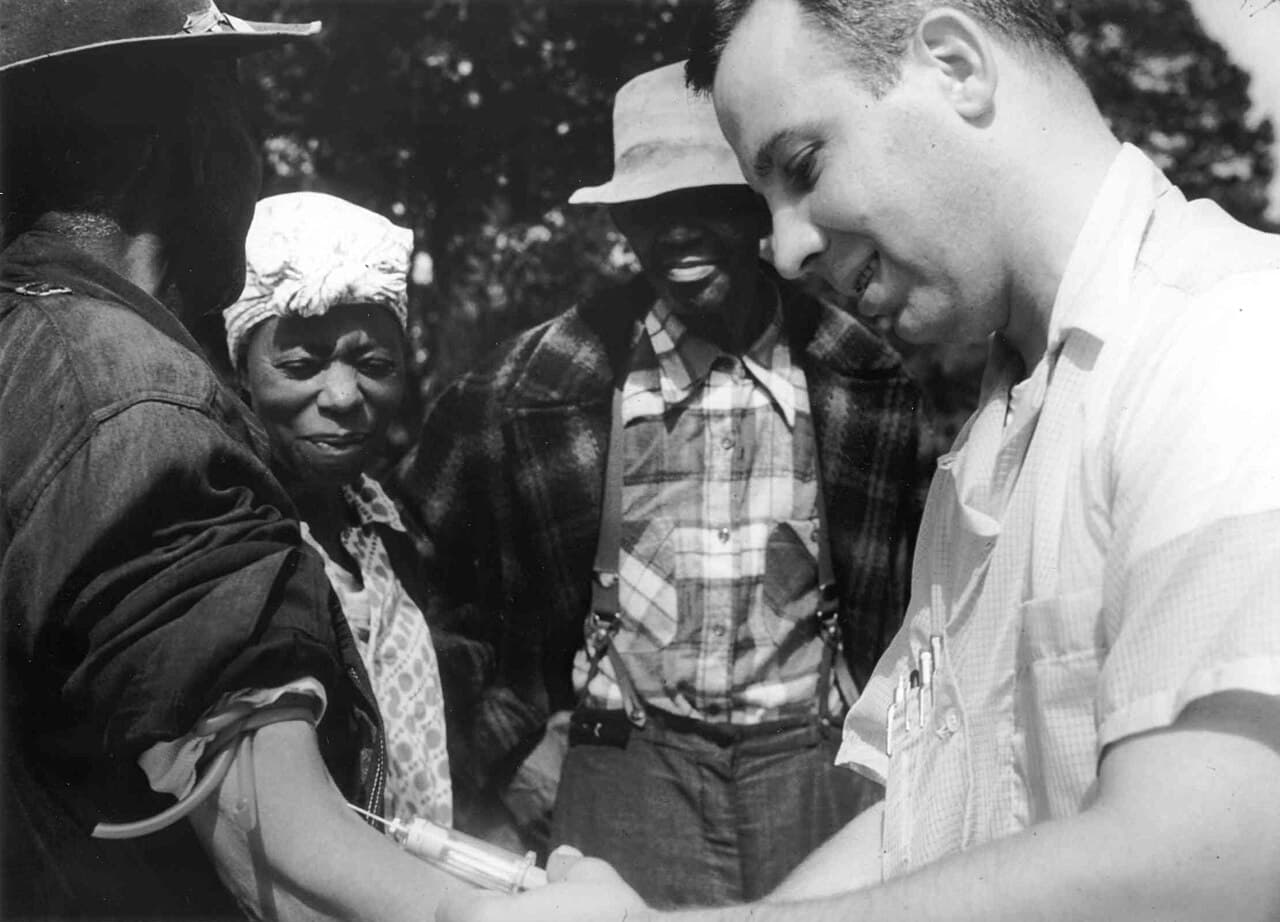
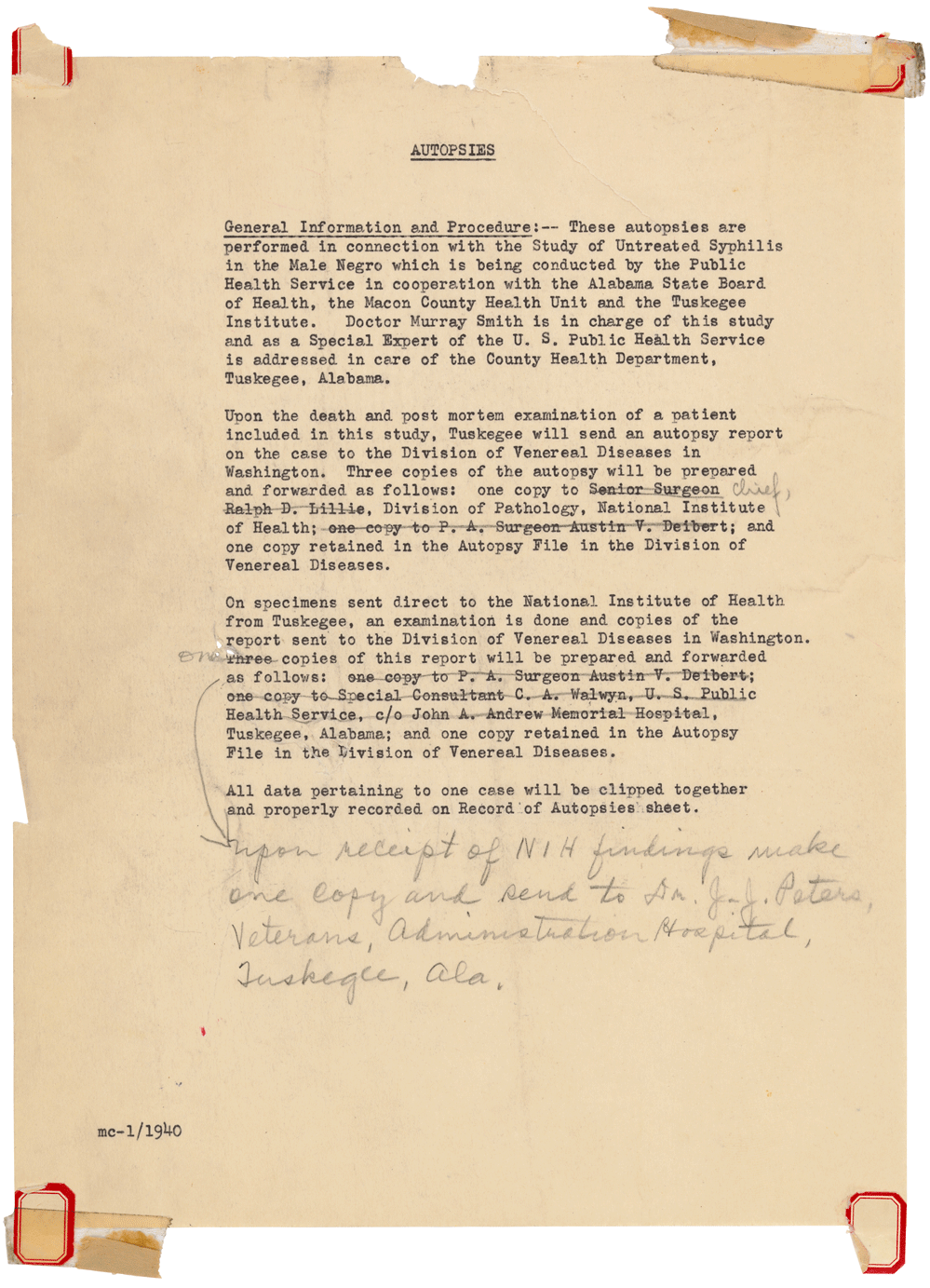
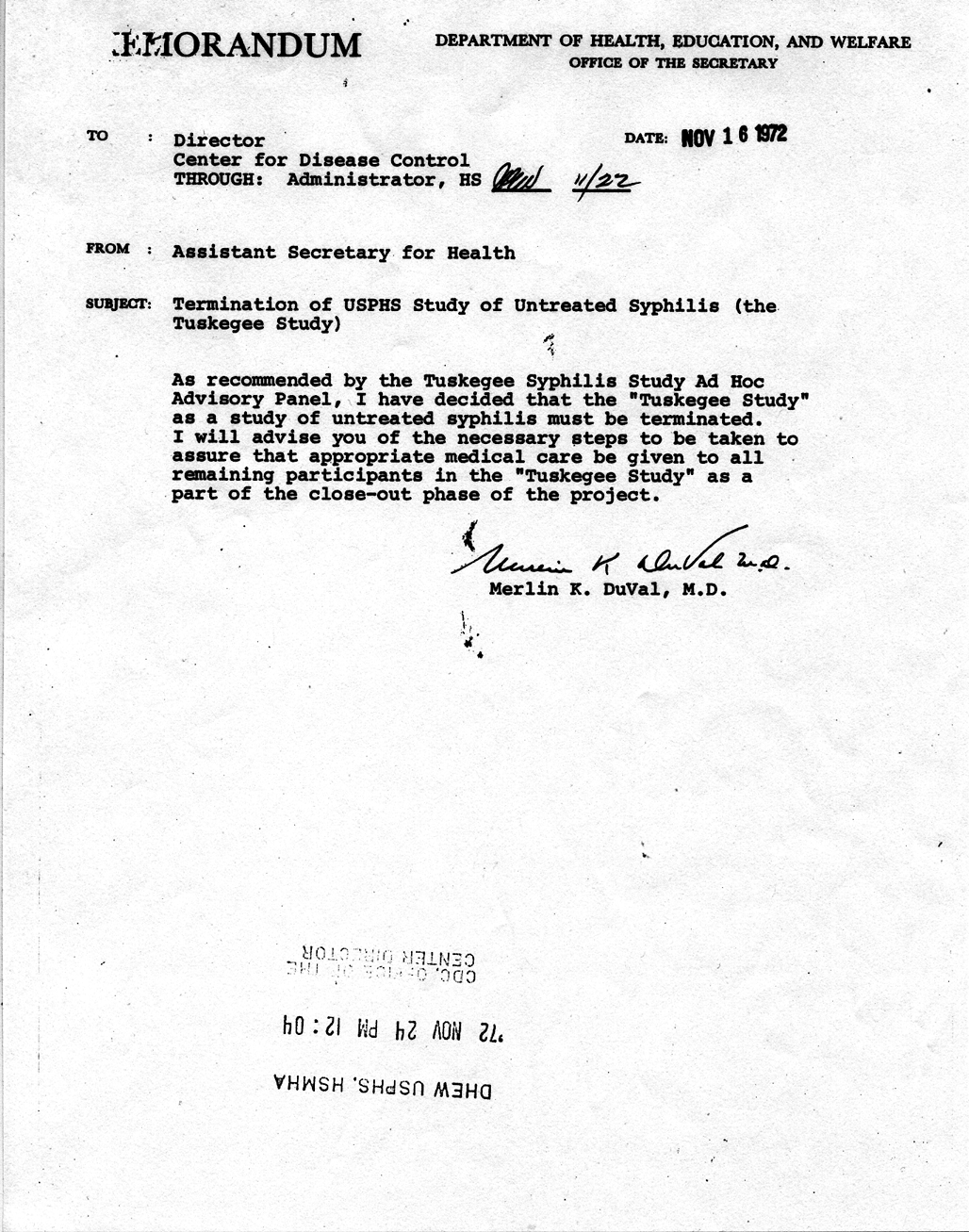
Almost everything most people believe about this study is wrong in one specific way, and the correction belongs at the top rather than buried at the bottom. The United States Public Health Service did not infect anyone with syphilis at Tuskegee. The Centers for Disease Control, the successor of the agency that ran it, says so in its own words: "No. According to a journal article about the study, published in 1936, the 399 men in the syphilitic group were initially recruited because they already had late-latent syphilis." They already had it. What was done to them was worse in a quieter way. They were watched, for forty years, and kept from being cured. Six hundred men enrolled in 1932. Three hundred and ninety-nine had syphilis and two hundred and one did not, and the second group existed only as a comparison. They were Black men, twenty-five and older, most of them poor sharecroppers in Macon County, Alabama. They were recruited, in the Encyclopedia of Alabama's phrase, "by word of mouth, in houses of worship, and through employers." The stated purpose, in the CDC's own words, was "to observe the natural history of untreated syphilis." Nobody told them that. They were told they were being treated for "bad blood," a term used across the rural South for a range of complaints including syphilis, anaemia and simple exhaustion. They were told the study would last six months. It ran for forty years. What they were given was real and small: free medical examinations, rides to the clinic, hot meals on examination days, treatment for minor ailments, and a promise that their funerals would be paid for. Fifty dollars went to a participating family in exchange for agreeing to an autopsy. The person who saw them most was Nurse Eunice Rivers, who had trained at the Tuskegee Institute and was recruited at the very start to be the study's point of contact with the men. She stayed for its entire duration. Then penicillin arrived, and the study became indefensible. The CDC's own timeline dates the drug's arrival as the treatment of choice to 1943; the CDC's museum page says it was widely accepted by the 1950s. Either way the study did not stop, and the CDC states flatly that it "did not offer treatment, even after it was easily available." How far the concealment went is genuinely disputed between sources: one account says 256 of the men registered for the draft during the Second World War, were diagnosed at induction centres, were ordered to get treatment, and were then prevented from getting it by the researchers. Another says the men were simply kept off the draft rolls so that they would never be examined at all. Those are two different mechanisms and we cannot tell you which happened. Both describe the same intent. The study's own director, Raymond Vonderlehr, defended continuing it on the grounds that this was "one of the last opportunities which the science of medicine will have to conduct an investigation of this kind." It ended because one man would not let it go. Peter Buxtun, a venereal disease investigator for the Public Health Service in San Francisco, wrote to the national director of the Division of Venereal Diseases raising ethical objections; sources date that letter to 1966 and the CDC's own museum page says 1968. Nothing happened. He eventually went to the press, and on 25 July 1972 Jean Heller of the Associated Press published the story in the Washington Star. It was on the front page of the New York Times the next day. An advisory panel called the study "ethically unjustified" that October and it was terminated in November. Fred D. Gray, the civil rights lawyer, brought the class action. The government settled in 1974 for ten million dollars. Living men with syphilis received $37,500; the heirs of those who had died received $15,000; men in the control group received $16,000, and their heirs $5,000. A Tuskegee Health Benefit Program was set up to provide medical care to the survivors, extended in 1975 to wives, widows and children. What it changed in law is the only good thing on this page. The National Research Act, Public Law 93-348, was signed on 12 July 1974. It created a national commission on the protection of human subjects and required institutions taking federal research money to establish review boards "to protect the rights of the human subjects." The Belmont Report followed on 18 April 1979 with three principles that now govern research on people everywhere: respect for persons, beneficence, and justice. Respect for persons, in the report's own words, "incorporates at least two ethical convictions: first, that individuals should be treated as autonomous agents, and second, that persons with diminished autonomy are entitled to protection." On 16 May 1997, in the East Room of the White House, President Clinton apologised. Five of the eight surviving men were there: Herman Shaw, who was about to turn ninety-five, Charlie Pollard, Carter Howard, Fred Simmons and Frederick Moss. Three others were represented by family. Clinton said: "The United States government did something that was wrong, deeply, profoundly, morally wrong. It was an outrage to our commitment to integrity and equality for all our citizens." And then: "We can look at you in the eye and finally say on behalf of the American people, what the United States government did was shameful, and I am sorry." He also said the thing that is hardest to argue with: "We cannot be one America when a whole segment of our nation has no trust in America." The last surviving participant died in January 2004. The last widow receiving benefits died in January 2009. One further caution, because it is the kind of claim this archive is careful with. It is very often said that this study is the reason for Black Americans' distrust of medicine. A 2016 study found measurable effects on medical mistrust and life expectancy. But the historian Vanessa Northington Gamble has argued that while the study contributed, it "was not the most important reason," and that the mistrust predates it by more than a century, in the medical experimentation carried out on enslaved people and in the robbing of Black graves for cadavers. We have printed both, because a single cause is almost always the wrong shape for something this old. If your family carries one of these six hundred names, or if a relative was one of the wives or children, we would be glad to add what you know here. The men were named in the records all along. It is the rest of us who learned them late. Compiled by MyHistoryStone from the Centers for Disease Control and Prevention's own history of the study and its timeline, the Encyclopedia of Alabama, the National Archives at Atlanta finding aid for Record Group 442, the National Research Act of 1974 as printed in the United States Statutes at Large, the Belmont Report as published by the Office for Human Research Protections, and the official White House transcript of the apology of 16 May 1997.
Share a memory
Leave a memory or a message for the family. What you write appears right away, and the family can remove any entry.
Loading messages...