 Home
Home
In Memory of
Isaac Burns Murphy
MyHistoryStone Archive
1861 – 1896
Lexington, Kentucky, United States · 35 years
Final Resting Place
Kentucky Horse Park, beside Man o' War
Location
Churchill Downs
In motion
5 photographs
The photographs on this page, brought to life.
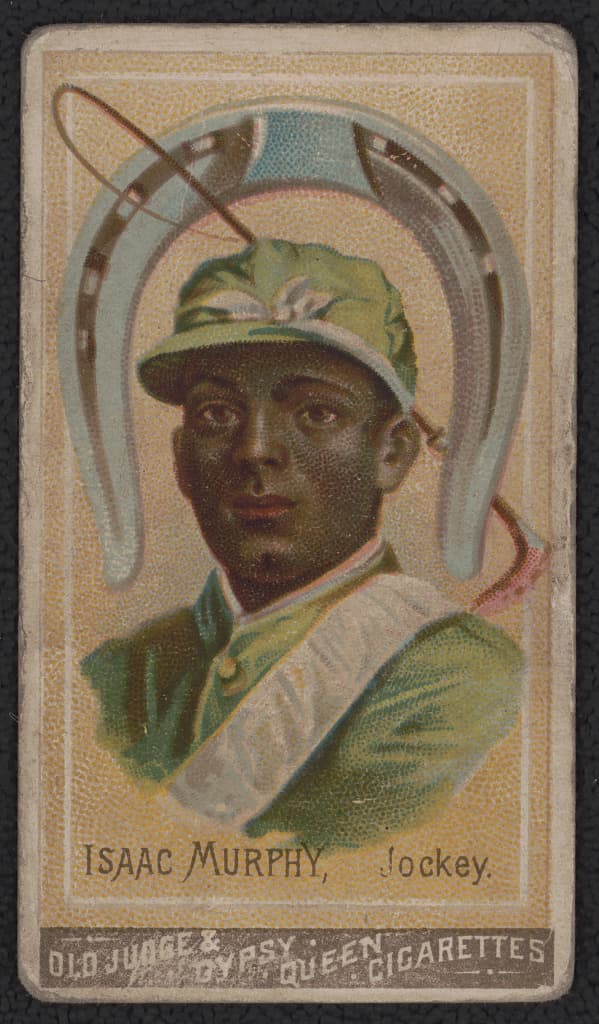
Isaac Murphy on an 1888 Goodwin & Co. cigarette card, issued while he was still riding. Goodwin & Co., Library of Congress, Prints and Photographs Division
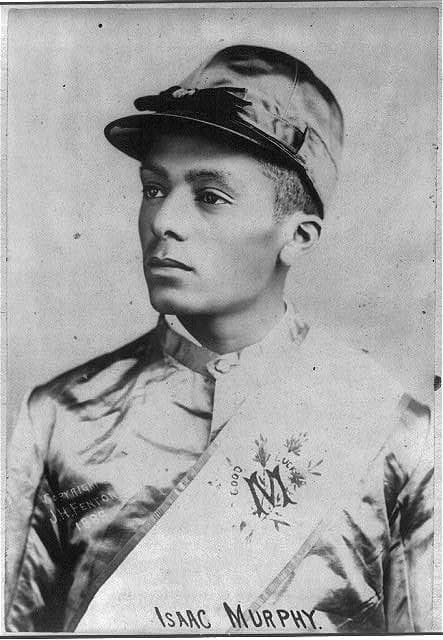
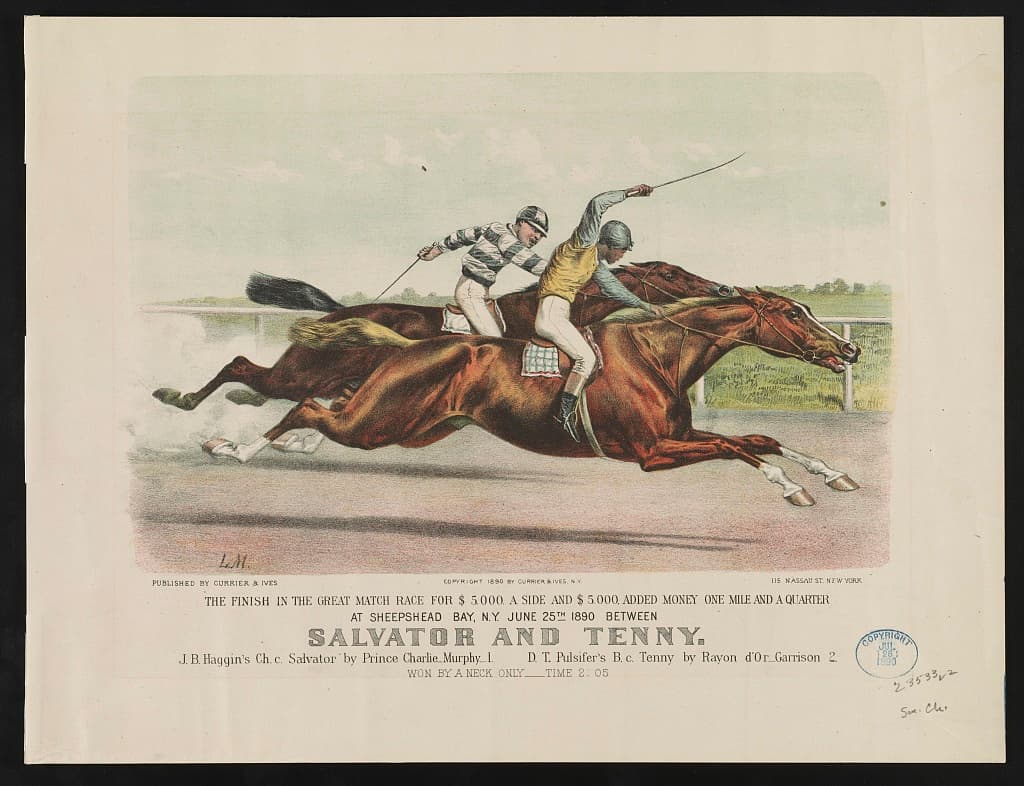
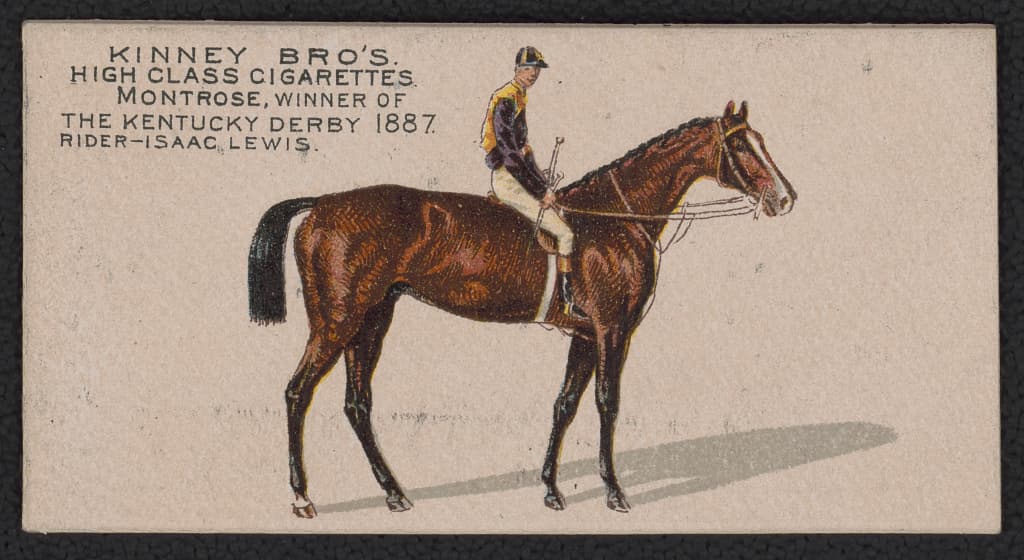
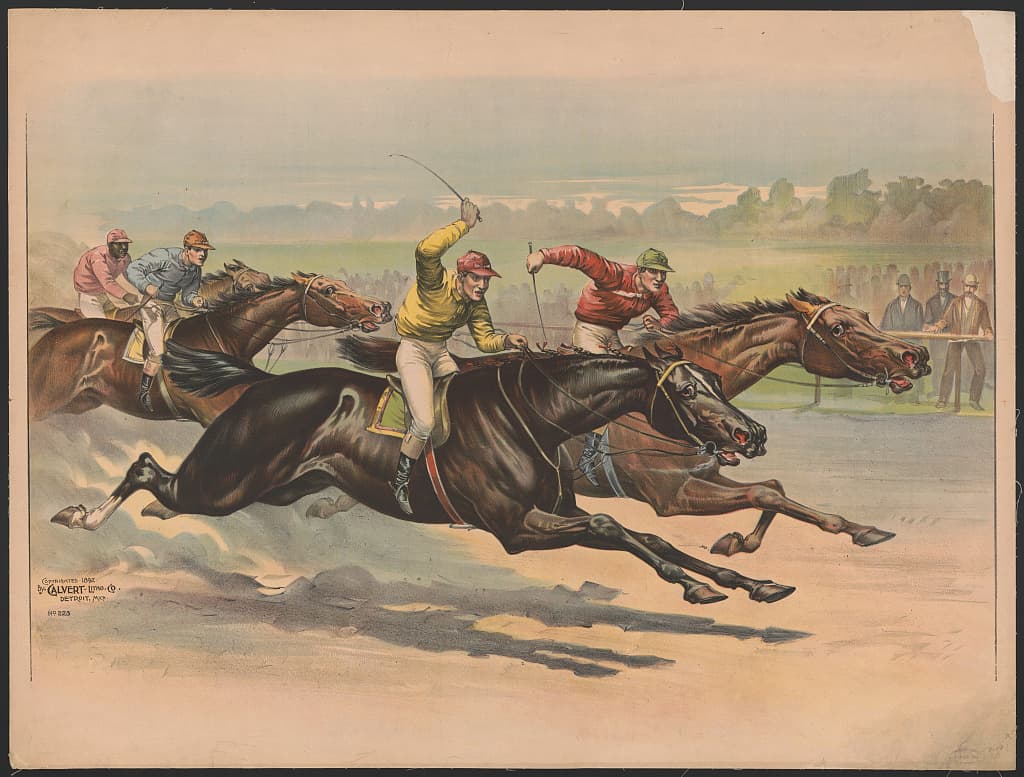
Isaac Burns Murphy won forty-four percent of the races he rode. That figure appears on his gravestone marker, in every encyclopedia, and in most sentences ever written about him. It comes from his own count. That is not an accusation. It is the shape of the whole problem with this man's record, and it starts at the very beginning, because the sources cannot even agree on whether he was born free. He was born in 1861. One account says Clark County, Kentucky; another says Fayette County; a marker in Lexington says only that he was born "on a farm in the Bluegrass not far from Lexington." Wikipedia and Britannica both state that his parents were free. Two historical markers in his own city say the opposite. The marker at the site of his home says "His parents were enslaved." The marker at his grave says "Born a slave, he rose to become the nation's most famous and respected sports figure." Both of those were put up by people in Lexington who had every reason to get it right, and so were the encyclopedias, and they contradict each other about the first fact of his life. His mother was America Murphy, a domestic servant on the farm. His father, according to the Lexington marker, was Jerry Skillman, a field hand on a neighbouring farm, who enlisted in the Union Army and died a soldier under the name Jerry Burns at Camp Nelson in Jessamine County in 1864. Other accounts say his father died in a Confederate prisoner of war camp. Camp Nelson was a Union post, so these are not two ways of saying one thing. In 1876, most likely to honour his mother's father, the boy changed his name from Burns to Murphy. At thirteen he was apprenticed as a stable boy to a leading trainer named Eli Jordan. At fourteen he rode his first winner at a country track at Crab Orchard, fifty miles south of Lexington. At fifteen he was winning at the Kentucky Association and at the Louisville Jockey Club, which is now called Churchill Downs. He rode in eleven Kentucky Derbies and won three of them: Buchanan in 1884, Riley in 1890 and Kingman in 1891. He was the first jockey to win three, and the first to win two in a row. Kingman was the first Derby winner co-owned by an African American. Now the number. By his own calculation Murphy won 628 of 1,412 starts, which is forty-four percent, and the Hall of Fame jockey Eddie Arcaro said of it, "There is no chance that his record of winning will ever be surpassed." By a later calculation from incomplete records the figure is 530 wins from 1,538 rides, about thirty-four percent. His own city's marker prints both and refuses to choose: "He won 34.5 percent of his races according to official records and 44 percent by his own count," and calls either figure an exceptional standard. Britannica does the same. The marker at his grave prints only the forty-four. What we could not find in any source we reached is anyone explaining where either dataset came from, or testing it. Every source that gives both numbers says the higher one is his. Nobody we could reach calls it disputed, and nobody we could reach defends it either. Either figure would still be the best in the history of the sport. He was paid like it. He earned up to twenty-five thousand dollars a year, owned a string of thoroughbreds, and in 1887 bought a two storey brick house of ten rooms on seven acres for ten thousand dollars. He was one of the highest paid athletes in the country and among the most famous Black men in America. On 25 June 1890 he rode Salvator against Tenny at Sheepshead Bay, with Snapper Garrison up on the other horse, in a match race that Currier and Ives put on a lithograph and that is sometimes called the first photo finish. Two months later, on 26 August 1890 at Monmouth Park, he came in last on Firenzi and fell off after crossing the line. They said he was drunk and suspended him pending investigation. He said, for the rest of his life, that he had been drugged. Nothing in any source we could reach records him ever being formally cleared. The accusation followed him. He kept riding, but in 1895, his last year, he had twenty mounts and two wins. He died at thirty-five. Two sources give 16 February 1896 and heart failure; another gives 12 February 1896 and pneumonia. More than five hundred people came to the funeral, Black and white. He was buried in African Cemetery No. 2, and in 1967 he was reinterred at what is now the Kentucky Horse Park, beside Man o' War. The second half of this story is bigger than one man. In 1890 a Kentucky headline in Spirit of the Times read: "All the Best Jockeys of the West Are Colored." Black riders won the Travers, the Futurity, the American Derby, the Belmont, the Preakness, and sixteen of the first twenty-eight Kentucky Derbies. Oliver Lewis won the very first Derby in 1875 on Aristides by two lengths, and thirteen of the fifteen jockeys in that race were African American; the horse was trained by Ansel Williamson, born enslaved in Virginia around 1806. Willie Simms won the Derby in 1896 and 1898 and remains the only African American jockey to have won all three Triple Crown races. Shelby Barnes and Anthony Hamilton are in the Hall of Fame. Jimmy Winkfield won in 1901 and 1902, and then there were no more. They did not fade. The marker in Lexington names what happened: a decline "rooted in racism and the Jim Crow segregation it triggered," accelerated by economic recessions, by pressure and bias from white owners and riders, by the Great Migration, and by anti-gambling laws that left only twenty-five tracks operating by 1908. Another account adds that bigger purses drew white jockeys into the profession, and that white riders on tracks everywhere used violence to attack and intimidate Black jockeys and the horses they rode, until owners stopped hiring them. By 1911 they were gone from the Derby. Winkfield himself was blackballed and went to Russia in 1903; when he came back to the United States for a reception in 1961 he was told to use a side door. In 1955 Isaac Burns Murphy became the first jockey elected to the National Museum of Racing's Hall of Fame. Since 1995 the Isaac Murphy Award has gone each year to the rider with the highest winning percentage, which is the right memorial for a man whose percentage nobody can agree on. If your family has anything from the Black jockeys of that era, a photograph, a programme, silks, a name, we would like to put it here. The record of what those men did survives mostly in the winners' lists, and the winners' lists are not the whole of it. Compiled by MyHistoryStone from Britannica, published biographical accounts of Isaac Burns Murphy, Oliver Lewis, Ansel Williamson, Willie Simms and Jimmy Winkfield, Library of Congress catalogue records for the 1888 Goodwin Champions card and the 1890 Currier and Ives lithograph of the Salvator and Tenny match race, and the inscriptions on the Isaac Murphy markers in Lexington and at the Kentucky Horse Park.
Share a memory
Leave a memory or a message for the family. What you write appears right away, and the family can remove any entry.
Loading messages...