 Home
Home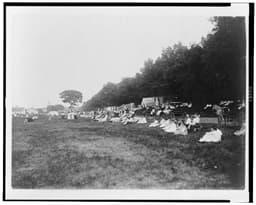
A Tribute to
Chautauqua
MyHistoryStone Archive
1874
Chautauqua, New York, United States
Residence
Fair Point, on Chautauqua Lake
Worked At
Ten thousand towns
In motion
4 photographs
The photographs on this page, brought to life.
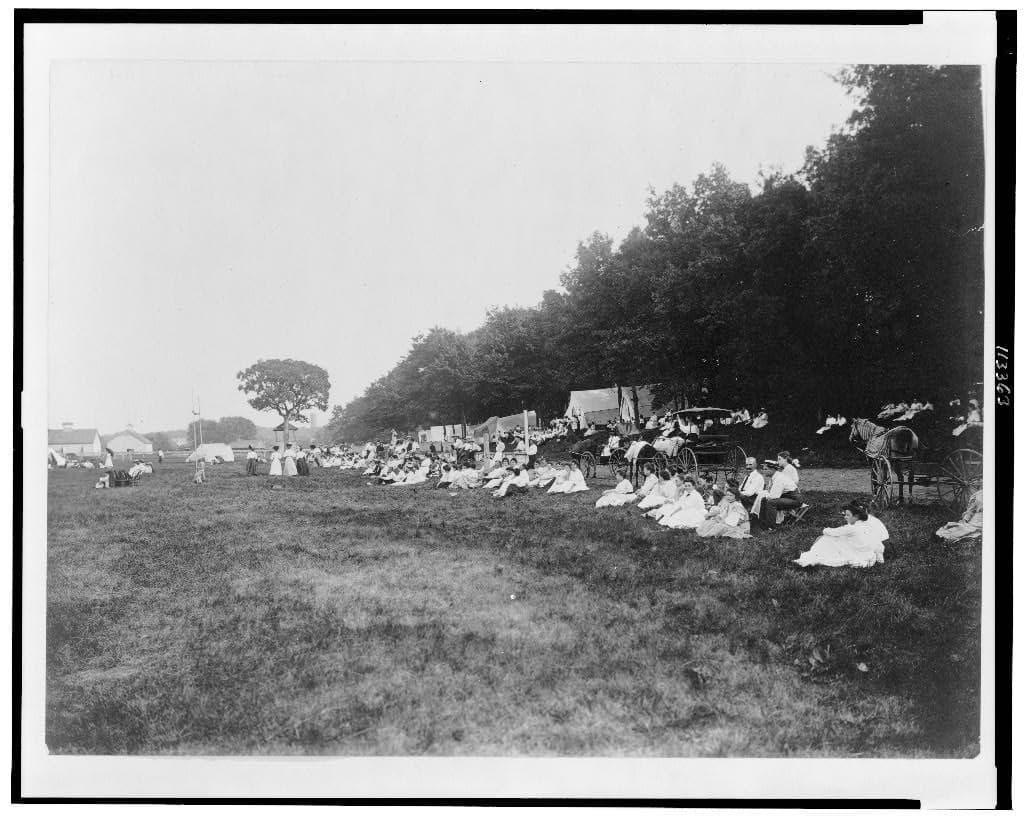
The crowd seated on the grass at Chautauqua Park, Charles City, Iowa, September 1907. Blumenstiel & Smith Studio, Library of Congress, Prints and Photographs Division
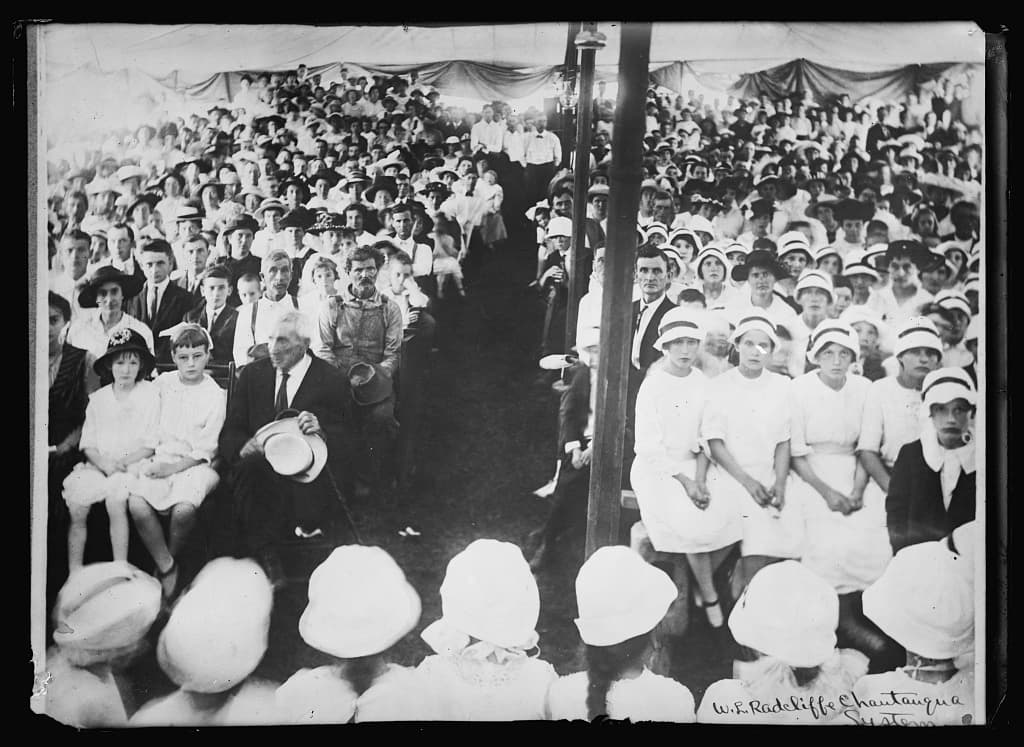
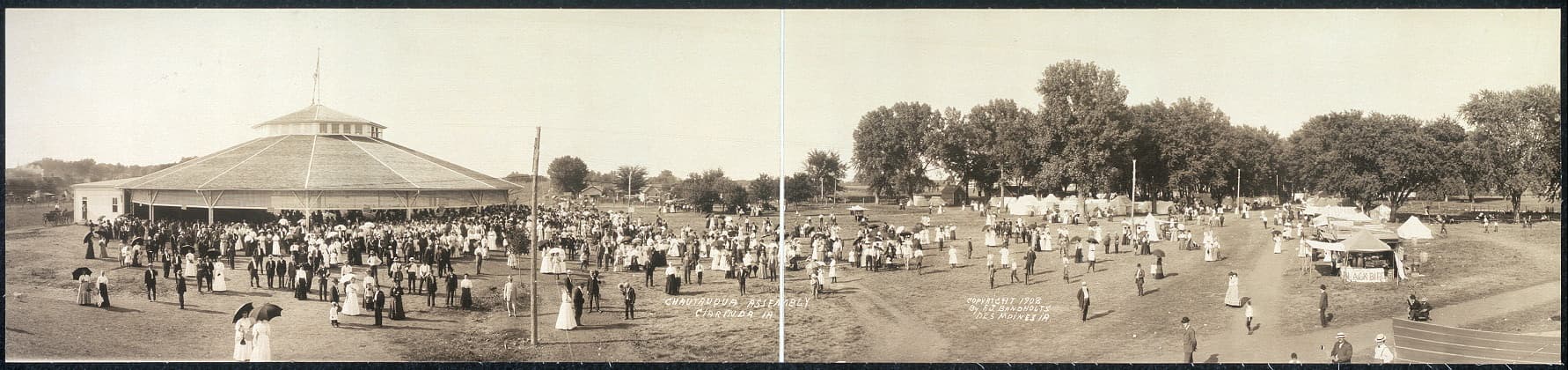
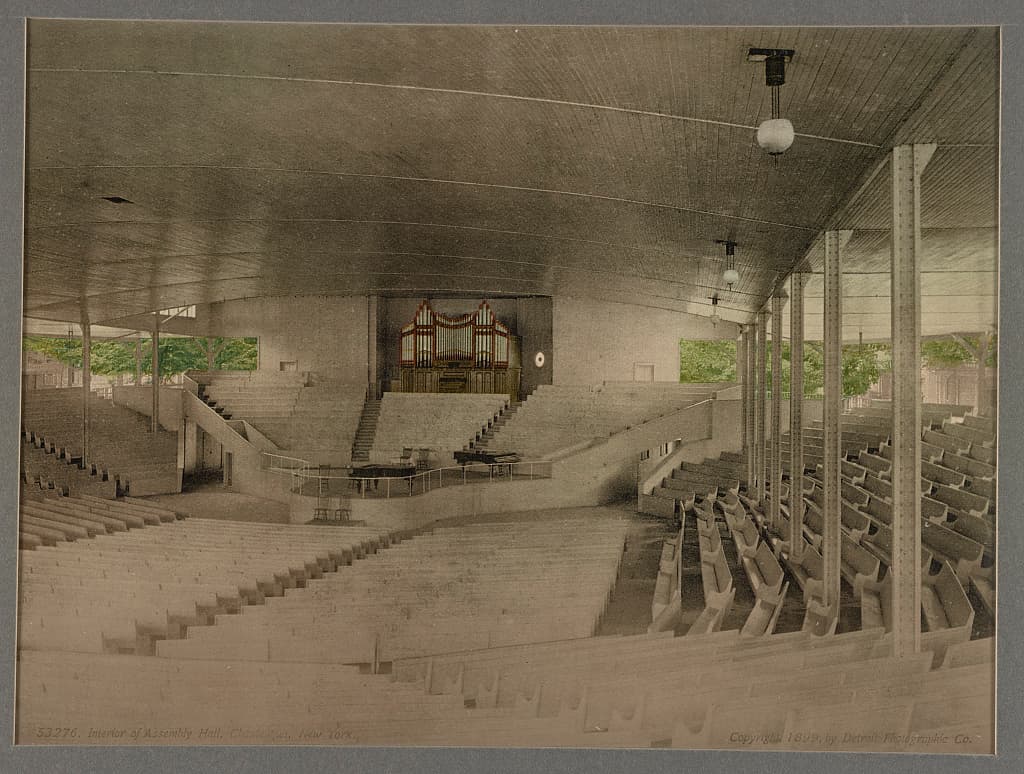
For about thirty years a brown tent went up on a well drained field outside town, and for a week the whole county came to hear a former presidential candidate, an opera singer, a man who did ventriloquism and violin, and somebody with lantern slides of the Holy Land. Then the tent came down and went to the next town, and the talent followed it a day behind. At the height of it there were tents in ten thousand communities, and then it stopped, and most people alive today have never heard the word. It began as something much smaller and much more earnest. In August 1874, at a campsite called Fair Point on Chautauqua Lake in western New York, John Heyl Vincent, a Methodist minister who edited the Sunday School Journal, and Lewis Miller, an Ohio manufacturer of farm machinery, held an assembly to train Sunday school teachers. The first summer class lasted sixteen days, taught forty young men and women, and charged six dollars. Miller's daughter Mina married Thomas Edison twelve years later. In 1902 the assembly was renamed the Chautauqua Institution. In 1878 it added something odder and more ambitious: the Chautauqua Literary and Scientific Circle, a four year course of directed reading you did at home, in a local circle, with the books mailed to you. By 1901 roughly 25,000 people had enrolled, 17,750 of them women and 7,250 men. In Nebraska alone the circles included Capital City and four separate Lincoln circles by 1888, Plymouth, East Lincoln, Beatrice, and one at the Nebraska State Penitentiary. That last one tells you more about what this was than any attendance figure. Three quite different things ended up wearing the name, and confusing them is the usual mistake. There was the Institution itself, one permanent place in New York. There were the independent or daughter chautauquas, permanent grounds elsewhere modelled on it, of which there were nearly a hundred and fifty by 1900. And there was the circuit, or tent chautauqua, a commercial travelling business that took the name and went on the road. The Institution's own National Historic Landmark nomination is blunt about the third: the travelling companies "simply appropriated" the name, and to millions of Americans Chautauqua came to mean them rather than the place in New York. The nomination adds that the parent organisation "cordially supported imitative assemblies in fixed locations," which is a careful way of drawing a line around the ones it did not support. The circuit was built by Keith Vawter, a manager at the Redpath Lyceum Bureau, with Roy Ellison, beginning in 1904 and working by 1907. The mechanism was the clever part. Talent was organised by which day of the week it played, so the first day performers moved on to the next town while the second day performers came in behind them, and a chain of tents could run across a whole region at once, each town getting the same week a few days out of step with its neighbour. Not everyone admired it. Frank Gunsaulus accused Vawter of "cheapening Chautauqua, breaking it down, replacing it with something what will have neither dignity nor permanence," and we have left his grammar as he said it. How big it got depends on who is counting. One account gives more than ten thousand communities and audiences of more than forty-five million by the mid 1920s. Britannica gives the peak year as 1924 and no totals at all. The figure of twenty-one million attendees circulates widely and we could not trace it to any source we were able to reach, so we are not going to repeat it as though we had. There is a quotation attached to all of this that almost everyone gets wrong. Theodore Roosevelt is endlessly quoted calling Chautauqua "the most American thing in America." He appears not to have said it. What is recorded is duller, and better, and sounds much more like a man actually standing in a tent: that it was "a source of positive strength and refreshment of mind and body to come to meet a typical American gathering like this, a gathering that is typically American in that it is typical of America at its best." The draw above all others was William Jennings Bryan, three times a candidate for president, who made thousands of appearances. The most prolific was Russell Conwell, who is said to have delivered his lecture "Acres of Diamonds" five thousand times. Also on the circuits: Maud Ballington Booth, called the Little Mother of the Prisons; Jane Addams speaking on Hull House; Governor Robert La Follette of Wisconsin; the bandleader Bohumir Kryl, a protege of Sousa; and Charles Ross Taggart, billed as The Man From Vermont, who did violin, ventriloquism and comedy in one act. In Arkansas the circuit lecturers included a sitting governor, Charles Brough, who called Chautauqua "America's summer school." What it looked like from inside one town is the part worth keeping. Hastings, Nebraska built a pavilion in 1907 seating 3,500, designed by a local architect, C. W. Way, to look like a large meeting tent; it was the biggest in the state, was partly destroyed by arson in 1992, and was rebuilt the next year. Waxahachie, Texas began its assemblies in 1899, with crowds camping on the ground from across North and East Texas and Oklahoma, and built a 2,500 seat hall in 1902 that converted to open air. The Chautauqua Assembly of Arkansas started at Siloam Springs in 1885 and drew about two thousand people to its opening exercises. Then it went. The circuits declined after 1924 and had run their course by about 1940. The reasons usually given are radio, the automobile and the Depression, and we want to be straight with you: not one of the sources we were able to reach actually says so. It is a plausible explanation that everybody repeats, and we could not source it, so it is not stated here as fact. In Arkansas the decline is dated to the 1920s, with chautauqua remaining popular in isolated rural parts of the state into the early 1930s. Some of it is still standing. The Chautauqua Institution runs a nine week season on 2,070 acres and draws close to a hundred thousand visitors; its historic district was listed on the National Register in 1973, though one source says 1974, and designated a National Historic Landmark district in 1989. The Colorado Chautauqua in Boulder opened on 4 July 1898, founded by Texas educators, drew four thousand people on its opening day, became a National Historic Landmark in 2006, and describes itself as the only chautauqua west of the Mississippi still used for its original purpose. Lakeside, Ohio was founded in 1873, a year before New York. Ocean Park, Maine, founded in 1881, is sometimes called Chautauqua by the Sea. If your town had a chautauqua, there is a good chance somebody in your family has the season ticket, or the programme, or a photograph of the tent with half the county standing in front of it. We would like to put it here. Compiled by MyHistoryStone from the National Historic Landmark nomination for the Chautauqua Institution Historic District, the Nebraska State Historical Society's study of the Chautauqua Literary and Scientific Circles in Nebraska, the Encyclopedia of Arkansas, NCpedia, the Colorado Encyclopedia, Britannica, the University of Iowa's Traveling Culture collection, and historical marker inscriptions in Chautauqua, New York, Hastings, Nebraska and Waxahachie, Texas.
Add to this story
Know something about Chautauqua? Add it here - a memory, a detail, a correction. What you write appears right away, and the page owner can remove any entry.
Loading messages...