 Home
Home
The Story of
The Elaine Massacre
MyHistoryStone Archive
1919
Elaine, Arkansas, United States
Location
Hoop Spur, north of Elaine
In motion
5 photographs
The photographs on this page, brought to life.
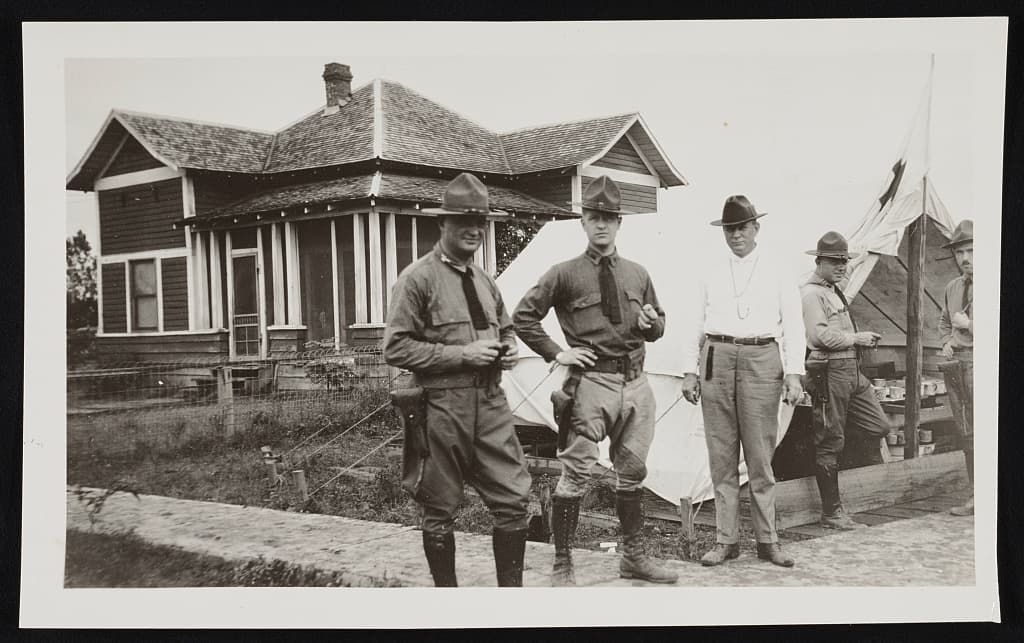
Colonel Isaac C. Jenks, who commanded the troops sent to Elaine from Camp Pike, with unnamed soldiers. Library of Congress, Prints and Photographs Division
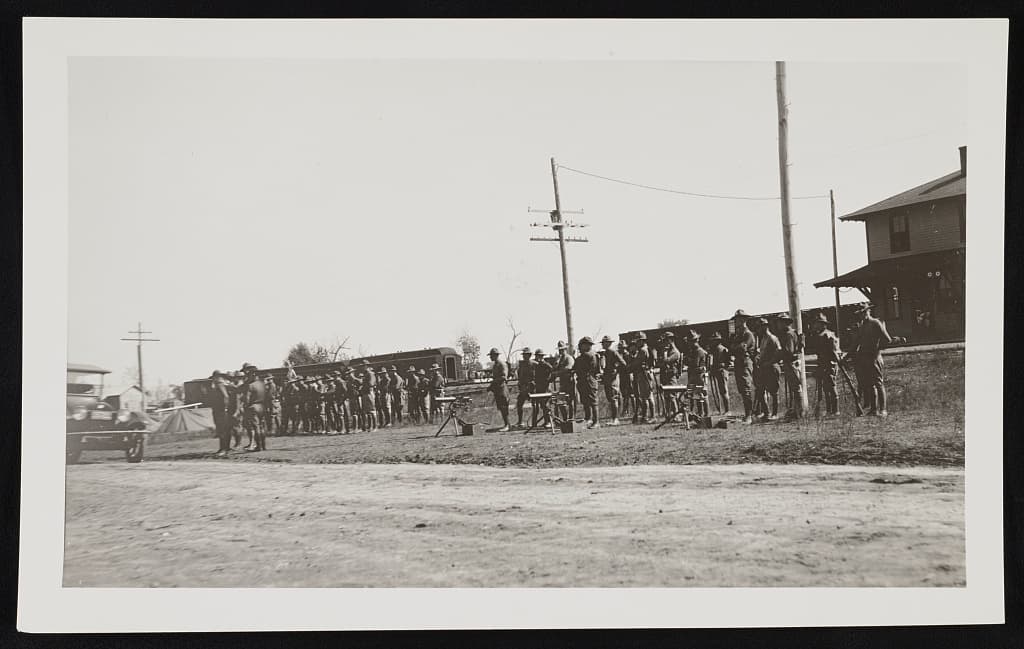
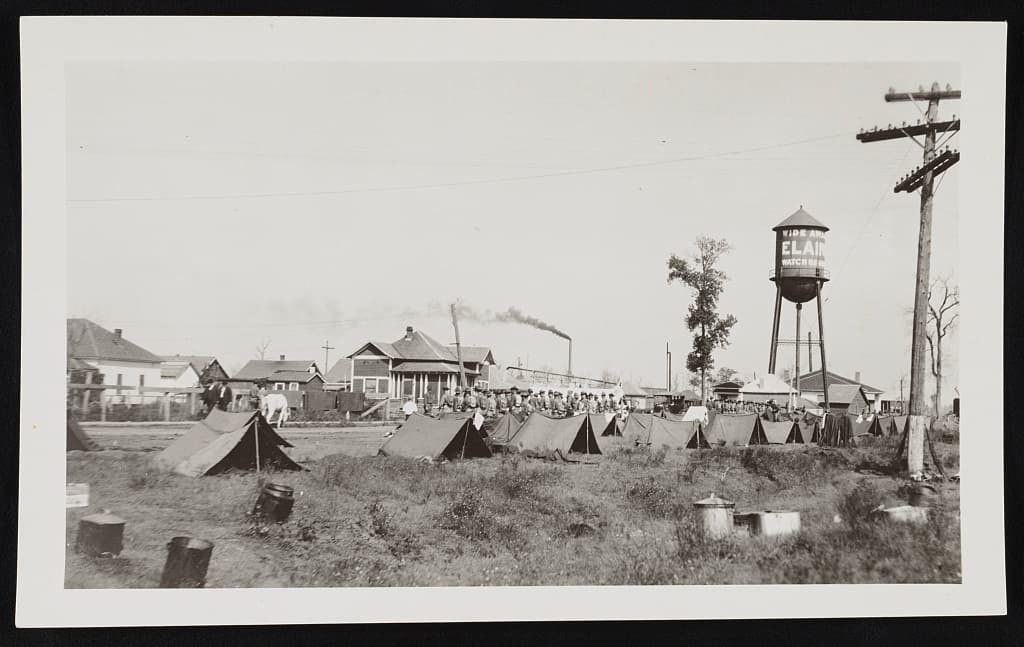
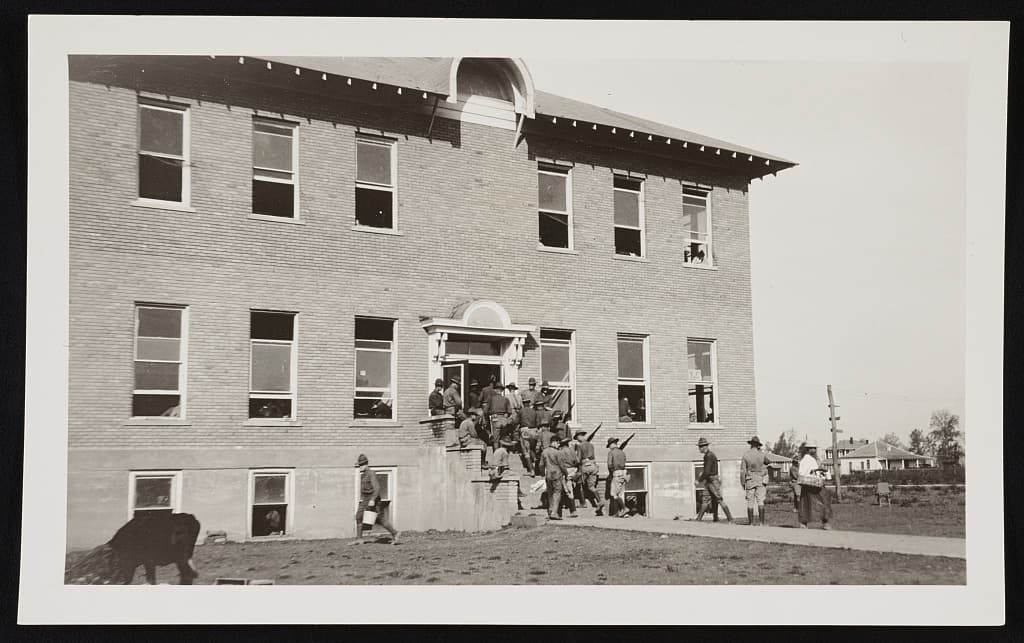
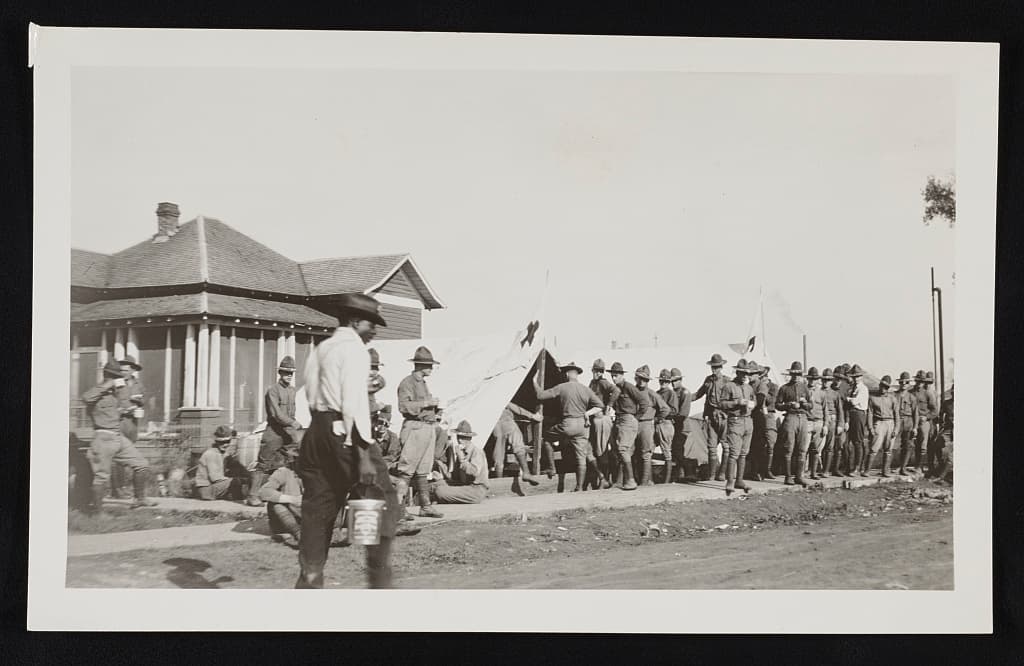
On the night of 30 September 1919 about a hundred Black farmers met in a church at Hoop Spur, three miles north of Elaine, Arkansas, to talk about how to get paid for their cotton. Within a week somewhere between eleven and eight hundred people were dead, and the difference between those two numbers is the reason this page exists. The men in that church were sharecroppers in a system that made an accounting almost impossible to get. A study of the events published in 1960 put it plainly: "At the time of settlement neither an itemized statement of accounts owed nor an accounting of the money received for cotton and seed was, in most cases, given or shown the Negroes." The landowner sold the crop whenever and however he saw fit. Cotton sold in October 1918 had, for many families in Phillips County, still not been settled by July of the following year. And there was, in that same study's words, "an unwritten law of the cotton country that they could not quit and leave a plantation until their debts were paid." So they had organised. The Progressive Farmers and Household Union of America was founded by Robert L. Hill, born at Dermott in 1892, a sharecropper who also worked as a brakeman for the Missouri Pacific. Its aim was better payment for their crops, and it had retained a white Little Rock law firm headed by Ulysses S. Bratton, a former assistant federal district attorney, to pursue fair settlements. A contemporary NAACP account described it exactly that way: "a Mr. Bratton, a white lawyer from Little Rock, Ark., was employed by sixty or seventy colored families to go to Elaine to represent them in a dispute with the white planters." There were armed guards outside the church that night, posted to keep the meeting from being broken up. Two deputised white men and a Black trustee arrived, and shots were exchanged. W. A. Adkins, a security officer for the Missouri Pacific Railroad, was killed. Charles Pratt, a white deputy sheriff, was wounded. Who fired first has never been established. The Encyclopedia of Arkansas says only that accounts "are in sharp conflict," and we are going to leave it there, because that is where the evidence leaves it. What followed was not a riot. Between five hundred and a thousand armed white men gathered, from the surrounding Arkansas counties and from across the river in Mississippi. Governor Charles Hillman Brough obtained War Department authorisation and troops came in from Camp Pike on the morning of 2 October, more than five hundred of them by one account and 583 with a twelve gun machine gun battalion by another, under Colonel Isaac Jenks. Jenks recorded that his troops had caused only two Black deaths. A correspondent for the Memphis Press wrote that many were reported killed by the soldiers. In 1921 two white members of the posses, T. K. Jones and H. F. Smiddy, swore affidavits admitting torture at the Phillips County jail, where prisoners were beaten, whipped and shocked to produce confessions. Smiddy swore that mobs "began to hunt negroes and shotting them," and we have kept his spelling. Four brothers named Johnston, David Augustine Elihue, Gibson Allen, Lewis Harrison and Leroy, were killed on 2 October on their way back to Helena from a hunting trip. They had nothing to do with the union. Now the count, which is the thing this archive cannot fix and will not pretend to. Official records of the time list eleven Black dead. Walter White wrote in The Nation on 6 December 1919 of "twenty-five Negroes killed, although some place the Negro fatalities as high as one hundred." Ida B. Wells-Barnett, in 1920, gave fifty to more than a hundred. People in Elaine told White the figure was up to two hundred, according to the memoir he published in 1948. The number most often repeated in the twenty-first century is 237. A 2019 account gives more than eight hundred. A scholar surveying everything written between 1919 and 1925 found claims ranging from twenty to 856. Five white people died, and of those five only Adkins is named in anything we could reach. Nobody has ever reconciled these figures, the descendants of the dead are still asking for a real count, and printing a single confident number here would be its own small dishonesty. Governor Brough appointed a Committee of Seven, prominent local white businessmen, to establish what had happened. Without interviewing a single Black farmer it concluded that the union had been "established for the purpose of banding Negroes together for the killing of White people." An all white grand jury indicted 122 people on 31 October. Two hundred and eighty five had been held in a Helena jail built for forty-eight. The white attorney appointed to defend them, Jacob Fink, admitted to the jury that he had not interviewed any witnesses; he made no motion for a change of venue and challenged no prospective juror, taking the first twelve called. The defence called no witnesses, produced no evidence, and did not put the defendants on the stand. Reported deliberation times differ, and every version is short: four minutes, five, eight, fewer than ten. Twelve men were sentenced to death by 5 November 1919. They were Frank Moore, Frank Hicks, Ed Hicks, Joe Knox, Paul Hall, Ed Coleman, Alfred Banks, Ed Ware, William Wordlaw, Albert Giles, Joe Fox and John Martin. The lawyer who would not let that stand was Scipio Africanus Jones. He was born enslaved near Tulip, Arkansas, on 3 August 1863, to a fifteen year old mother named Jemmina. He chopped cotton to pay for school, worked as a janitor in the offices of a federal judge and two other lawyers and read their law books in his own time, passed the Arkansas bar in 1889, and in 1915 was elected special judge of the Little Rock police court, which made him the first African American to serve as a judge in Arkansas. He shared the defence at first with George W. Murphy, a former state attorney general, and took the lead when Murphy died in 1920. Through the appeals he received lynching threats and slept at a different family's house every night. Jones split the twelve into two tracks because the Arkansas Supreme Court had. Six of them, the Ware defendants, had their convictions reversed because the jury had failed to say whether the murder was in the first degree or the second. They were retried, convicted again, and reversed a second time on the exclusion of Black jurors, and then the state simply let two terms of court pass without trying them again, and they walked. The other six, the Moore defendants, had their death sentences affirmed and their challenge to the all white juries rejected as untimely, and the Supreme Court of the United States refused to hear them. That left federal habeas corpus, and that is what became Moore v. Dempsey. It was decided on 19 February 1923, six votes to two. Justice Oliver Wendell Holmes wrote that where "the whole proceeding is a mask," where "counsel, jury and judge were swept to the fatal end by an irresistible wave of public passion, and that the State Courts failed to correct the wrong," then neither perfection in the machinery of correction nor the fact that the trial court saw no other way to avoid an immediate outbreak by the mob "can prevent this Court from securing to the petitioners their constitutional rights." The Court did not formally overrule Frank v. Mangum, decided in 1915; Holmes simply built on the dissent he himself had written in that case. Justices McReynolds and Sutherland dissented, objecting that the judgments of "a great State" could not be "successfully impeached by the mere ex parte affidavits made upon information and belief of ignorant convicts joined by two white men" whom the dissent went on to call confessedly atrocious criminals. That sentence is quoted here on purpose. It is what the men were up against, printed in the United States Reports. The men went free in the end by negotiation rather than vindication. Jones arranged pleas in 1923, and on 14 January 1925 Governor Thomas McRae released the Moore defendants on indefinite furloughs, hours ahead of a governor elect who belonged to the Ku Klux Klan. Jones had the released men escorted out of the state so they would not be lynched on the way home. A memorial to the dead was dedicated in downtown Helena-West Helena on 29 September 2019, a hundred years on, and the Elaine Twelve were honoured on the Arkansas Civil Rights Heritage Trail in Little Rock that November. A memorial willow planted at the site in April 2019 was cut down that August and its tag stolen. Residents asked for a hate crime investigation. As of 2021 the case was unsolved. If your family carries a name from Phillips County in the autumn of 1919, whether it is on any list or not, we would be glad to add what you know to this page. The count is the one thing here that a family can still correct. Compiled by MyHistoryStone from the Encyclopedia of Arkansas, the opinions in Moore v. Dempsey, 261 U.S. 86 (1923) and Frank v. Mangum, 237 U.S. 309 (1915) as printed in the United States Reports, Walter White's 1919 reporting in The Nation, the 1921 affidavits of T. K. Jones and H. F. Smiddy as described in the published record, and historical marker inscriptions in Phillips County, Arkansas.
Share a memory
Leave a memory or a message for the family. What you write appears right away, and the family can remove any entry.
Loading messages...