 Home
Home
A Tribute to
The Bonus Army
MyHistoryStone Archive
1932
Washington, District of Columbia, United States
Final Resting Place
Arlington National Cemetery
Location
Camp Marks, on the Anacostia Flats
In motion
5 photographs
The photographs on this page, brought to life.
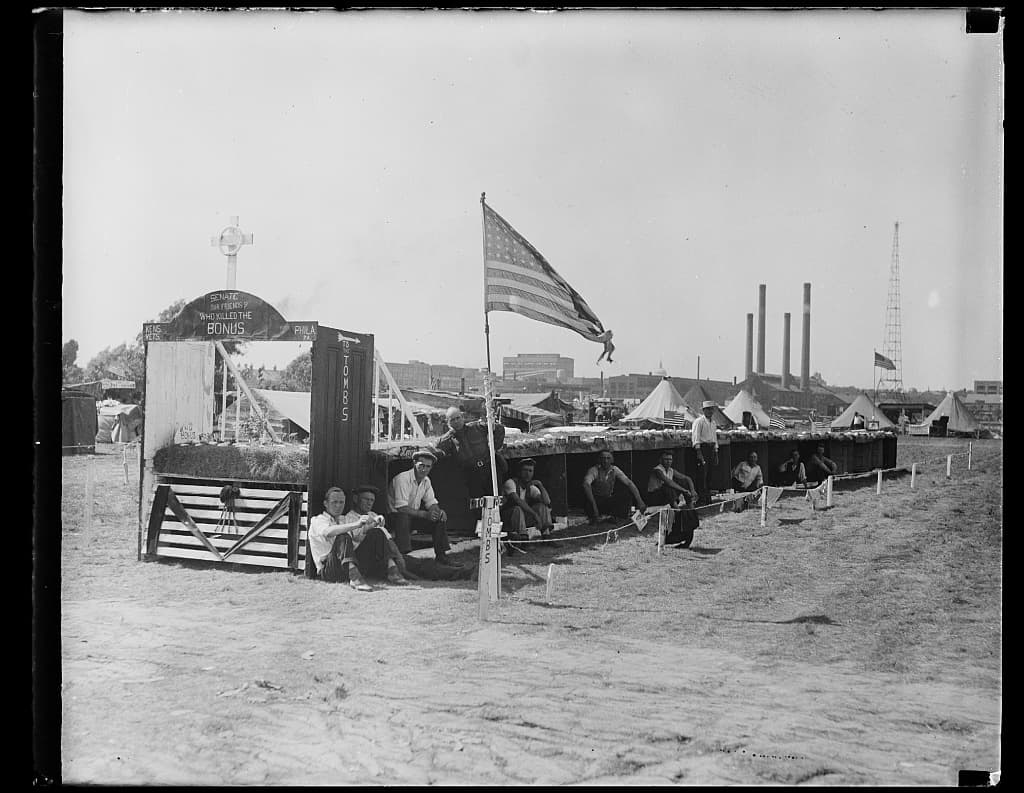
The Library titles this Bonus Army camp photograph "Who killed the bonus." and puts a question mark on the location. Harris & Ewing, Library of Congress, Prints and Photographs Division
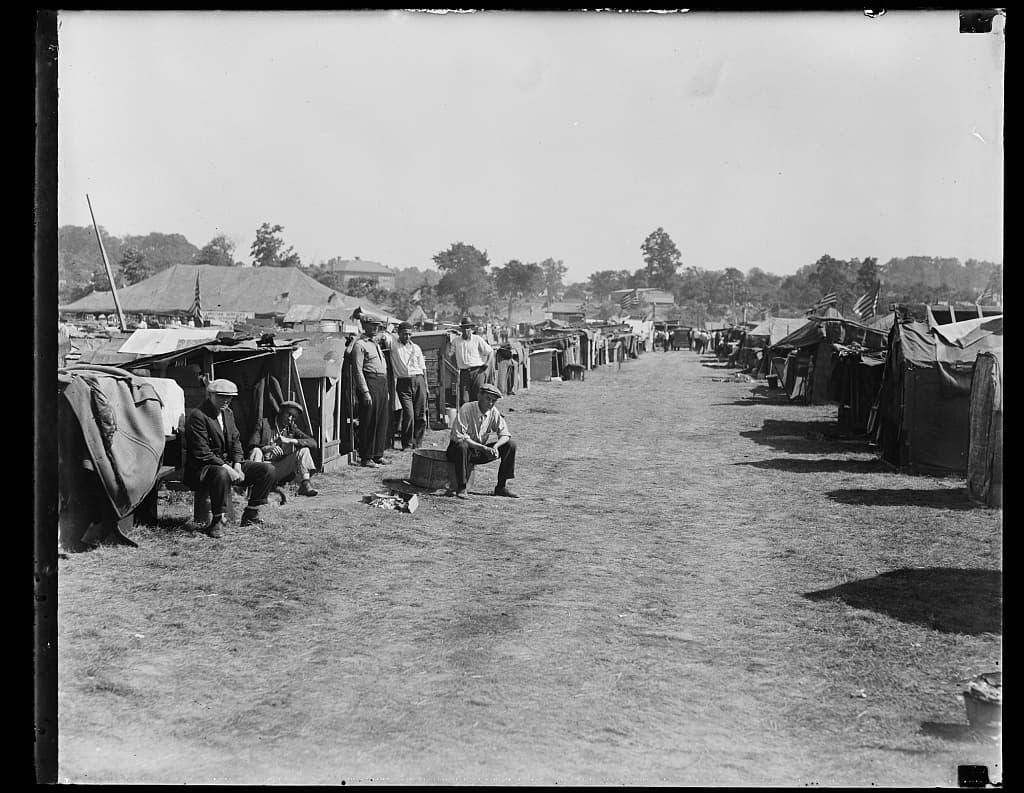
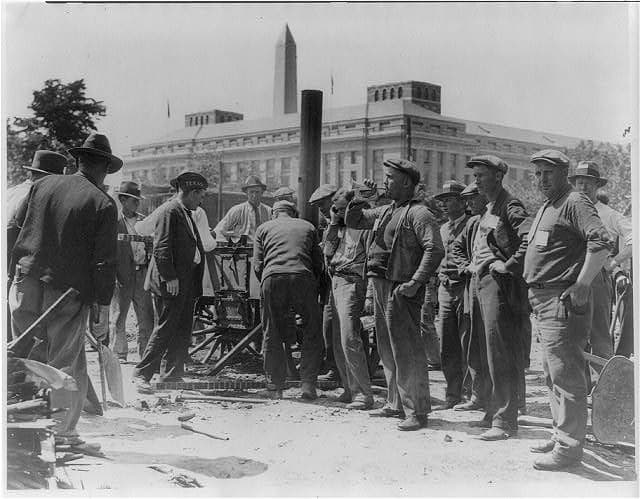
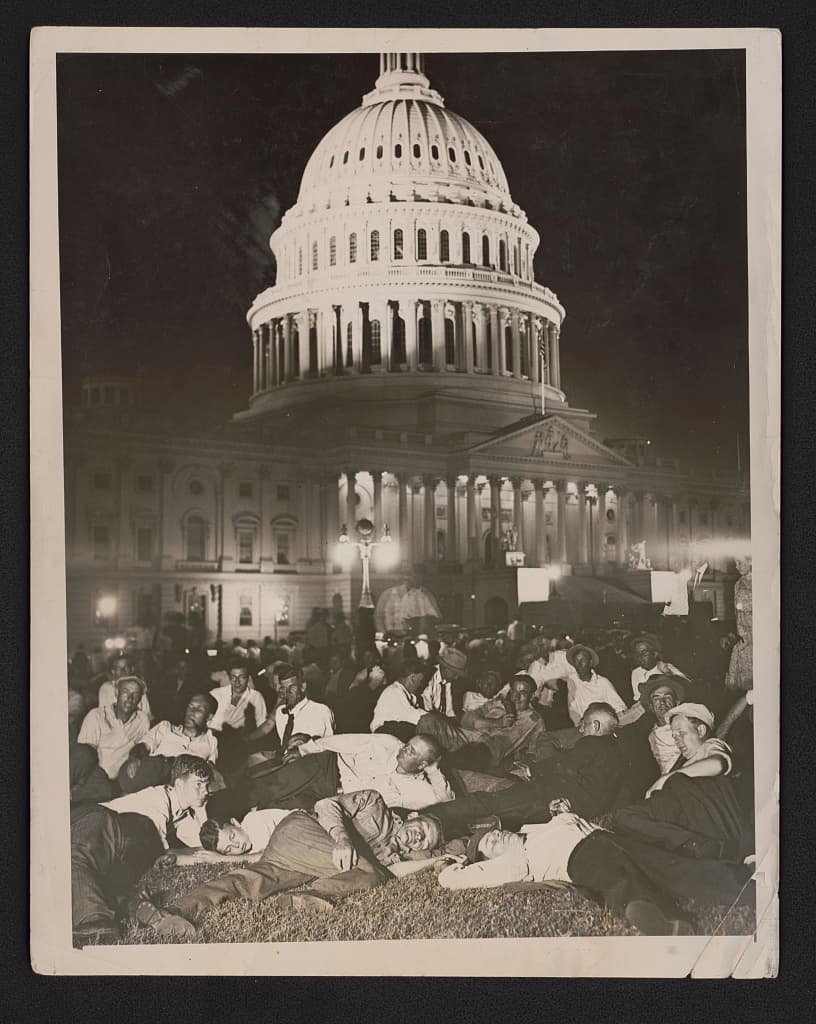
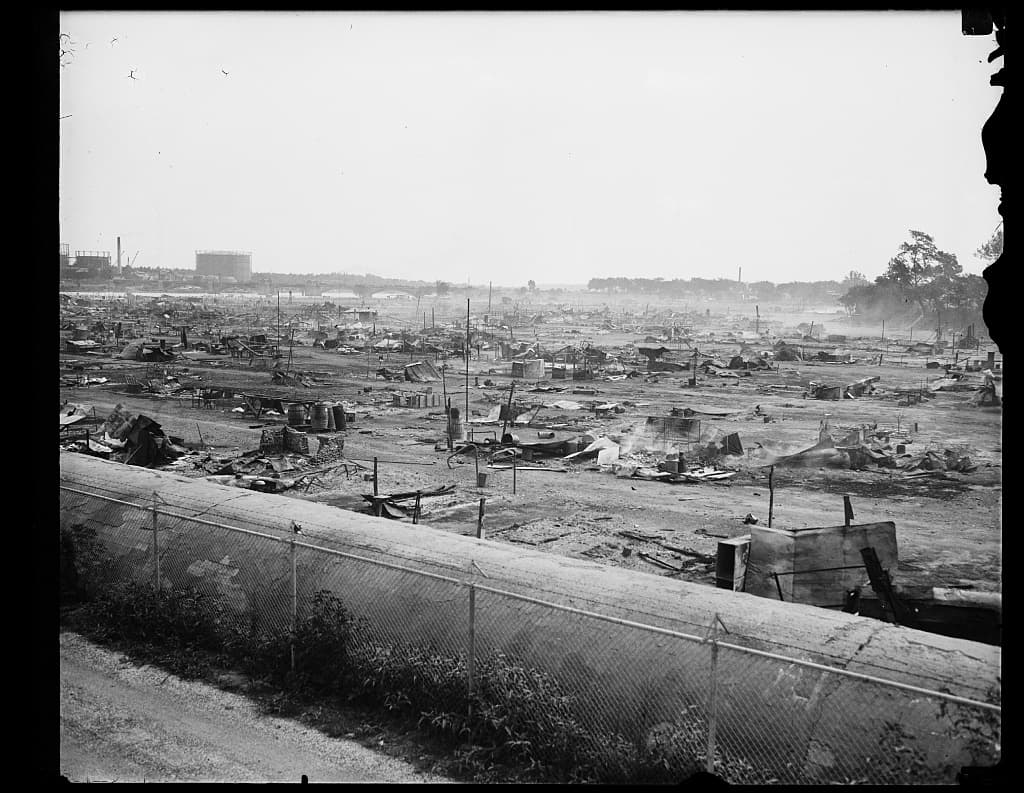
In the summer of 1932 men who had been shot at in France built a town out of scrap lumber and packing crates on the mud flats across the Anacostia River from the Capitol dome, and waited for Congress to pay them what it had already promised. What they had come for was written into law eight years earlier. The World War Adjusted Compensation Act, enacted on 19 May 1924, credited a veteran $1.25 for each day of overseas service and $1 for each day of home service, for active service of more than sixty days between 5 April 1917 and 1 July 1919, up to $500 for a man who never went over and $625 for one who did. That credit was then increased by a quarter and converted into what it would buy as a twenty year endowment policy at four percent interest. The certificates matured twenty years from issue. Calvin Coolidge vetoed the bill, writing that patriotism "bought and paid for is not patriotism," and Congress passed it over him. Then the Depression came, and men who could not feed their children in 1932 were holding paper that would not be worth anything until 1945. Nobody has ever agreed on how many came. One account puts the total at 43,000 people, of whom 17,000 were veterans and the rest families and affiliated groups. The National Park Service marker standing on the ground today says 1,500 had arrived by June and the number grew "to between 10,000 to 20,000." A Park Service history of the park gives close to 11,000. The National Archives says only "tens of thousands." We have printed all four, because each of them is somebody official counting, and they cannot all be right. The main camp was called Camp Marks, after a friendly police captain named S. J. Marks. The men laid out streets, dug sanitation, set up their own police force and held parades. Registration required an honorable discharge or a bonus certificate in hand. There was a religious tent and a Salvation Army lending library with a makeshift post office. One Park Service history describes it, in its own quotation marks, as a "fully integrated camp." Other accounts make no such claim and note only that the site sat on the historically African American side of Anacostia, where the children of the camp shared a baseball diamond. The camp shanties were built, in that history's words, from cardboard boxes and scraps of wood. The man between the veterans and the government was Pelham D. Glassford, superintendent of the District police. He had been the youngest general officer in the Army in 1918. He went out to the camp daily on a motorcycle, arranged volunteer medical care, donated food and clothing and tents, and recommended that the men be allowed to drift away rather than be driven out. He got them a six day extension. Afterwards the District Board of Commissioners held him responsible for the violence and blocked the officers he wanted to appoint, and he resigned in December. The bill they had come for, introduced by Wright Patman, passed the House on 15 June 1932 by 211 votes to 176. The Senate rejected it, 62 to 18. Most of the men stayed anyway. On 28 July the Attorney General, William D. Mitchell, ordered the veterans off government property, and President Hoover ordered the Army to clear the camp. What happened next is the part of this story that has never been settled. General Douglas MacArthur commanded the 12th Infantry and the 3rd Cavalry with tanks in support, five of them by one account and six by another, and the troops advanced with bayonets fixed and sabers drawn behind tear gas. One account states that Hoover twice sent instructions that the troops were not to cross the Anacostia bridge, and that MacArthur "chose to ignore the president." Another states the orders were never delivered at all, and that Eisenhower, General Perry L. Miles and Davison all disputed General George Moseley's claim that he had carried them. No source we could reach names the man who actually put Hoover's order into MacArthur's hand. Both versions have been in print for ninety years and only one of them can be a complete account. Two men died, and they had names. William Hushka was thirty-seven, a Lithuanian immigrant who had owned a butcher shop in St. Louis and sold it to enlist in 1917. He was shot by a police officer named George Shinault and was buried at Arlington a week later. Eric Carlson was thirty-eight, of Oakland, California, and had fought in the trenches in France. He is at Arlington too. A twelve week old infant named Bernard Meyer died in hospital after the gas; a government investigation reported that he died of enteritis, and a hospital spokesman said the gas "didn't do it any good." The record does not settle that one either, and we are not going to settle it here. Two officers who were there that day became famous later. Eisenhower, MacArthur's aide, argued that his chief should not appear in public at the eviction at all, saying afterwards that it was "no place for the Chief of Staff," and then wrote the Army's official report endorsing MacArthur's conduct. Major George S. Patton led six hundred cavalry down Pennsylvania Avenue. Among the men his troopers drove out was Joe Angelo, who had saved Patton's life in the Meuse-Argonne in 1918 and held the Distinguished Service Cross for it. Patton ordered him away. That last detail is repeated everywhere without any source pointing to contemporary reporting behind it, which is worth saying out loud on a page like this one. The following spring a second march came and was handled differently. Roosevelt offered 25,000 places in the Civilian Conservation Corps, waiving the rules about age and marriage, and transport home for anyone who did not want one. Eleanor Roosevelt walked into the camp alone, had lunch, and listened to the men sing. One of them said afterwards, "Hoover sent the army, Roosevelt sent his wife." In January 1936 Congress made the certificates payable at once, over Roosevelt's veto. Even the vote counts disagree: one account gives the House override as 324 to 61 and another as 322 to 98. So do the totals paid out, given variously as two billion dollars nine years early, about 1.5 billion, and 1.745 billion. The bonds were issued in fifty dollar denominations at three percent. The marker on the Anacostia flats today is titled "The Birthplace of the G.I. Bill." It ends with a sentence most markers would have left off: "Black veterans, however, could not utilize their benefits because of segregation, Jim Crow laws, and widespread racial discrimination." If your family kept a bonus certificate, or a photograph of the camp, or a letter from a man who was there, we would like to add it to this page. The people who camped on those flats are better remembered by name than by a number nobody can agree on. Compiled by MyHistoryStone from the World War Adjusted Compensation Act of 1924 and the Adjusted Compensation Payment Act of 1936 as printed in the United States Statutes at Large, the National Park Service marker at Anacostia Park, National Park Service histories of the park, the National Archives Unwritten Record, and published biographical accounts of Walter W. Waters, Pelham D. Glassford, Douglas MacArthur and George S. Patton.
Share a memory
Leave a memory or a message for the family. What you write appears right away, and the family can remove any entry.
Loading messages...