 Home
HomeThe Book Women

A Tribute to
The Pack Horse Librarians of Kentucky
MyHistoryStone Archive
1935 – 1943
Hindman, Kentucky, United States · 8 years
Location
Eastern Kentucky
Worked At
The WPA Pack Horse Library Project
In motion
5 photographs
The photographs on this page, brought to life.
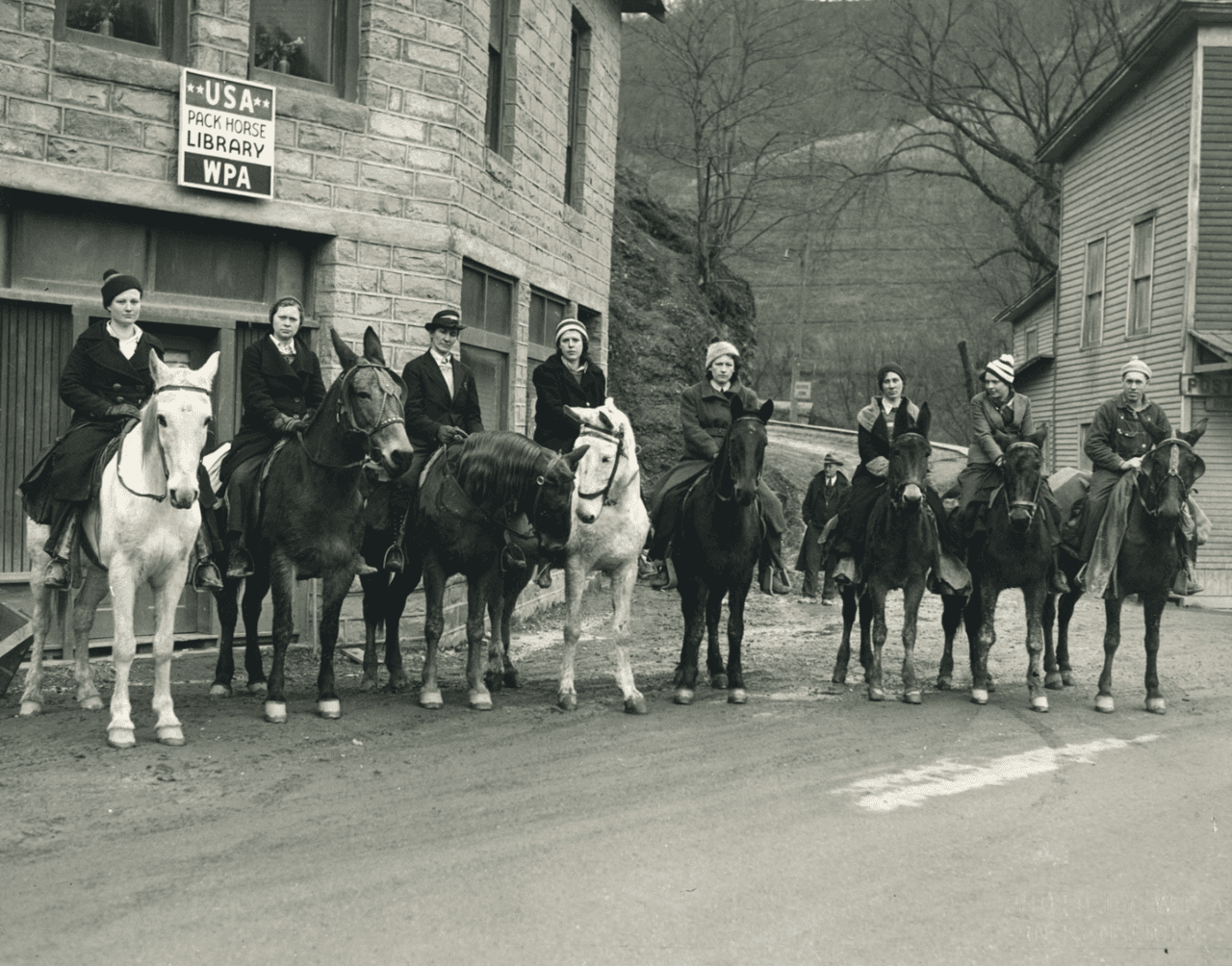
Book carriers ready to take the trail from Hindman, Kentucky. The album calls them Bookwomen. Work Projects Administration, Kentucky State Librarian. Public domain, via Wikimedia Commons.
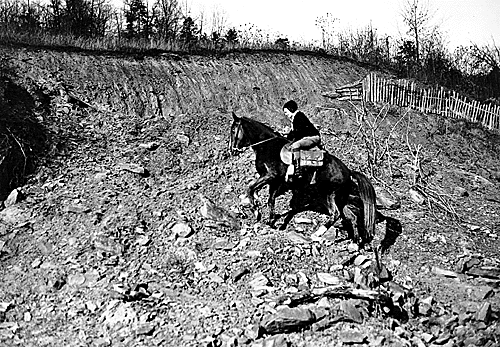
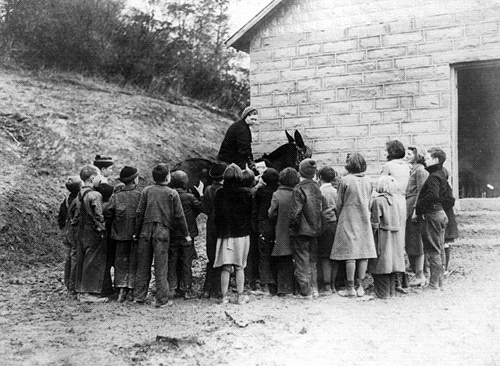
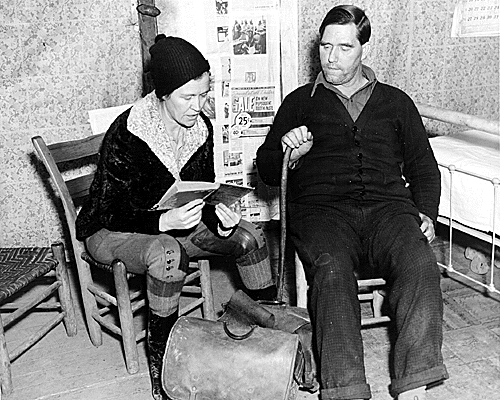
They were paid twenty-eight dollars a month, and they had to bring their own horse. There had been an attempt before. In 1913 a pack horse library started at Paintsville, Kentucky, run by May F. Stafford and paid for by a coal operator named John C. C. Mayo. Mayo died in 1914 and it stopped. Then, in 1934, a Presbyterian minister in Leslie County named Benton Deaton offered his community centre's library to the federal government if it would pay people to carry the books out to those who could not come and get them. The Federal Emergency Relief Administration ran it first; the Works Progress Administration took it over in 1935. At the federal level it fell under Ellen S. Woodward, Assistant Administrator of the Division of Women's and Professional Projects, and in Kentucky the sponsor was the state Board of Education. How big it was depends on who is counting. The number of carriers is given as around two hundred, and as nearly a thousand by 1943. The number of people reached is given as about a hundred thousand and as more than one and a half million. There were around thirty pack horse libraries at the peak, eight of them by 1936. Woodward, speaking in 1937, gave ten Kentucky counties with five workers each, and named them: Clay, Elliott, Harlan, Jackson, Knott, Lee, Leslie, Owsley, Pulaski and Whitley, with eleven more counties asking for the service. The popular retelling says forty-eight counties. In 1936 the project circulated about thirty-three thousand books to some fifty-seven thousand families, or served fifty thousand families, depending on the source, and by 1937 it was reaching a hundred and fifty-five schools. Sixty-three Kentucky counties had no library service of any kind in the early 1930s. The routes ran a hundred to a hundred and twenty miles a week and were ridden at least twice a month. A pack held about a hundred books, lent for about a week. Some of it could not be ridden at all: one carrier, Grace Caudill Lucas, had to lead her horse across the cliffs, and in deep water her feet sometimes froze to the stirrups. Another walked her eighteen mile route on foot after her mule died. Another had a mule so old she walked beside it for part of the way. Where there was no track they followed creek beds and fence lines, and in some places they went by rowboat. The pay was twenty-eight dollars a month from the WPA, and the horse or mule was the carrier's own problem, sometimes leased from a local farmer. The central facility for a county library cost about forty dollars a month in rent and utilities, which the community found. Each library had a clerk or head librarian and four to ten carriers, and once a month the carriers came in to what they called conferences. The project could not simply buy books, so the books were begged. They came as donations from about half the states. Parent Teacher Associations and women's clubs in Kentucky raised money; Lena Nofcier ran book drives and penny collections through the PTA; the Daughters of the American Revolution in Paintsville paid shipping costs; a Mrs. Malcolm McLeod in Pittsburgh ran a collection and sent it to London, Kentucky, which acted as a receiving centre. Cheese boxes became card catalogue files. Licence plates were bent into bookends. When the books wore out the women made new ones. They cut the stories and pictures out of the ruined volumes and pasted them into binders. Then they went further and made books that had not existed before: recipe books and quilt pattern books, written down by the women on the routes and by the women on the routes' patrons, and circulated through the mountains like anything else. More than two hundred books were produced this way by librarians and patrons together. There is a scholarly study devoted to just those scrapbooks, by Jason Vance, which treats the carriers as authors and self-publishers, which is what they were. What people asked for was the Bible and what one account calls instructive literature, along with Robinson Crusoe and Mark Twain, the Women's Home Companion and Popular Mechanics. The collections leaned toward children's books; for adults they held current events, history, religion and biography. Maggie Mae Smith, a supervisor in Whitley County, wrote that the children ran out to meet the book women saying, bring me a book to read. Woodward's 1937 speech quotes patrons directly, including a line that has been repeated ever since: learn me to read, book lady, please if you learn me, I won't be lonesome any more. That speech was publicity, the dialect is the speaker's rendering, and both things can be true at once. About thirty-one percent of people in eastern Kentucky could not read, a figure one source dates to 1930 and another gives with no year at all. The state circulated one book per person against an American Library Association standard of five to ten. The names that survive are mostly the supervisors, which is its own comment on the record. May F. Stafford at Paintsville. Maggie Mae Smith in Whitley County. Grace Moore Burchett in Floyd County, over Prestonsburg, Martin, Lackey and Wheelwright. Ann Richards in Harlan County. Ethel Perryman at London. Naomi Lemon at Pikeville. Imogene Dutton at Somerset. Louise S. Van Cleve at Campbellsville, which opened on 3 November 1938. Elizabeth Fullerton at the WPA, who revived Stafford's idea. Of the carriers themselves we have Grace Caudill Lucas, Nan Milan at Pine Mountain riding an eight mile radius, and Rose Farmer in Leslie County. That is a very short list for two hundred women, or a thousand. It ended because the WPA ended. Roosevelt directed the Federal Works Administrator to wind it up in December 1942, and with no money budgeted the agency ceased to exist after 30 June 1943. Motorised bookmobiles replaced the horses by 1946 by one account and only in the 1950s by another. Carl D. Perkins, who had taught in a one room schoolhouse in those years, credited the pack horse librarians when he introduced federal library funding legislation in 1956. By 2014 Kentucky was running seventy-five bookmobiles, more than any other state. One more thing, and it is the reason this page has the photographs it has. The Library of Congress holds no photograph of this project, the National Archives search returned none, there is no marker for it in the Historical Marker Database, and we could not identify a surviving pack horse library building. What does survive is a set of Works Progress Administration press photographs of the carriers themselves, taken in 1938, and those are the ones above. We had very nearly written that no photographs of these women existed at all. Looking in one more place is the whole difference. If your grandmother carried books in eastern Kentucky, or your family borrowed them, we would like her name and her county here, because the list above is far too short. Compiled by MyHistoryStone from the Works Progress Administration records and Ellen S. Woodward's 1937 address as published by the Virginia Commonwealth University Social Welfare History Project, the Digital Public Library of America exhibition on the history of United States public libraries, Smithsonian Magazine, the Living New Deal, and the scholarly literature on the project by Jeanne Cannella Schmitzer, Donald C. Boyd and Jason Vance.
Add to this story
Know something about The Pack Horse Librarians of Kentucky? Add it here - a memory, a detail, a correction. What you write appears right away, and the page owner can remove any entry.
Loading messages...