 Home
HomeThe School Children's Storm
The Story of
The Children's Blizzard of 1888
MyHistoryStone Archive
January 12, 1888
Ord, Nebraska, United States
Location
Nebraska and Dakota Territory
In motion
4 photographs
The photographs on this page, brought to life.
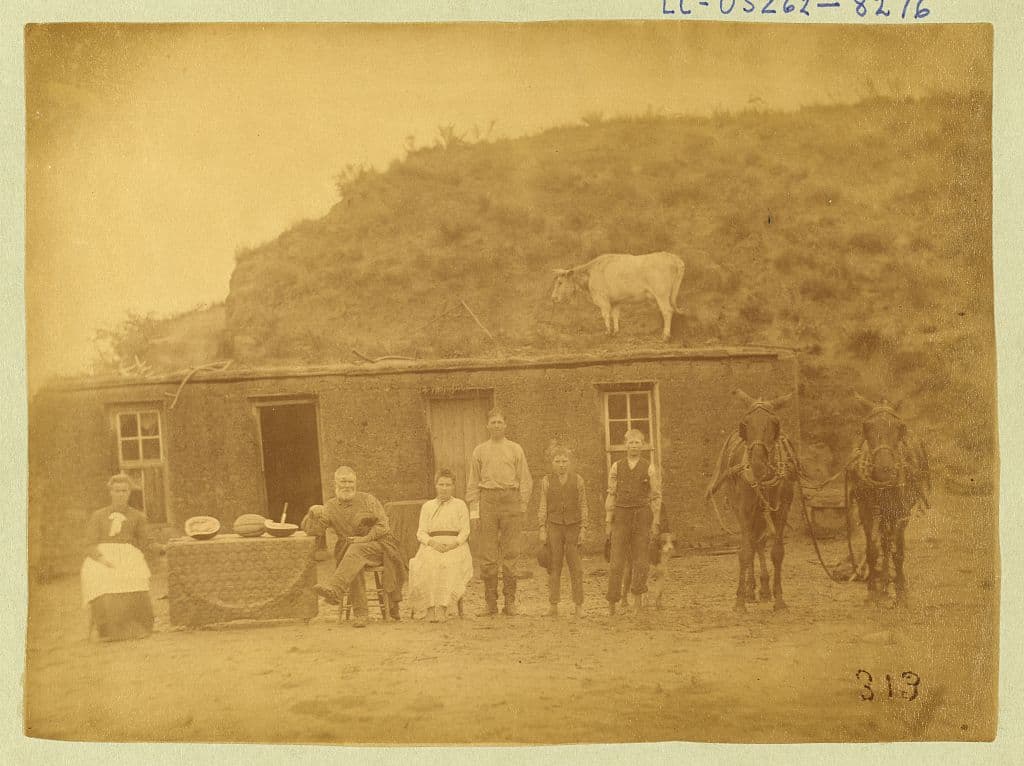
The Rawding family north of Sargent, Custer County, Nebraska, about 1886, with a cow on the sod roof. Solomon D. Butcher. Library of Congress.
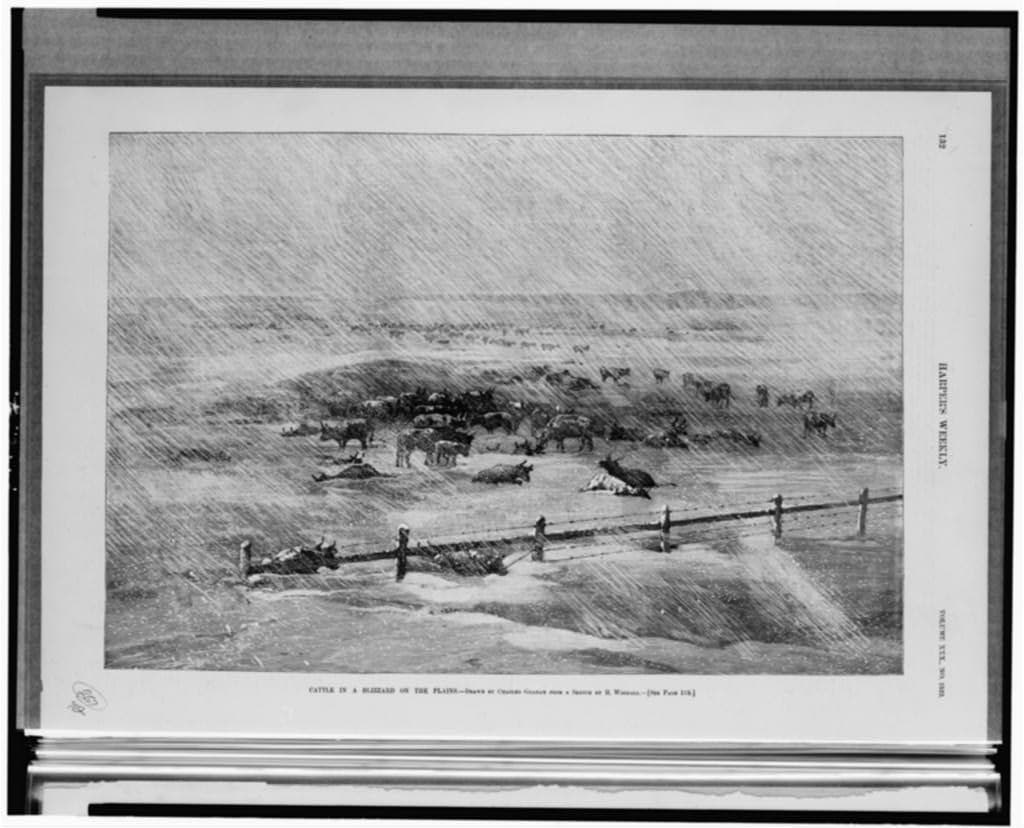
The morning was warm enough that some of them went to school without their coats. The cold air that became the storm formed around 8 January 1888 near Medicine Hat and Qu'Appelle, and by the eleventh it spread more than seven hundred and eighty miles. It hit Montana in the early hours of 12 January, crossed Dakota Territory from midmorning to early afternoon, reached Lincoln, Nebraska by three in the afternoon and southwestern Wisconsin by eleven at night. The Signal Service observer at Huron wrote down the moment it arrived: the air was perfectly calm for about one minute, and the next minute the sky was completely overcast by heavy black clouds. What made it lethal was the warmth in front of it. Omaha had been six below zero at seven in the morning on the eleventh and was twenty-eight degrees at seven the next morning. Across the central plains the temperature had climbed twenty to forty degrees. Then it fell. Huron went from twenty degrees to two below by two in the afternoon. Keokuk, Iowa dropped fifty-five degrees in eight hours. Fargo recorded forty-seven below, Neche in Dakota fifty-eight below, and Nebraska somewhere between thirty and forty below depending on which account you take. Winds are given at fifty, fifty-six and sixty miles an hour, and wind chills below sixty degrees below zero. It lasted twelve to eighteen hours. The children were out because it was mild and because the storm arrived during school hours. The National Weather Service puts it as a false sense of security that swept over the land, such that some children opted not to grab their hat and gloves. It is often written that schools dismissed early because of the weather; the sources we reached say only that dismissal coincided with the storm's arrival, and we are not going to write it the other way. Nobody knows how many died. The figure in general use is two hundred and thirty-five, which traces to a National Oceanic and Atmospheric Administration compilation of the worst natural disasters by death toll that we could not open, so we cannot say who compiled it or from what. The same encyclopedia entry that carries it also notes that some estimate a thousand. A Minnesota account gives two hundred and fifty to five hundred and attributes those numbers to newspaper editors of the region. Another gives two hundred to two hundred and fifty. Nebraska's own historical marker says no accurate count of the total deaths from the storm is possible and that estimates for Nebraska have ranged from forty to a hundred; the state historian in 1947 gave a hundred and nine for Dakota Territory. No source we found gives a breakdown of how many of the dead were children, only that many or most were. David Laskin has noted the two reasons every count runs low: deaths in remote districts were never reported, and scores died in the weeks afterwards of pneumonia. Minnie Freeman was teaching near Ord in Valley County, still in her teens. The state's marker says that when the wind tore the roof off the sod schoolhouse she saved her pupils by leading them through the storm to a farmhouse half a mile away; other accounts say thirteen children and a mile and a half. The rope is the part that has never been settled: the state historian wrote in 1947 that she tied them together single file with herself at the head of the line, and a later account records that one of the children said it was not true. The marker does not mention a rope at all. A parlour song came out of it the same year, Nebraska's Fearless Maid, published by Lyon and Healy. We could find no record of a medal. In 1967, for the state centennial, Jeanne Reynal set a Venetian glass mural of the storm on the west wall of the north bay of the Nebraska State Capitol, with Freeman leading the children. She married Edgar Byron Penney in Omaha in 1891, moved eventually to Chicago, and died there on 1 November 1943. What History Nebraska holds of her is one folder with two items in it: a clipping headed The Brave Heroine of the Blizzard, and a letter she wrote to her friend Anna Bell at Mira Creek in November 1887, two months before any of this. She was not the only one and the state says so on the marker: many other teachers performed similar acts of heroism, and at least one lost her life in the attempt. Lois Royce, teaching near Plainview, ran out of fuel at three in the afternoon and set out for her boarding house eighty-two yards away with three children, two boys of nine and a girl of six. The children froze. She lost both feet, and by one account both legs below the knee. Etta Shattuck, nineteen, took shelter in a haystack, was found seventy-eight hours later by Daniel D. Murphy and his men, and died on 6 or 7 February after surgery to remove her frostbitten legs. The state historian calls her Emma Shattuck and puts her in Holt County; another account calls her Etta and puts her in Seward County. We have not been able to reconcile her name or her county, which is its own kind of memorial problem. Some of the dead have names. Johnny Walsh, ten, froze near Avoca, Minnesota. Six Baker children died near Chester Township. Seselia Knutson froze forty steps from her own door. Hanley Countryman of Alexandria died a hundred and fifty yards from his house. Beyond those, the names come from the newspapers of January 1888, which reported in the language of rumour: it is feared that, are believed to be, have not been heard from since, chances of life are very small. Those lists are reports, not records, and we have not printed them as though they were. The weather service of the day was the Army Signal Service, not the Weather Bureau, which did not exist under that name until 1891. Adolphus Greely had been Chief Signal Officer since March 1887. Lieutenant Thomas Mayhew Woodruff at St. Paul had issued an indication of a cold wave for Dakota and Nebraska with heavy drifting snow; one Minnesota account states that the Signal Corps chose not to issue a cold wave warning the night before. It is often said that the service was forbidden to use the word blizzard. We could not find that in any source. What we did find is a later Weather Bureau ban on the word tornado, after the 1891 transfer to civilian control, which is a different word in a different decade, and which is very likely where the story comes from. The word blizzard itself had been in ordinary use in the western states since the 1850s. What the storm produced, half a century later, was a club. In January 1940 a former Speaker of the Nebraska House, W. H. O'Gara, suggested a dinner for the survivors, and they met at the Lindell Hotel in Lincoln on the twelfth. They renamed themselves the January 12, 1888 Blizzard Club in 1944 to stop being confused with New York's blizzard of March that year. They collected first-hand accounts, published them in 1947 as In All Its Fury and in a series of brochures afterwards, and kept records until 1985. That is where most of what anyone knows about that day actually comes from: people who were children in it, writing it down when they were old. If your family was on the plains that Thursday, and especially if someone in it did not come home, we would like their name here and we will print it as you give it. Compiled by MyHistoryStone from the Nebraska state historical marker as transcribed by the Historical Marker Database, History Nebraska's publications and collection guides including the 1947 account by James C. Olson and the finding aids for the Minnie Mae Freeman Penney papers and the January 12, 1888 Blizzard Club, the National Weather Service Aberdeen office's account of the storm, the National Weather Service timeline, MinnPost's 125th anniversary reconstruction, and Readex's survey of the newspaper coverage of January 1888.
Share a memory
Leave a memory or a message for the family. What you write appears right away, and the family can remove any entry.
Loading messages...