 Home
HomeMay 31, 1889
A Tribute to
The Johnstown Flood
MyHistoryStone Archive
May 31, 1889
Johnstown, Pennsylvania, United States
Hometown
Johnstown, Pennsylvania
Location
The South Fork Dam
In motion
5 photographs
The photographs on this page, brought to life.
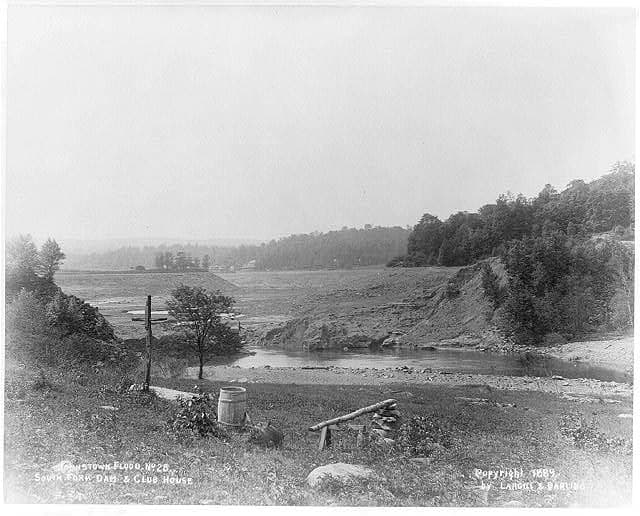
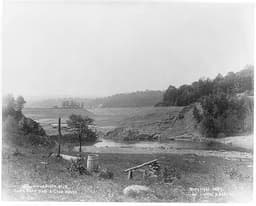
The South Fork dam with the lake gone. The print's own caption reads South Fork Dam and club house. Langill & Darling, 1889. Library of Congress.
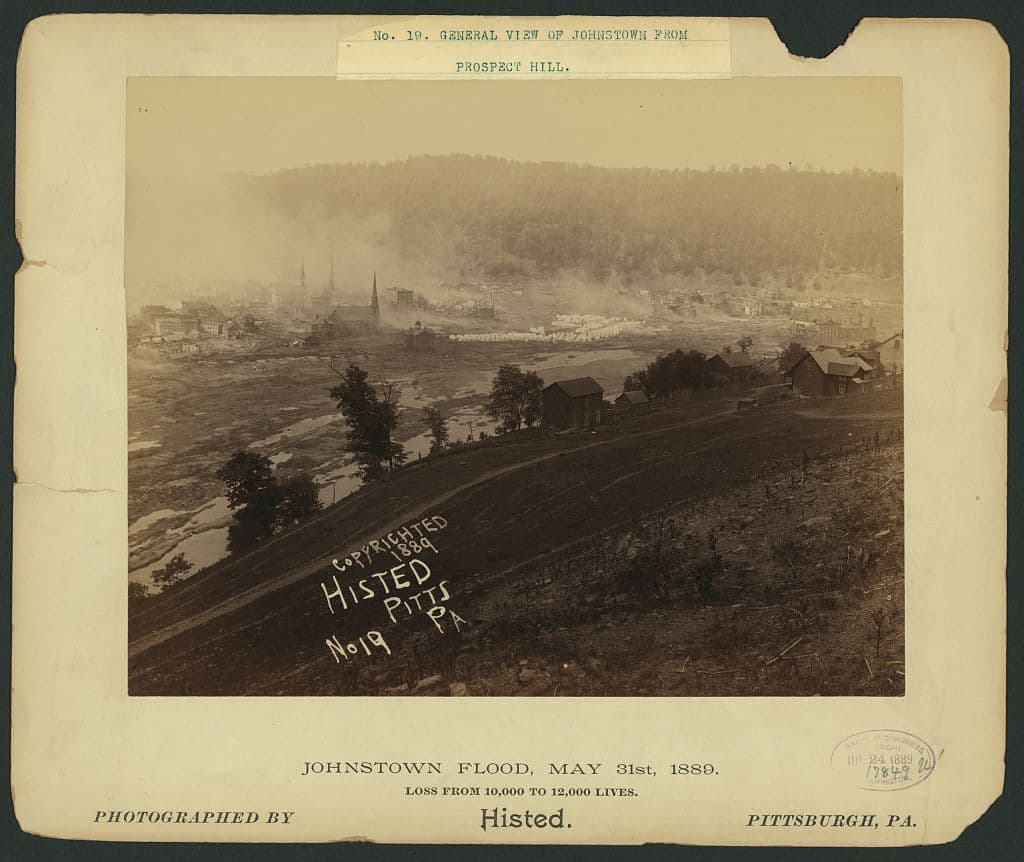
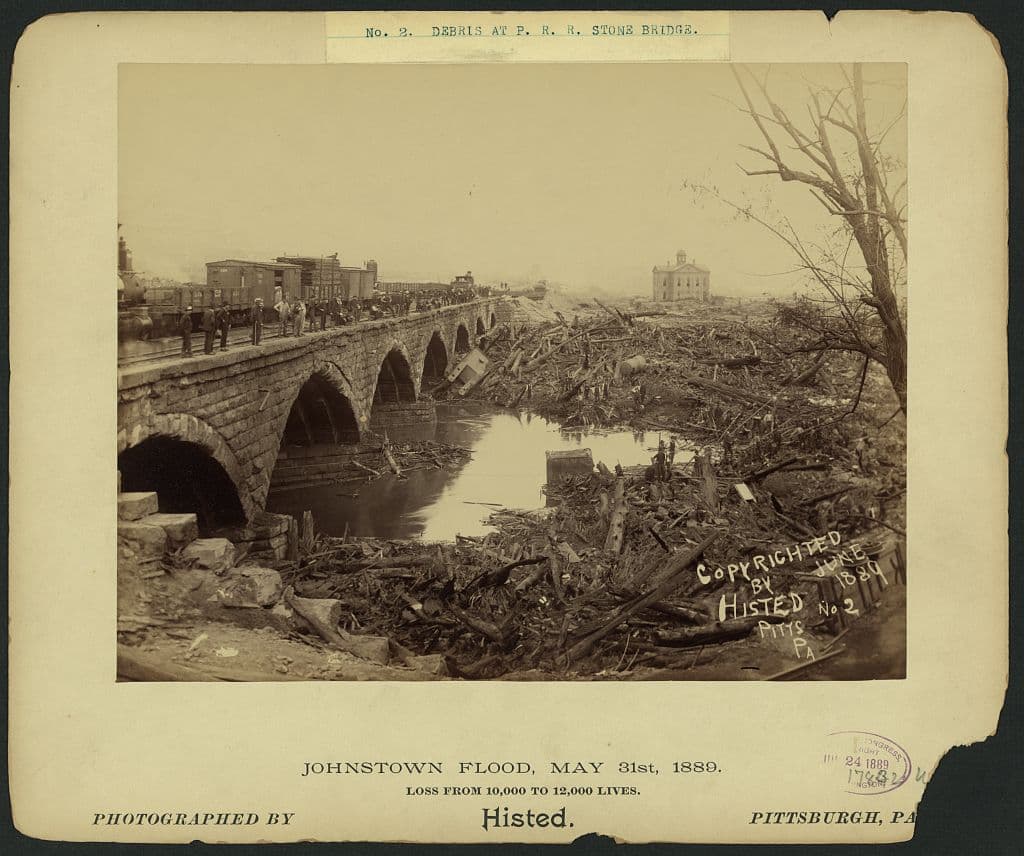
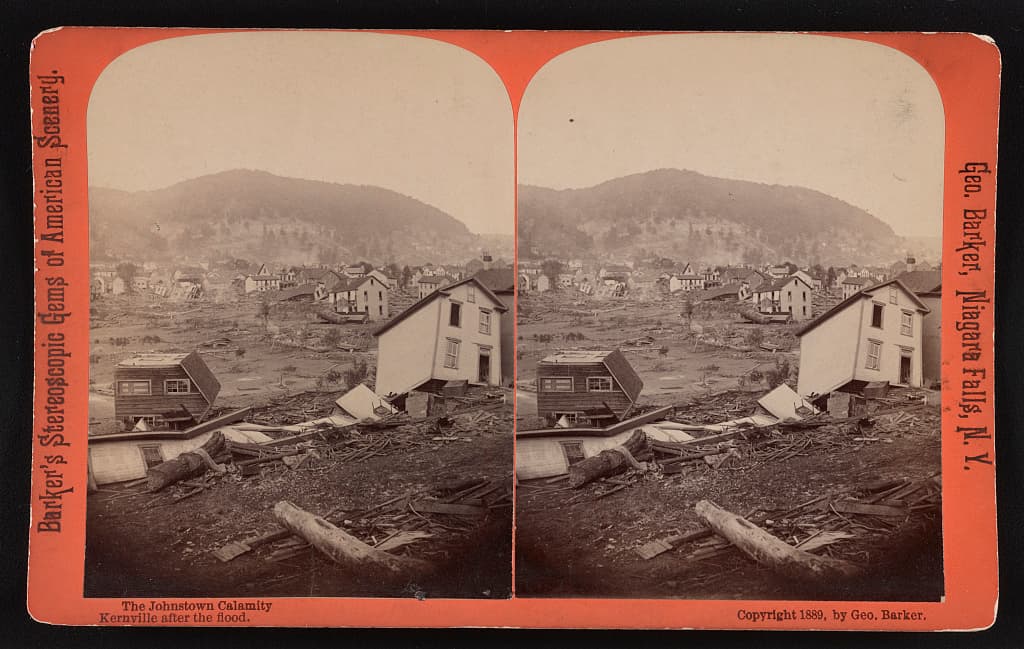
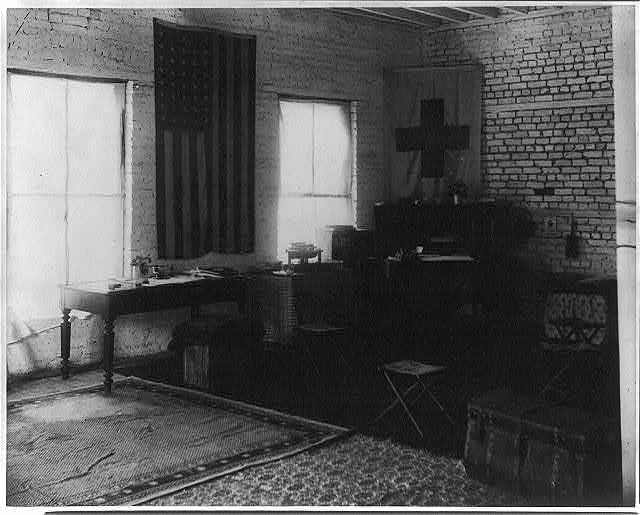
The club lowered the top of the dam by a couple of feet so that two carriages could pass each other on the road across it. The South Fork Dam was not built by the men who are blamed for it. The Commonwealth of Pennsylvania built it to feed the Main Line canal, starting in 1838 or 1840 and finishing in 1852 or 1853, an earth dam about nine hundred and thirty-one feet long and seventy-two feet high holding back a lake a little over two miles long. The railroad made the canal obsolete almost immediately. The dam broke once already, in 1862, when the reservoir was half full and nearly two hundred feet of the embankment washed out; the backfill of that breach left a sag in the middle that was still there in 1889. The South Fork Fishing and Hunting Club organised on 19 March 1879 and was chartered on 17 November, with Benjamin F. Ruff and Henry Clay Frick as principal shareholders. Membership is given as sixty-one, as more than fifty, and as limited to a hundred families. Andrew Carnegie, Andrew Mellon, Philander Knox and James Hay Reed are among the names the sources attach to it. They built a forty-seven room clubhouse and sixteen cottages, kept two steam yachts, stocked the lake with bass and trout, and charged a dollar sixty a day for members and two and a half for guests. Three things were done to the dam. The five cast iron discharge pipes, which would have let the lake be drawn down in a controlled way, had been removed and sold for scrap around 1878 by a previous owner, John Reilly, before the club existed; this is worth stating plainly because it is very commonly laid at the club's door. What the club did was decline to reinstall them and fill in the culvert instead. The club lowered the crest, by two feet or by three depending on the account, to make a carriage road, leaving it about four feet above the spillway. And the club put fish screens across the spillway to keep the stocked fish in, which caught debris and cut the spillway's capacity. They were told. Daniel Johnson Morrell, general manager of the Cambria Iron Company down in Johnstown, sent an engineer and geologist named John Fulton to inspect the repairs in 1880. Fulton found all three problems, and his central objection was that without the sluice pipes the lake could not be lowered to fix a leak at all. Ruff wrote back to Morrell on 2 December 1880 that the leaks came from the culvert rather than the missing pipes, and that, in the sentence that survives him, you and your people are in no danger from our enterprise. Morrell joined the club to keep an eye on the dam and offered to pay for part of the repairs himself. The offer was refused. Between six and ten inches of rain fell in twenty-four hours on 30 and 31 May 1889. By that morning the lake was rising nine or ten inches an hour. Colonel Elias J. Unger, the club president, who lived in the house beside the dam, had about fifteen men trying to cut a second spillway and then ploughing the crest and piling the dirt up to raise it. The club engineer John Parke rode down to South Fork and sent warnings from about eleven in the morning; the Park Service counts at least three that day, the last reaching Johnstown around three o'clock. They were not passed on to the town's authorities, because there had been false alarms before. A minister at the dam, G. W. Brown, watched it go and wrote, God have mercy on the people below. The failure is timed at between ten and twenty minutes before three by one account and at 3:15 by another. Twenty million tons of water went out in thirty-five to forty-five minutes, or by modern modelling about sixty-five. The wave is put at thirty feet, thirty-five to forty, thirty-seven by eyewitnesses at Johnstown, and sixty. It travelled at about forty miles an hour and reached the town around four o'clock, or at 4:07. Four square miles of downtown were destroyed, about sixteen hundred homes, seventeen million dollars in property. Locomotives weighing a hundred and seventy thousand pounds were carried nearly a mile. At the Stone Bridge the wreckage of the town piled up in the arches, thirty acres of it, and caught fire that night and burned for three days. One marker at the site says three hundred bodies were later found there and calls the fire a funeral pyre; another account says at least eighty people died in the fire itself. A dynamite crew had to come from Pittsburgh to break the jam. The count is 2,209, and the Park Service explains where it came from: a list printed about fourteen months after the flood. The same page says that for a variety of reasons some victims were never included and the actual toll was probably well over three thousand. The figure is sometimes given as 2,208, because a man listed among the dead, Leroy Temple, turned out to have survived and came back to Johnstown eleven years later. Between seven hundred and fifty and seven hundred and seventy-seven of the dead were never identified and lie in the Plot of the Unknown at Grandview Cemetery under a monument the Pennsylvania Flood Commission put up on 31 May 1892. Ninety-nine entire families died, including three hundred and ninety-six children. Bodies were found as far away as Cincinnati and as late as 1911. Clara Barton arrived on 5 June 1889, sixty-seven years old, and stayed until 24 October. Her Red Cross distributed supplies worth two hundred and eleven thousand dollars and helped about twenty-five thousand people, and built shelters called Red Cross hotels, the first of them on the ground where the flood had taken St. Mark's Episcopal Church. It was the organisation's first great peacetime relief operation, which is the thing Barton had been arguing the Red Cross should be for. In all, three million seven hundred and forty-two thousand eight hundred and eighteen dollars and seventy-eight cents was raised, from the United States and eighteen other countries. Nobody paid. The club was defended by the firm of Knox and Reed, whose partners were both club members, and the courts held the failure to be an act of God. Four suits were fended off and none of the people who brought them profited; the only successful cases arising from the flood were against the Pennsylvania Railroad. The club contributed a thousand blankets, and about half the members gave to the relief fund, Carnegie's company among them with ten thousand dollars. No member ever expressed a sense of personal responsibility. The case is credited with pushing American law toward strict liability, under which a defendant who has done nothing negligent can still be held liable for damage caused by an unnatural use of land. The survivors are named in the record and deserve to be here. Anna Fenn Maxwell lost her husband John and all seven of their children, and described the water rising until their heads nearly touched the ceiling; she survived, remarried, and died in 1928. Victor Heiser, sixteen, watched his house go from the barn roof, rode the water, jumped to a brick house and sheltered in the attic with nineteen others; both his parents died; he became a physician and a public health officer. Rev. Dr. David Beale pulled floating survivors into his parsonage and then walked to Alma Hall and prayed with the two hundred and sixty-four people sheltering there. Dr. William Matthews, with two broken ribs, treated the wounded in that building and delivered two babies. The Johnstown Flood National Memorial was established by Congress in 1964. The ends of the dam are still there where they meet the valley sides, and at the centre a three hundred foot section is simply gone. The clubhouse and several of the cottages survive. If your family was in the valley that afternoon, or among the ninety-nine families, or among the unnamed in the Plot of the Unknown, this page is where their names belong. Compiled by MyHistoryStone from the National Park Service pages and frequently asked questions for the Johnstown Flood National Memorial, the 2016 National Park Service Cultural Landscapes Inventory for the site, the Johnstown Area Heritage Association, the Association of State Dam Safety Officials case study of the South Fork Dam, and the Historical Marker Database transcriptions of the National Park Service waysides at the dam, the Stone Bridge and Cambria City.
Share a memory
Leave a memory or a message for the family. What you write appears right away, and the family can remove any entry.
Loading messages...