 Home
HomeThe Lovelace Tests

A Tribute to
The Mercury 13
MyHistoryStone Archive
1960 – 1962
United States · 2 years
Location
Albuquerque, New Mexico
Worked At
The Lovelace Foundation
In motion
4 photographs
The photographs on this page, brought to life.
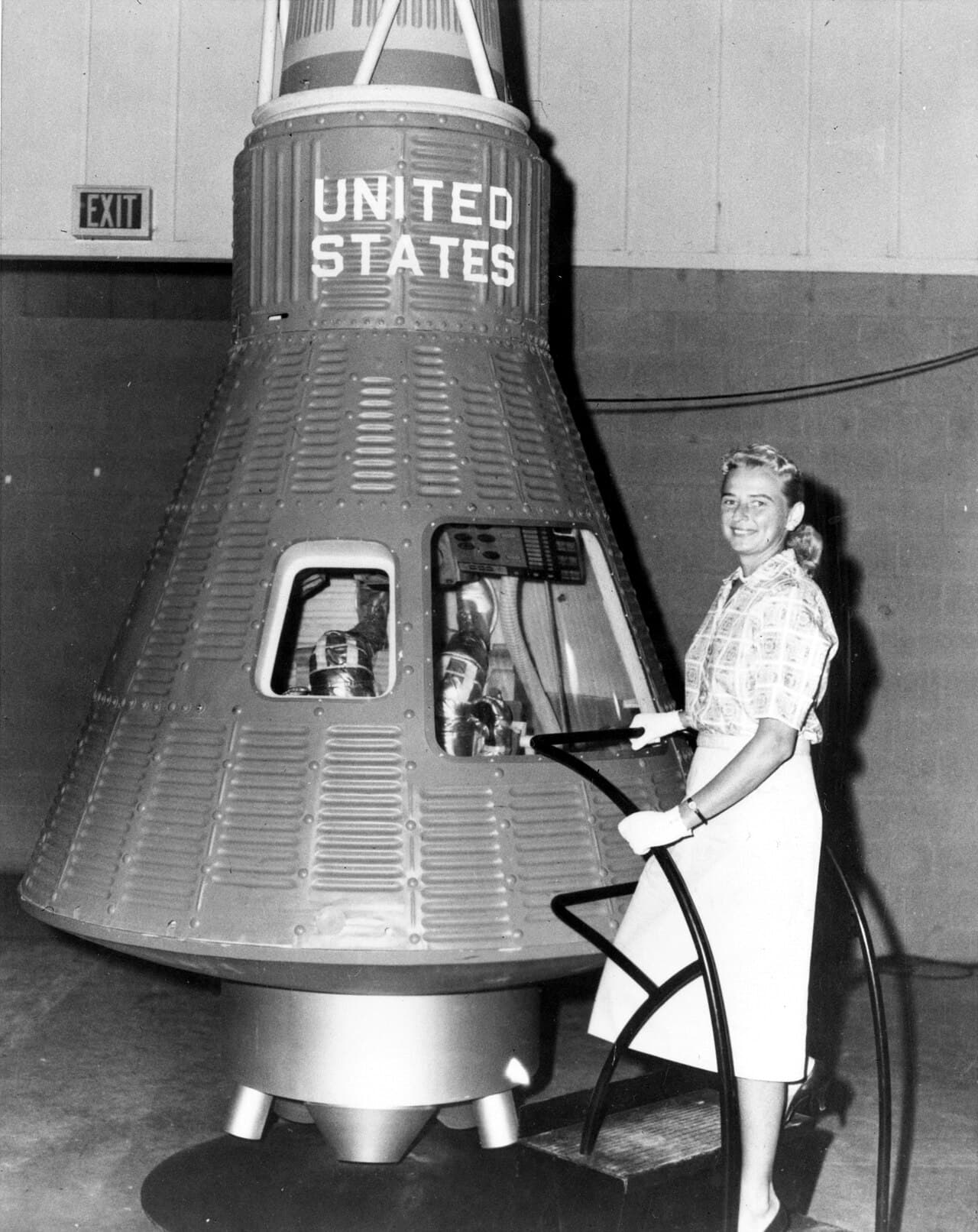
Jerrie Cobb beside a Mercury capsule. She was never a NASA astronaut candidate. NASA. Public domain, via Wikimedia Commons.
.jpg%2F1280px-JERRIE_COBB_-_PILOT_-_TESTING_GIMBAL_RIG_IN_THE_ALTITUDE_WIND_TUNNEL%252C_AWT_(GRC-1960-C-53086).jpg&w=3840&q=75)
.jpg&w=3840&q=75)
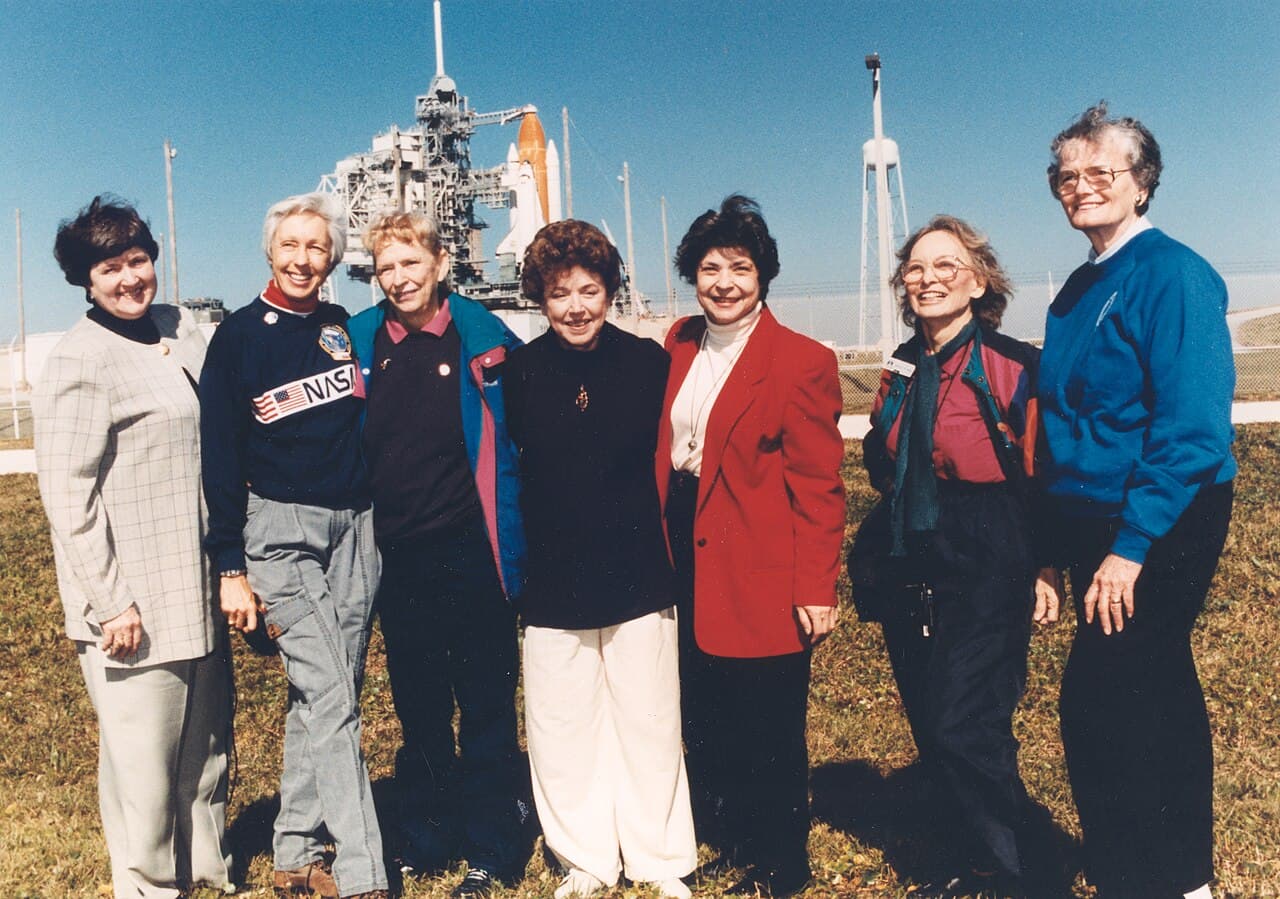
Thirteen women passed the same medical screening as the Mercury astronauts. It was never a NASA programme, and that turns out to be the whole story. In 1960 Dr. William Randolph Lovelace II, who had designed the physical tests NASA used to select the Mercury Seven, began putting women pilots through the identical screening at his own clinic in Albuquerque, New Mexico. He called it the Woman in Space Program. He ran it with Brigadier General Donald Flickinger. Jacqueline Cochran advised it and paid the women's expenses, or her husband financed it, depending which account you read. The records of more than seven hundred women pilots were reviewed. The minimum was a thousand flying hours. Twenty-five were invited, nineteen were tested, and thirteen passed. Their names, because a list of thirteen is the point of this page: Myrtle Cagle. Jerrie Cobb. Janet Dietrich and her twin sister Marion Dietrich. Wally Funk. Sarah Gorelick. Jane Hart. Jean Hixson. Irene Leverton. Jerri Sloan. Bernice Steadman. Gene Nora Stumbough. Rhea Hurrle. Several married later and are listed elsewhere under other surnames. The tests were the same brutal set the men had taken. X-rays. A four-hour eye examination. A weighted stationary bicycle ridden to exhaustion. Stomach acid drawn off through a swallowed tube. A tilt table. Electric shocks to the ulnar nerve. Ice water poured into the ear to induce vertigo. Body composition measured in a nuclear counter at Los Alamos. One difference: the men went through it as a group, and NASA says each woman came to Albuquerque alone or in a pair for her week. Wally Funk was twenty-three, or twenty-one; the sources differ. Jane Hart was forty-one and had eight children. Jerrie Cobb was the only one to complete all three phases, and finished in the top two per cent of all candidates of either sex. In the isolation tank Funk lasted ten hours and thirty-five minutes without hallucinating and scored third best of anyone. The third phase was to be at the Naval School of Aviation Medicine at Pensacola, using Navy jets and Navy equipment. A few days before the women were due to report, telegrams arrived cancelling it. The reason was procedural and complete: there was no official NASA request, so the Navy would not release its facilities to an unofficial project. Two of the women had already quit their jobs. This is where the whole thing turns, and it is worth being exact. NASA's own history pages call the programme privately funded and say so repeatedly. The women were never astronaut candidates. They never trained as a group. NASA never sanctioned any of it. The one institutional thread is that Lovelace also chaired NASA's Special Committee on Bioastronautics, which is how a private clinic came to be running the government's own test protocol. The name Mercury 13 was coined in 1995, by analogy with the Mercury Seven. Nobody called them that at the time. Cobb flew to Washington. She and Jane Hart wrote to President Kennedy and went to see Vice President Johnson. An assistant of Johnson's, Liz Carpenter, drafted a letter to the NASA administrator questioning the selection requirements. Johnson did not send it. He wrote across it: Let's stop this now! On 17 and 18 July 1962 a special subcommittee of the House Committee on Science and Astronautics held hearings on the selection of astronauts. Cobb and Hart testified in favour. Jacqueline Cochran testified against, as did NASA's George Low and the astronauts John Glenn and Scott Carpenter. The line of Glenn's that everyone quotes is that the fact women are not in this field is a fact of our social order; we should say that it is cited to a newspaper article from 2002 rather than to the hearing transcript, and we could not reach the transcript to check it. What is not in dispute is that Glenn conceded at the hearing that he himself had been assigned to Mercury without the college degree the rules required. The rule that excluded them was that astronauts had to be graduates of military jet test pilot schools with engineering degrees. In 1962 women were barred from Air Force training schools. There was no route. One reported service objection was that women could not be sent because there was nothing for them to wear, meaning no pressure suits had been made in their sizes. Scott Carpenter said afterwards that NASA had never had any intention of putting those women in space, that the idea had been foisted upon it, that it was happy to have the research data, and that the women were before their time. The date and setting of that remark are not recorded in what we could reach. The hearings produced nothing. Valentina Tereshkova flew in June 1963, and Cobb said it was a shame that since a woman was eventually going to go, they had not gone ahead and done it first. Tereshkova later said to Cobb that they had always assumed she would be first, and asked what had happened. The first American woman astronaut, Sally Ride, was selected in 1978 and flew in 1983. They got on with other lives. Cobb spent more than thirty years flying missionary supply routes over the Andes and the Amazon and was nominated for the Nobel Peace Prize in 1981. Jane Hart helped found the National Organization for Women and was arrested at a Pentagon demonstration in 1969. In February 1995 Eileen Collins became the first woman to pilot the Space Shuttle and invited seven of them to the launch: Gene Nora Jessen, Wally Funk, Jerrie Cobb, Jerri Sloan Truhill, Sarah Ratley, Myrtle Cagle and Bernice Steadman. In July 1999, when Collins commanded a mission, ten of them came, and she has carried mementoes into orbit for nearly all of them. On 20 July 2021 Wally Funk flew to space on the first crewed New Shepard flight, at eighty-two, sixty years after the telegram. She became the oldest person ever to go. Most of them did not. Jerrie Cobb died in 2019 and Jane Hart in 2015. If you are family to one of the thirteen, or you have a letter from Albuquerque, we would like it here. Compiled by MyHistoryStone from the NASA History Office's account of Lovelace's Woman in Space Program, the Ninety-Nines, Blue Origin's flight record, and published biographies of the individual women. We were unable to reach the transcript of the July 1962 hearings, and have marked in the text which quotations that affects.
Add to this story
Know something about The Mercury 13? Add it here - a memory, a detail, a correction. What you write appears right away, and the page owner can remove any entry.
Loading messages...