 Home
HomeEveryone Signed
The Story of
The Deaf Community of Martha's Vineyard
MyHistoryStone Archive
1694 – 1952
Chilmark, Massachusetts, United States · 258 years
Hometown
Chilmark and West Tisbury
In motion
3 photographs
The photographs on this page, brought to life.
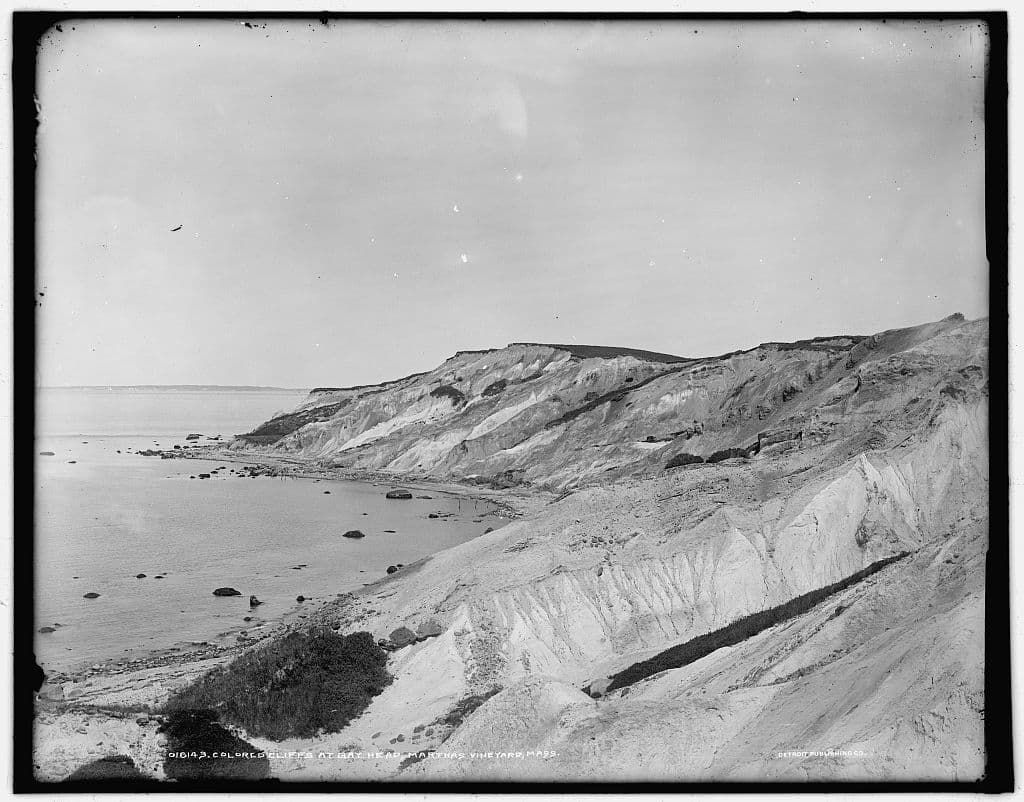
The clay cliffs at Gay Head, now Aquinnah, about 1900. No photograph of the deaf islanders exists. Detroit Publishing Company. Library of Congress.
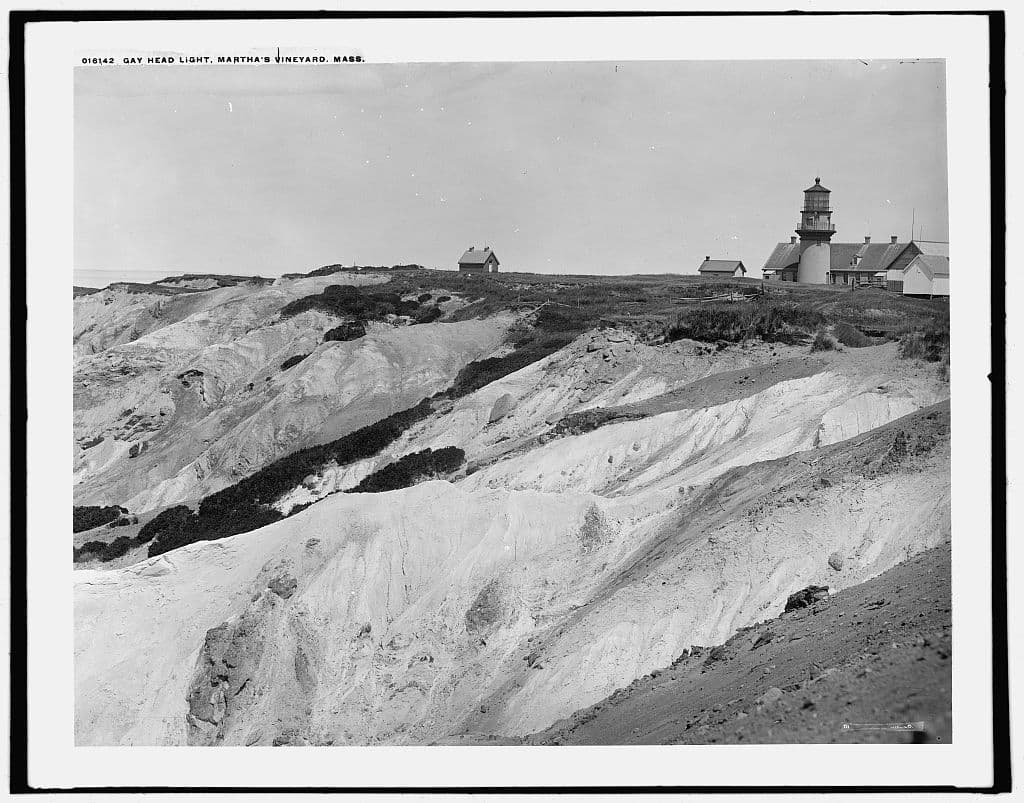
.jpg%2F1280px-Menemsha_Creek%252C_Mass_(62932).jpg&w=3840&q=75)
On this island, for something like two hundred and fifty years, deaf people were not a category. Hearing people signed too, including when there were no deaf people in the room. Hereditary deafness had appeared on Martha's Vineyard by 1714. Jonathan Lambert, a carpenter and farmer who was deaf, had moved there with his hearing wife in 1694 and is the first deaf resident anyone can name. Over the following centuries the rate climbed to something no mainland community came near. The figures are worth setting out exactly, because they are quoted loosely everywhere. In 1854 the island average was about one deaf person in a hundred and fifty-five. The national average at the time was about one in five thousand seven hundred and twenty-eight. In the town of Chilmark it was one in twenty-five. In Squibnocket, a corner of Chilmark with about sixty people in it, one source puts it as high as one in four. Some sources attach the one-in-twenty-five figure to Chilmark and some to Squibnocket, and they cannot both be describing the same place. The genetics are established in outline and thin in detail. The deafness was hereditary and recessive, and it concentrated because people married within a small and geographically isolated community. Beyond that, no source we found names a gene, a locus, or a molecular study. The story everyone tells, that the trait came from families who emigrated in the early seventeenth century from the Weald in Kent, is asserted in every account and documented in none that we could reach. What makes the island remarkable is not the deafness. It is what the island did about it, which was almost nothing, because it did not experience it as a problem to be solved. Hearing children learned to sign in their first years. Adults signed to one another during sermons. Farmers signed across a field. Fishermen signed between boats where a shout would not carry. Children signed behind the schoolteacher's back. Hearing people signed when no deaf person was present, because it was simply one of the ways people there talked. The fishermen had their own vocabulary for the work. Deaf islanders held both skilled and unskilled jobs, earned average or better incomes, and took part in church. In the late nineteenth century sixty-five per cent of marriages involving a deaf islander were deaf-to-hearing, against about twenty per cent on the mainland. We should say what we could not find. No source we reached documents a deaf islander speaking or voting at a town meeting, or holding office, or the pattern of property ownership. Those are the sorts of claims that get made about this place, and the evidence for them was not in front of us. The reputation itself has been questioned. Scholars have called the island a deaf utopia, and Annelies Kusters, writing in the Journal of Deaf Studies and Deaf Education in 2010, went back over the literature and argued that this framing needs more scrutiny than it usually gets. The standard reference is Nora Ellen Groce's Everyone Here Spoke Sign Language, published in 1985. It is a copyrighted book and we have not quoted from it; its central finding, as everyone since restates it, is that because the language was shared, deafness there did not work as a social barrier. The outside world took a different view. Alexander Graham Bell did research on the island, and the Martha's Vineyard Museum's exhibition covers it, though we could not find any source that quotes what he concluded about the place specifically. What he was arguing more broadly is on the record. In November 1883 he read a paper to the National Academy of Sciences called Upon the Formation of a Deaf Variety of the Human Race. He had compiled data showing that deaf parents had deaf children more often than the general population, and he was worried that deaf intermarriage combined with residential schools would produce a separate hereditary deaf people. His answer was oralism and assimilation. He believed sign language imprisoned the person using it. He also refused to support policies limiting the rights of deaf people, and the paper stopped short of advocating marriage restrictions. In 1910 he took the chair of the scientific board of the Eugenics Record Office. All of that is the same man. It ended for ordinary reasons. The American School for the Deaf opened at Hartford in 1817, and island children went there and brought American Sign Language home with them. More of them stayed on the mainland. Roads and tourism brought new families and the recessive trait dispersed. The work changed too: fishing and farming had suited deaf islanders and jobs in tourism did not. The last deaf islander born into the tradition was Katie West, who died in 1952, except in one account where she is Eva West and the year is 1950. Whether the island's sign language fed into American Sign Language is genuinely unsettled, and the disagreement is visible even between two encyclopedia articles: one says the systems merged to become ASL, the other says the island's language was distinct from it. One structural note survives that points away from ASL: islanders used two-handed signs, more like British Sign Language. No study we found quantifies the contribution either way. A few elderly hearing islanders could still produce signs into the 1980s. Eric Cottle, a Chilmark fisherman born in 1917, was recorded demonstrating them in 1994 and again in an oral history in 2000, ten years before he died. Joan Poole Nash began interviewing her own great-grandmother and grandfather with a video camera in 1979, at nineteen. There are no fluent signers left. The Martha's Vineyard Museum mounted an exhibition called They Were Heard in 2023 and put it online in 2026 with the main texts summarised in American Sign Language. There is no historical marker to any of this in Chilmark or West Tisbury; the markers there are about a lighthouse, a legend, a general store, a school bell and a heath hen. The town records are in the Chilmark town clerk's office. The families are still on the island. If you are descended from them, or you know a sign your grandmother used, this is the place to put it. Compiled by MyHistoryStone from the Martha's Vineyard Museum, the Journal of Deaf Studies and Deaf Education, the American School for the Deaf, published accounts of the island's sign language, and the Historical Marker Database. The English-language scholarship on this subject is largely one book, and we have summarised it rather than quoted it.
Share a memory
Leave a memory or a message for the family. What you write appears right away, and the family can remove any entry.
Loading messages...