 Home
HomeCommercial Street
A Tribute to
The Great Molasses Flood
MyHistoryStone Archive
January 15, 1919
Boston, Massachusetts, United States
Hometown
The North End, Boston
Location
Commercial Street
In motion
4 photographs
The photographs on this page, brought to life.
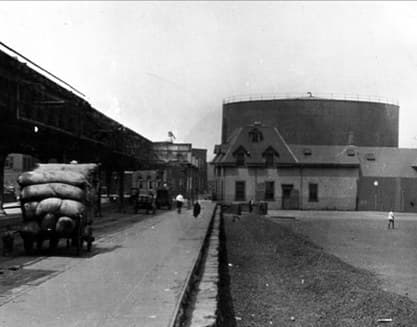
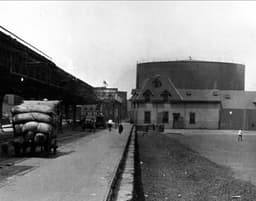
The tank on Commercial Street before it burst, with the elevated railway running past it. The Bostonian Society. Public domain, via Wikimedia Commons.
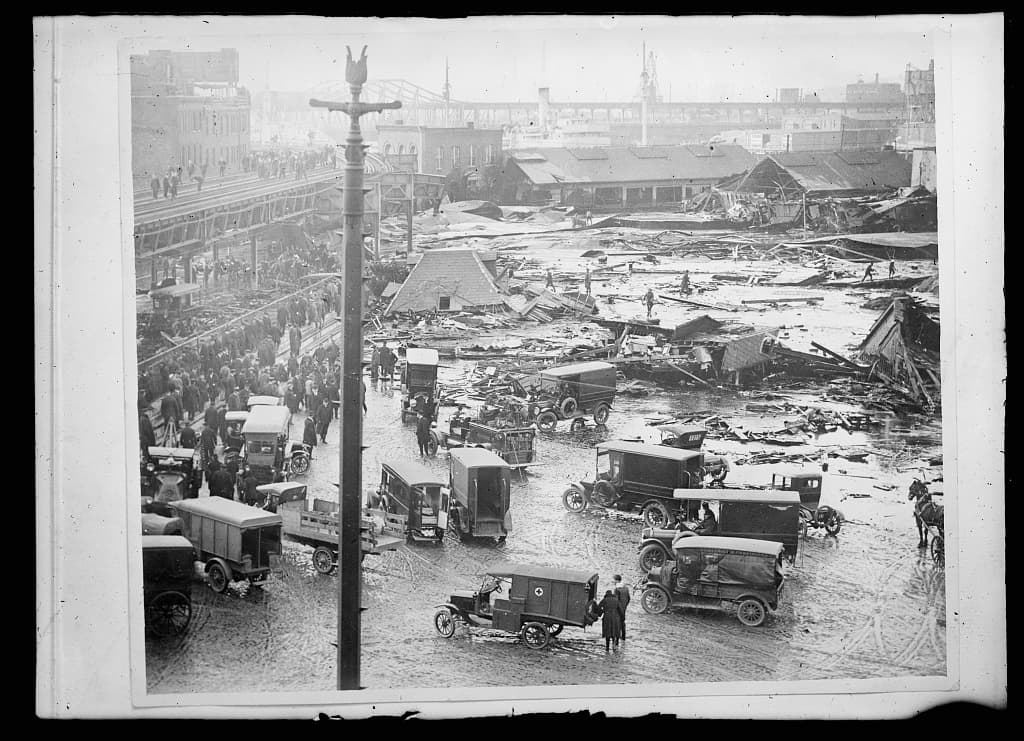
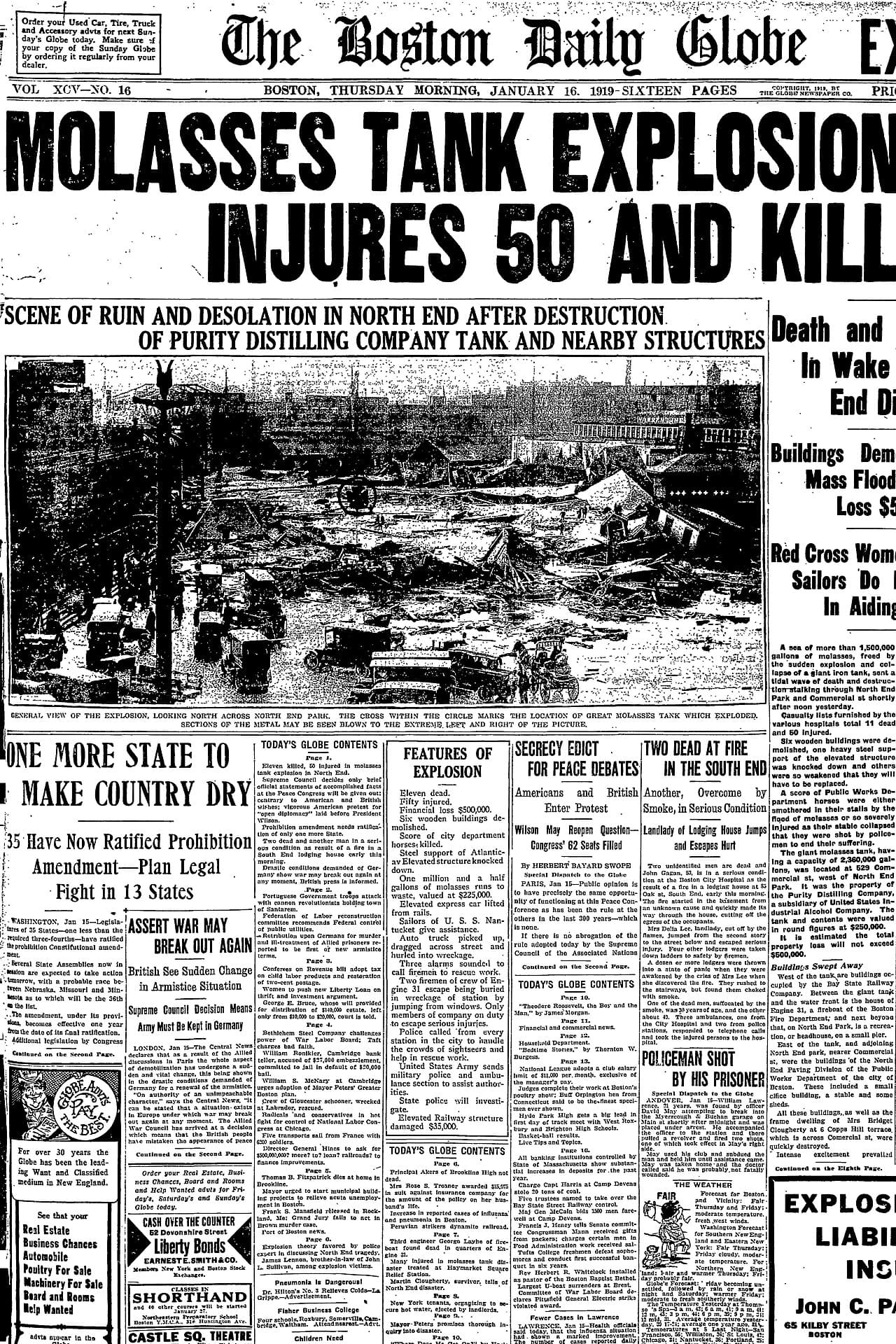
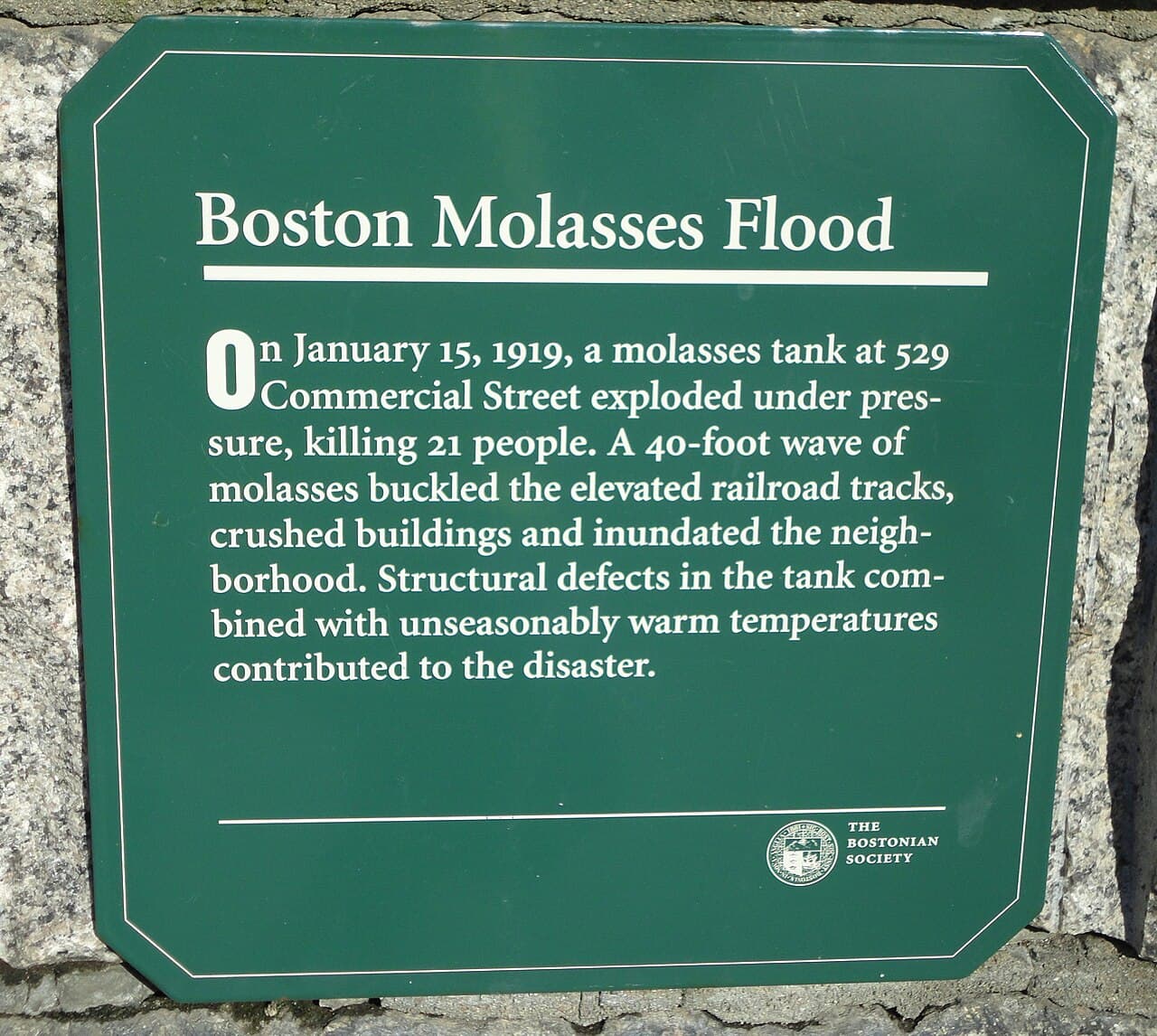
The company said anarchists had blown up the tank. The auditor spent years on it and found the tank had simply been built badly. Just after half past twelve on 15 January 1919, a steel tank on Commercial Street in the North End of Boston burst and let go of everything in it. Twenty-one people were killed and about a hundred and fifty were hurt. Roughly half died in the wave itself, crushed or drowned; the rest died over the following weeks of injuries and infection. Almost every number attached to this is disputed. The tank held two and a quarter million gallons, or about two and a half million. It was fifty feet high and ninety across, or fifty-eight and ninety-eight. The wave was fifteen feet high, or twenty-five, or, according to the plaque now standing at the site, forty. It moved at about thirty-five miles an hour, which is the one figure everyone agrees on. We have not chosen between the rest. The dead have names and most accounts do not print them, so here they are. Patrick Breen, forty-four, a labourer at the North End Paving Yard. William Brogan, sixty-one, a teamster from East Boston. John Callahan, forty-three, a paver. Bridget Clougherty, sixty-five, killed at home on Copps Hill Terrace, and her brother Stephen, thirty-four, who was having lunch with her. Maria Distasio, ten, gathering wood in the yard. William Duffy, fifty-eight, a stone cutter for twenty-one years. Peter Francis, sixty-four, a blacksmith from Charlestown. Flaminio Gallerani, thirty-seven, a driver. Pasquale Iantosca, ten, collecting firewood on his lunch hour from school. James Kinneally, forty-six, a labourer. Eric Laird, seventeen, a driver from Charlestown. George Layhe, thirty-eight, a firefighter, killed in the wreck of the Engine 31 firehouse. James Lennon, sixty-four, a foreman. Ralph Martin, twenty-one, unloading a wagon. James McMullen, forty-six, a foreman. Cesare Nicolo, thirty-two, an expressman, found four months later under Commercial Wharf. Thomas Noonan, forty-three, a longshoreman and a ten-year veteran of the British Army. Peter Shaughnessy, eighteen, a teamster from South Boston, on his first day on the job. John Sieberlich, sixty-nine, a blacksmith who had worked for the city about forty-seven years. Michael Sinnott, seventy-six, a messenger for the Public Works Department. Some of the ages and spellings differ between the city's list and the standard accounts; we have used the Boston list. The tank had been leaking since the first time it was filled in 1915. Neighbourhood children collected what ran out of it. It groaned every time it was loaded. The treasurer who oversaw its construction, Arthur Jell, skipped the basic test of filling it with water to check for leaks. Accounts say the company painted the tank brown so the leaks would not show, which is repeated everywhere and which we could not trace to a primary document; we are printing it as what it is. What failed was the steel. The plates ran from about two-thirds of an inch thick at the base to less than a third at the top, which a later analysis put at roughly half what a tank that size needed even by the standards of the day. The steel was low in manganese, which made it brittle. Its transition temperature may have been as high as fifty-nine degrees, and the tank was operating at about forty. A crack started at a rivet hole above the manhole. Warm molasses had been pumped in two days earlier and had not yet cooled; a 2016 study at Harvard concluded that in spring or summer the same failure might have killed almost nobody, because it was the cold that turned the flood thick and made it impossible to pull people out of. The United States Industrial Alcohol Company said the tank had been bombed. It pointed to a background of Italian anarchist activity and to a telephoned threat in 1918, and argued that someone had dropped a device into a vent. The alcohol the plant produced went into munitions, which was the motive it offered. A court-appointed auditor named Hugh W. Ogden heard the case. He found no sabotage. He found the tank had been built in a very substandard way and the company was liable. The hearings ran three years, or five, or six, depending on the account, with something like a thousand witnesses by one count and three thousand by another, and closing arguments alone took eleven weeks. A hundred and nineteen claims were combined. The company paid six hundred and twenty-eight thousand dollars, or between five hundred thousand and a million, again depending on the source; families of the dead are reported to have received about seven thousand dollars each. It was one of the first class actions in Massachusetts. Afterwards Boston began requiring that engineers file calculations and that architects sign and stamp their drawings, and the practice spread. That is the part of this that is still load-bearing every time anyone puts up a building in America. The site is a ball field now, in Langone Park. In 2019 a ground-penetrating radar survey found a hard reflector half a metre down and placed the tank a few metres from where the 1917 atlas puts it; nobody has dug to check. There is one small plaque, put up by the Bostonian Society, on a granite wall on Commercial Street. It says the tank exploded under pressure, gives the toll as twenty-one, and mentions the structural defects and the warm weather. It does not name anybody. People said for decades that the North End still smelled of molasses on hot days. A gas company meter reader said he could smell it in basements into the early 1960s. Every version of that story is recollection or a journalist's assertion; no source we found documents it. It is a good story and it may well be true, and it is not evidence. If your family was on Commercial Street that day, or worked at the yard, or was one of the hundred and nineteen, this page is where that belongs. Compiled by MyHistoryStone from the Historical Marker Database transcription of the Bostonian Society plaque, the Boston Globe and Boston.com list of the dead, Scientific American, the University of Massachusetts Boston Fiske Center geophysical survey, contemporary engineering post-mortems, and Digital Commonwealth, which holds sixty-three archival items on the flood at the Boston City Archives and the Boston Public Library.
Share a memory
Leave a memory or a message for the family. What you write appears right away, and the family can remove any entry.
Loading messages...