 Home
HomeFair Play
The Story of
The Heart Mountain Relocation Center
MyHistoryStone Archive
1942 – 1945
Park County, Wyoming, United States · 3 years
Neighborhood
Between Cody and Powell
Circa
1942
In motion
4 photographs
The photographs on this page, brought to life.
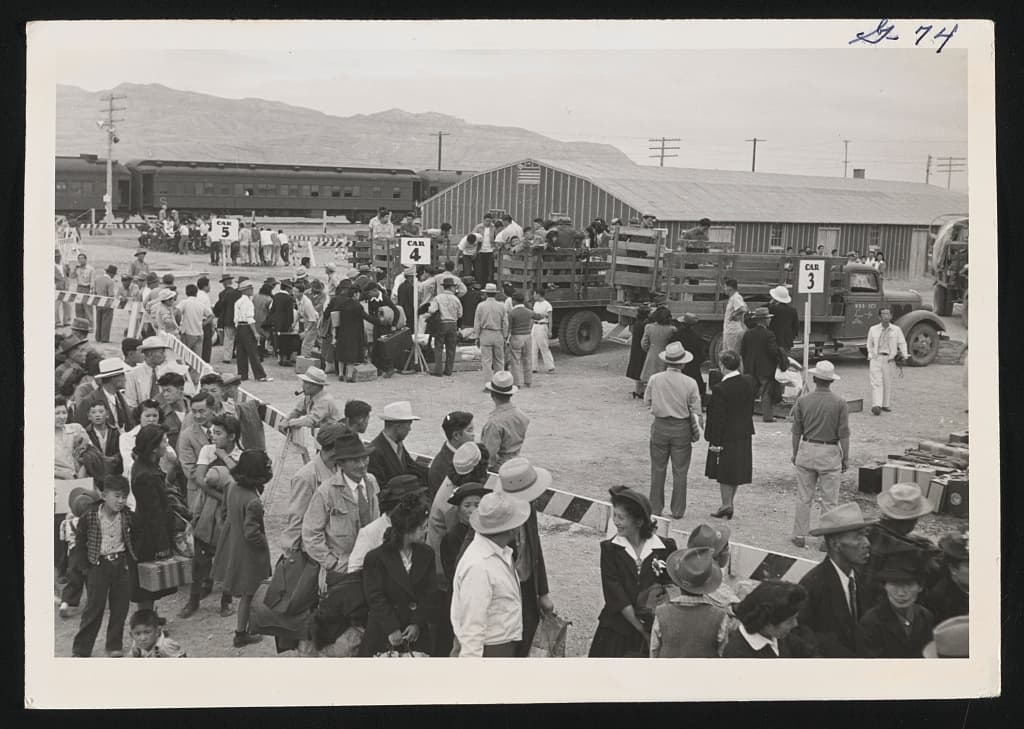
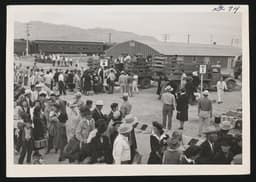
Arriving at Heart Mountain in September 1943, waiting in line to be trucked to the barracks. Bud Aoyama, War Relocation Authority. Library of Congress.
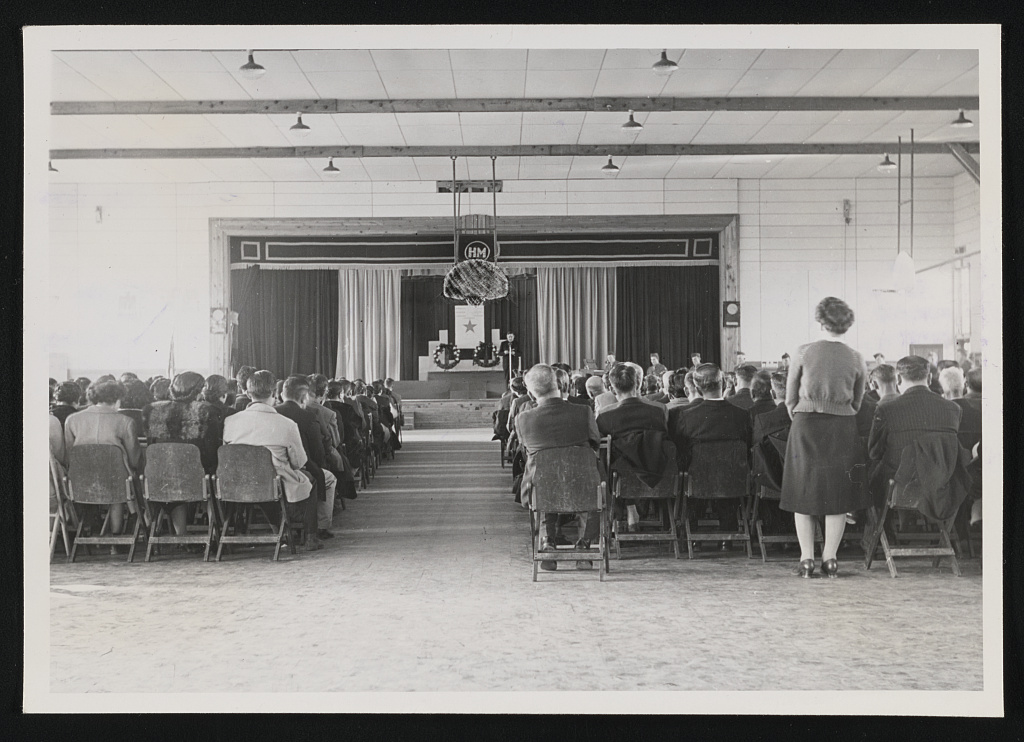
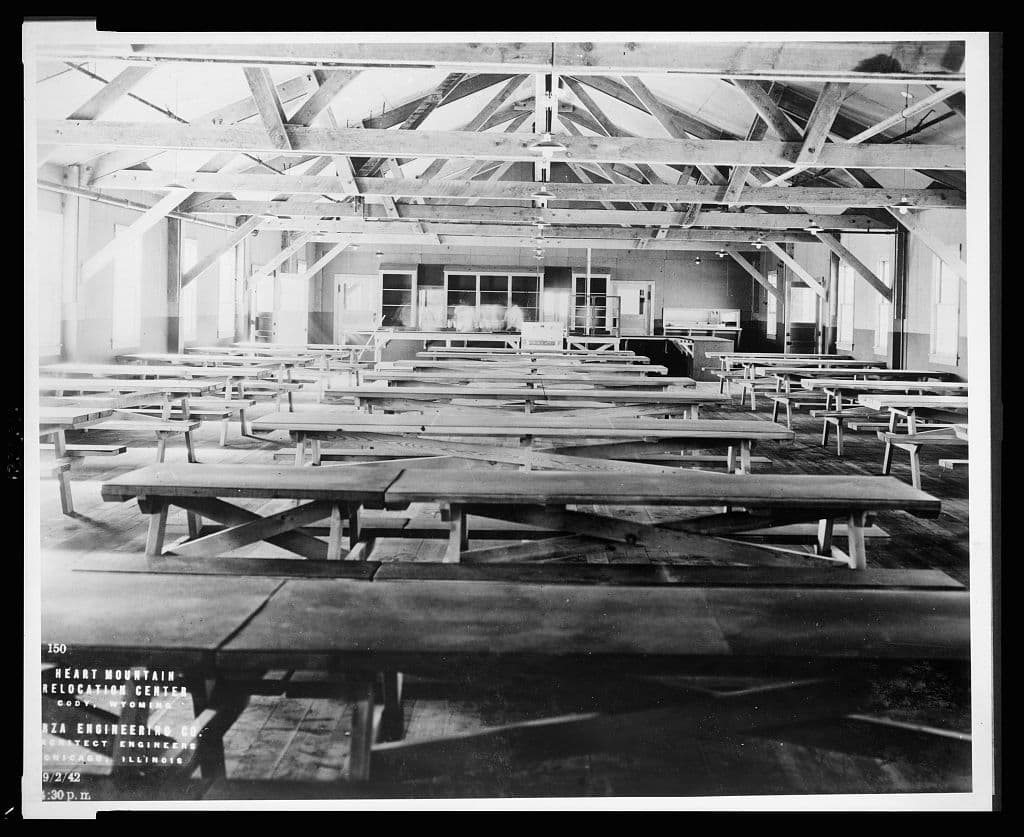
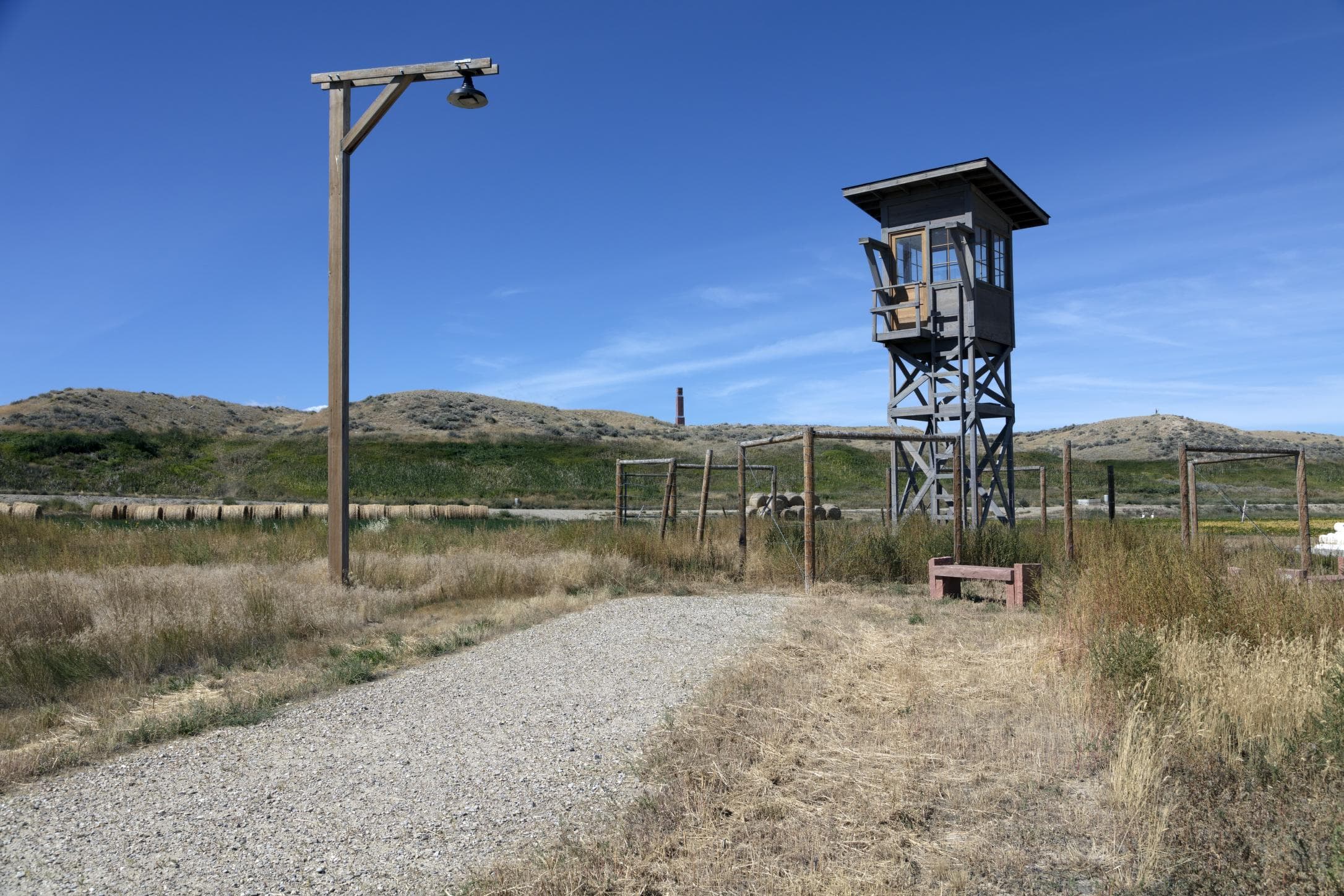
At its fullest it was the third largest city in Wyoming, and nobody in it was allowed to leave. The Heart Mountain Relocation Center opened on 12 August 1942 and closed on 10 November 1945, one thousand one hundred and eighty-seven days later. It sat at forty-seven hundred feet in open sagebrush between Cody and Powell, on land held by the Bureau of Reclamation, forty-six thousand acres in all with about seven hundred and forty of them fenced. The peak population, on 1 January 1943, was 10,767. How many people passed through it altogether is given three different ways by the same institution: the Heart Mountain Wyoming Foundation's history page says about 14,997, its own frequently asked questions say 14,025, and the memorial plaque on the site says 10,700. It was built in sixty-two days for five and a half million dollars by more than twenty-five hundred workers, out of thirteen million board feet of green pine and spruce. The recruitment advertisement said that if you can drive a nail, you can qualify as a carpenter. The builders bragged that a barrack apartment could go up in fifty-eight minutes. When the green lumber dried, gaps of up to half an inch opened between the boards, and the doors and windows would not close. Tar paper covered the outside. Each room had one pot-bellied coal stove and one light fixture. Each person had an army cot, a mattress and two wool blankets. Privacy was a blanket hung on a rope. Winter went to thirty below, and the fire department was sometimes called out in it. There were nine guard towers with searchlights, and the 331st Escort Guard Company, a hundred and twenty-four soldiers and three officers. Nobody left without a written permit. When the perimeter fence went up, three thousand people signed a petition against it, arguing that the fence proved Heart Mountain was a concentration camp and that they were prisoners of war. The train ride from California took about four days and three nights with the shades drawn, nobody allowed to look out, and armed guards in every car. At the Vocation rail siding people got off into open country. Some were heard to say shikata ga nai: it cannot be helped. Then they built things. They finished the Shoshone irrigation canal the Civilian Conservation Corps had started, adding a mile of it and waterproofing sections with eight hundred and fifty tons of bentonite, in time for planting in the spring of 1943. The growing season there averages a hundred and nine days. They raised wheat, barley, celery, corn, peas, radishes, daikon, nappa, potatoes, gobo and melons, and more than a thousand hogs and fifteen thousand chickens, and produced over a million eggs, none of which could be sold outside because outside sales were not permitted. The War Relocation Authority budgeted forty-five cents a day per person for food and spent thirty-two. Afterwards local farmers told them: you people showed us what could be done on this land. The high school had over fifteen hundred students in its first year, a band called the Californians, and a newspaper. Twenty-six white teachers were hired and four incarcerated ones, whose teaching certificates were stamped Valid at Heart Mountain only. The first classes had no desks, no blackboards and few supplies. A permanent school with thirty-nine classrooms opened for 1943-44, its heating system designed by an incarcerated engineer named Tatsu Hori. The classes of 1943, 1944 and 1945 graduated about eight hundred students between them. The school's stated problem, as the site marker puts it, was teaching the tenets of democracy within sight of the guard towers. The hospital had a hundred and fifty beds and opened at the end of August 1942. Incarcerated doctors were paid nineteen dollars a month, an Army private's wage. White nurses were paid a hundred and fifty. Incarcerated nurses were paid sixteen, and aides twelve. In June 1943 a hundred and two hospital employees went on strike for five days. Five hundred and fifty-six babies were born there, or five hundred and sixty-six; the first, William Shigeru Miyatani, arrived on 4 September 1942, an American citizen born behind a fence. In early 1944 the draft was extended to Nisei still held in the camps. Kiyoshi Okamoto, a schoolteacher from Hawaii and an ACLU member who had been calling himself the Fair Play Committee of One, was joined by Frank Emi and Paul Nakadate, and the Heart Mountain Fair Play Committee held its first public meeting on 8 February 1944 with sixty men present. Their position was not refusal of service. It was that citizenship rights be restored first, and then they would comply in full. Emi put it this way: we could either tuck our tails between our legs like dogs or stand up like free men and fight for justice. Eighty-five men refused to report, the highest rate of resistance in any of the ten camps. Sixty-three were tried together in federal court in Cheyenne, the largest mass trial in Wyoming's history, and Judge T. Blake Kennedy sentenced them to three years; the younger men went to McNeil Island and the older ones to Leavenworth. Twenty more were convicted in a second trial in July 1945. Seven leaders were separately convicted of conspiracy, and a federal appeals court threw those convictions out in 1945 on an error in the jury instructions, after which the government did not retry them. James Omura, the English-language editor of the Rocky Shimpo who had printed the committee's statements, was indicted with them and acquitted; whether the jury acquitted him on First Amendment grounds or simply for want of evidence is still argued over. President Truman pardoned all of the resisters in December 1947, on the 23rd or the 24th depending which source you take. At the same time, out of the same camp, more than seven hundred and fifty men and women left to serve in the armed forces, and by some counts more than eight hundred. Fifteen of them were killed: Corporal Yoshiharu Aoyama, Sergeant Robert Farmer, Private First Class Ted Fujioka, Private Stanley K. Hayami, Staff Sergeant Joe Hayashi, Sergeant John S. Kanazawa, Corporal Yasuo Kenmotsu, Private Isamu Kunimatsu, Sergeant George M. Mayeda, Private Jim Nagata, Private First Class Toll Seike, Private First Class William Taketa, Lieutenant Kei Takahashi, Private First Class Fred Yamamoto, and Lieutenant Hitoshi Yonemura. Both of those things were true in the same square mile at the same time. The camp newspaper took a side. The Heart Mountain Sentinel, widely regarded as the best paper produced in any of the camps, called the resisters deluded youths and ran an editorial saying their action was as serious an attack on the integrity of all Nisei as the sneak attack on Pearl Harbor. The words matter here and the sources choose them deliberately. Densho explains that internment is a legal term for the detention of enemy aliens, and that two-thirds of the people held were American citizens, so it uses incarceration instead. It notes that the government of the day called the removal an evacuation, implying the move was a precaution for people's own safety, as in a natural disaster, and that it invented the term non-alien so it would not have to write citizen. The older markers standing on the site still say internee. We have used each source's own words where we quote it. Wyoming passed an alien land law in 1943 that kept former inmates from homesteading the ground they had just made arable. It was not repealed until 2001. The Commission on Wartime Relocation and Internment of Civilians concluded that the whole thing had not been justified by military necessity, and that the decision rested on race prejudice, war hysteria and a failure of political leadership. The Civil Liberties Act of 1988 said so in law and paid twenty thousand dollars to each surviving individual. Four buildings still stand, and one root cellar, on private land. The Honor Roll the inmates built in August 1944 was rebuilt in 2002, because the original list of names did not survive. The interpretive centre opened in August 2011 on fifty acres the foundation bought in 2001. Senator Daniel Inouye spoke at the opening, and the inscription keeps his words as he said them: the work is just starting, and this centre will play an important role in reminding people that interment did happen in this great nation, and if we don't watch ourselves it could happen again. If your family was held here, or served from here, or both, this page is for the names and the photographs that are not in any archive. Compiled by MyHistoryStone from the Densho Encyclopedia and Densho's terminology guide, the Heart Mountain Wyoming Foundation, the National Park Service, the National Archives text of Executive Order 9066, the Civil Liberties Act of 1988 at govinfo.gov, and the interpretive markers on the site as transcribed by the Historical Marker Database.
Add to this story
Know something about The Heart Mountain Relocation Center? Add it here - a memory, a detail, a correction. What you write appears right away, and the page owner can remove any entry.
Loading messages...