 Home
HomeIron Riders

A Tribute to
The 25th Infantry Bicycle Corps
MyHistoryStone Archive
1896 – 1897
Missoula, Montana, United States · 1 year
Hometown
Fort Missoula, Montana
Location
Missoula to St. Louis
In motion
3 photographs
The photographs on this page, brought to life.
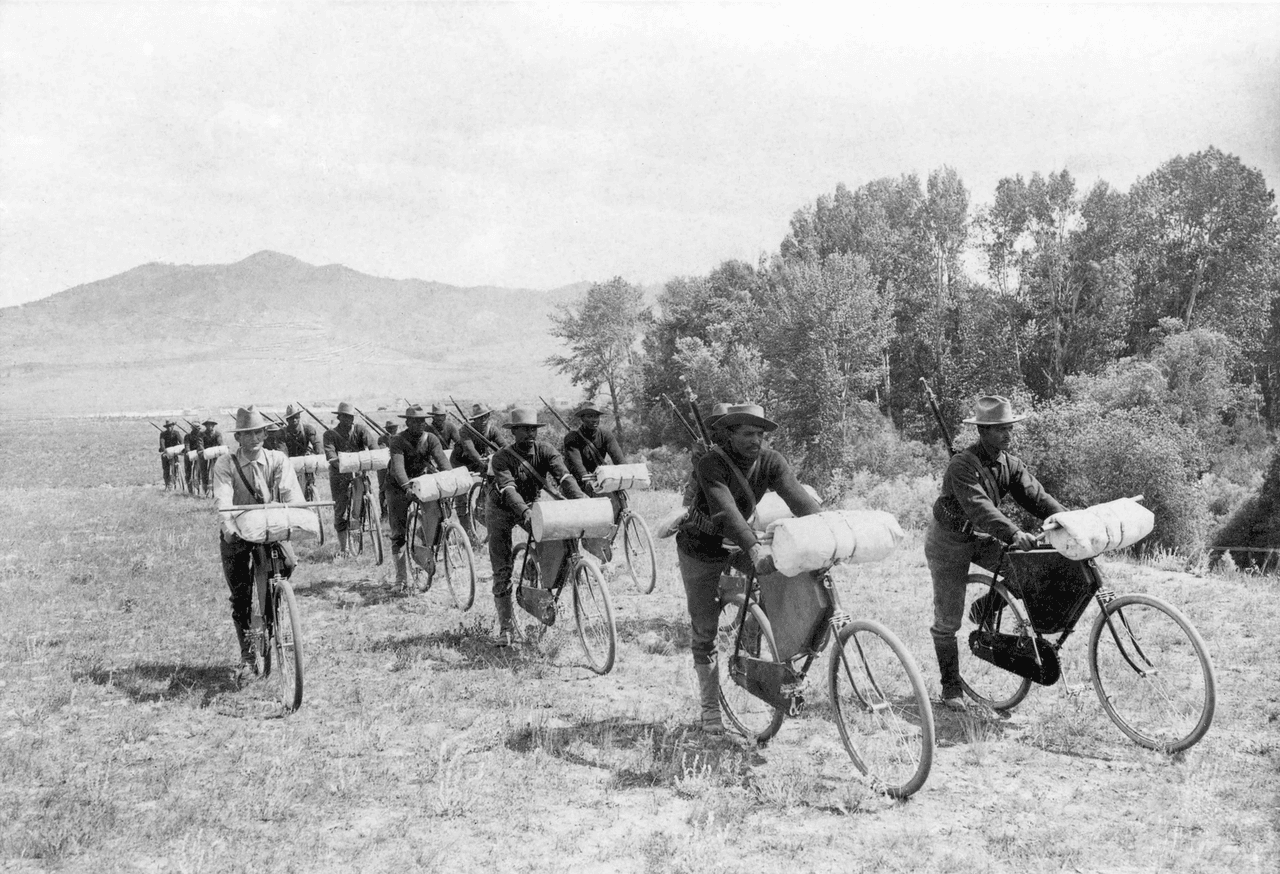
The corps at Fort Missoula in 1897, bedrolls strapped to the handlebars. Moss rides at the left. Mansfield Library Archives, University of Montana. Public domain, via Wikimedia Commons.
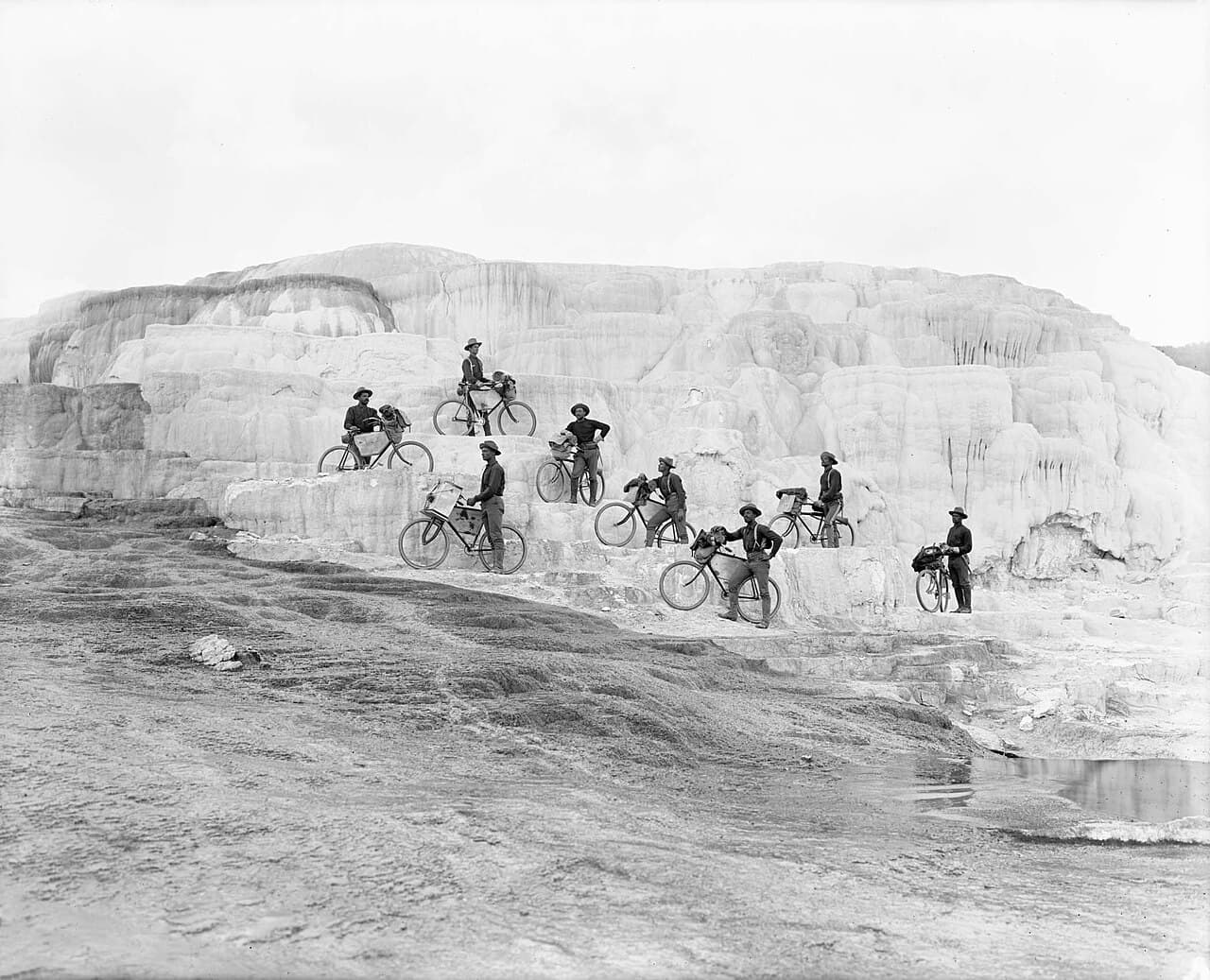
Twenty Black soldiers rode bicycles from Montana to Missouri in 1897 to find out whether the Army should use bicycles. The Army decided it already knew. Lieutenant James A. Moss came out of West Point in 1894 and was assigned to the 25th Infantry, one of the segregated regular Army regiments, at Fort Missoula. He was a keen cyclist. In May 1896 he got permission to form a bicycle corps, the first in the country, with eight enlisted men, and rode it to Yellowstone keeping careful notes on grades, road surfaces and weather. The following summer he proposed something much larger. A.G. Spalding supplied the machines free. They were the company's Military Special: steel rims, tandem spokes, extra-heavy forks and crowns, gear cases, luggage carriers, frame cases, brakes and Christy saddles, thirty-two pounds bare. What they weighed loaded is one of the things nobody agrees on. The Fort Missoula museum says the packed average was fifty-nine pounds. Missouri State Parks says about sixty. Adventure Cycling says seventy-six to eighty. A marker in Laclede, Missouri says a hundred, and asks the reader to imagine it. Each man also carried a rifle and a fifty-round cartridge belt. The personal kit was one blanket, half a shelter tent and the poles, a yard of mosquito netting, one pair of drawers, an undershirt, two pairs of socks, a knife, fork, spoon, cup, tin plate, toothbrush and powder. Rations were flour, baking powder, salt, pepper, dry beans, coffee, sugar, bacon, canned beef and baked beans, cached in advance at hundred-mile intervals, which is why the schedule was fifty miles a day. They left Fort Missoula at half past five in the morning on 14 June 1897 and reached St. Louis on 24 July. How far they went and how long it took depends entirely on the source. The Fort Missoula museum and Missouri State Parks both say nineteen hundred miles in forty-one days. Two historical markers say nineteen hundred miles in forty days. A Department of Transportation marker in Washington says fourteen hundred miles. Adventure Cycling says thirty-four days. The St. Louis Post-Dispatch of 25 July 1897 called it a twenty-two-hundred-mile journey, and Missouri State Parks reprints that line with a bracketed sic attached to it. The daily average is variously forty-six miles and nearly fifty-six. The roads were mostly unusable, so they followed the railroad and rode the ties. Montana was gumbo mud, then blowing sleet and snow at the Continental Divide, then wading the Little Big Horn. Wyoming and South Dakota were a monotonous series of hills with alkali flats and water the log calls abominable. In Nebraska there were a hundred and eighty-five miles of sand they walked, pushing the bicycles, with the thermometer at a hundred and ten in the shade, and the alkali water made men sick. Missouri was bad and hilly, and then the last day was heat and thick river-bottom mud. The men were these. Sergeant Mingo Sanders, thirty-nine, of Marion, South Carolina, acting first sergeant. Lance Corporals William Haynes, thirty-one, and Abram Martin, thirty-six, of Charleston, South Carolina, each commanding a squad. Musician Elias Johnson, twenty-seven, of Washington, D.C. Private John Findley, twenty-three, of Carrollton, Missouri, the corps mechanic, who had worked at the Imperial Bicycle Works. Private Francis Button, twenty-three, of Prince William County, Virginia. Private John H. Cook, twenty-five. Private Hiram Dingman, in his late twenties or early thirties. Private Frank L. Johnson, twenty-four. Private Eugene Jones, thirty-one, of Indiana. Private Samuel A. Reid, twenty-four, of Charlotte, North Carolina, later a schoolteacher and then a supervisor at Immanuel College. Private George Scott, twenty-seven, of Columbus, Ohio. Private Sam Williamson, twenty-four, of Fayette County, Tennessee. Private William Williamson, twenty-six. Private John H. Wilson, thirty-two, of Sprout Springs, Virginia. And Privates Travis Bridges, Elwood Forman, Sam Johnson, William B. Proctor and Richard Rout, for whom the record we consulted gives no birth year at all. With them rode Lieutenant Moss, the assistant post surgeon James M. Kennedy, and a twenty-year-old freelance journalist from Missoula named Edward Boos, whose photographs are now at the University of Montana. Only one man did not finish. Private Eugene Jones was sent back to Fort Missoula from St. Joseph, Missouri, ill. Moss suspected he was pretending. That is Moss's suspicion and the record keeps it as one. What met them in St. Louis is another number that will not settle. Missouri State Parks says a thousand cyclists and a squad of mounted police escorted them through cheering spectators to Forest Park. The National Park Service says more than forty thousand people, organised by the St. Louis Associated Cycling Club. The Post-Dispatch, the following morning, wrote that military cycling had been the rage in Germany and France but nothing approaching this journey had been accomplished. Moss's own conclusion was that the bicycle had been thoroughly tested under all possible conditions except that of being under actual fire. He asked to ride on to San Francisco. Colonel Andrew S. Burt endorsed the request, arguing that it would draw favourable attention to what he called colored soldiers. Permission was withheld. The Spanish-American War was coming, and the Army's answer, as one account puts it, was that everything that needed to be known about bicycles in the military was already known. The corps arrived back at Fort Missoula on 18 or 19 August 1897, by rail, and was disbanded. The bicycles went back to Spalding. How they were treated on the way is where two government sources contradict each other outright. The National Park Service records warm receptions, including from the Tenth Cavalry at Fort Custer and the Ninth Cavalry at Crawford, and describes no racial trouble at all. Missouri State Parks records racism and hostility from residents along the route, and quotes the log: in one instance water sufficient for cooking being refused, and no reliable information regarding the roads could be gained. We have printed both, because both are official and only one of them can be a complete account. Nine years later Mingo Sanders was stationed at Brownsville, Texas, over warnings from white officers that sending Black soldiers to Texas was asking for trouble. After a shooting in the town, he and the rest of the battalion were dishonorably discharged without a hearing. John H. Cook, who had ridden with him from Missoula to St. Louis, was discharged too. Both were exonerated in 1972. Sanders was pardoned posthumously. In 1974 Miriam Martin and seven other students from the University of Montana's African-American Studies programme rode the route, seventy-seven years later. In 2010 a Wyoming middle-school history teacher rode it in twenty-eight days with his mother driving support. In 2022, for the hundred and twenty-fifth anniversary, Erick Cedeño rode it again. If you are descended from one of these twenty men, or you can fill in a birth year the records lost, this page is where it should go. Compiled by MyHistoryStone from the Historical Museum at Fort Missoula, Missouri State Parks, the National Park Service, Adventure Cycling Association, the Montana Historical Society and Department of Transportation markers transcribed by the Historical Marker Database, and the St. Louis Post-Dispatch of 25 July 1897 as quoted by Missouri State Parks.
Share a memory
Leave a memory or a message for the family. What you write appears right away, and the family can remove any entry.
Loading messages...