 Home
HomePlacing Out
The Story of
The Orphan Trains
MyHistoryStone Archive
1854 – 1929
New York, New York, United States · 75 years
Hometown
New York City
In motion
4 photographs
The photographs on this page, brought to life.
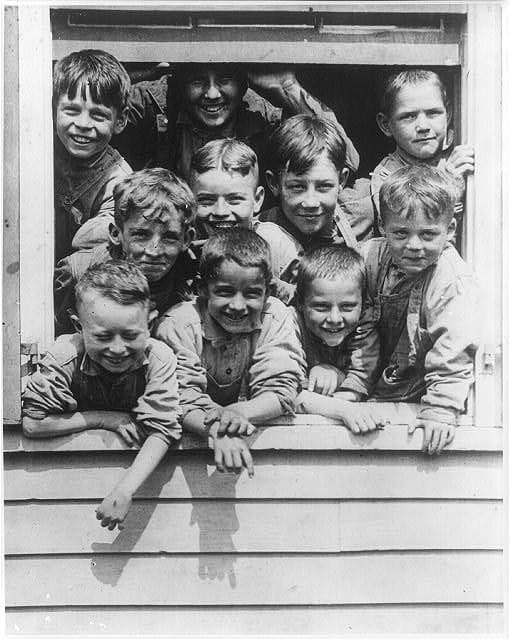
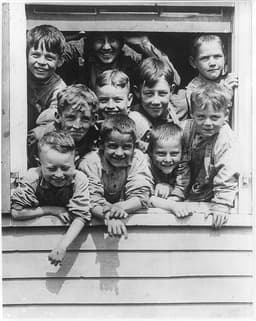
Boys at a window of the Children's Aid Society, about 1890. Jacob A. Riis. Library of Congress.
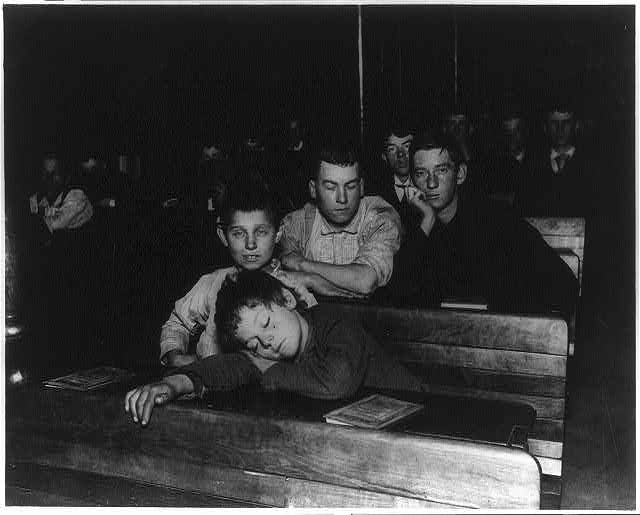
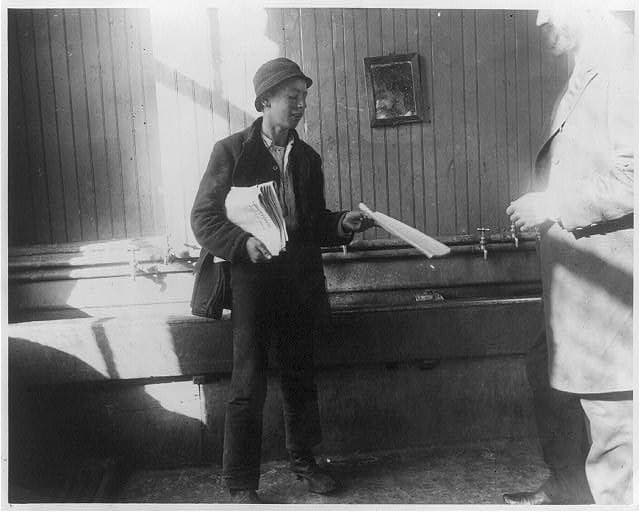
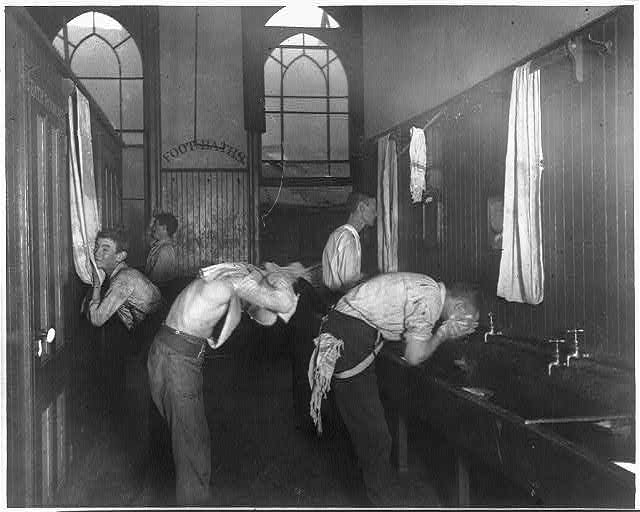
Fewer than half of them were orphans. Nobody agrees how many children there were, either. Charles Loring Brace was a Connecticut minister who came back from a tour of European institutions in 1851, went to work in the Five Points, and in 1853 helped found the Children's Aid Society. He believed the answer to the children he saw in the streets of New York was to put them on trains. "The best of all asylums for the outcast child is the farmer's home," he wrote. "The great duty is to get these children of unhappy fortune utterly out of their surroundings and to send them away to kind Christian homes in the country." He also wrote this, in the same book, in 1872: "Let but Law lift its hand from them for a season, and we should see an explosion from this class which might leave this city in ashes and blood." The book is called The Dangerous Classes of New York. Both sentences are his, and a page about the orphan trains that quotes only the first one is not telling you what the man thought he was doing. The totals are all over the map. PBS says over one hundred thousand children. Children's Aid, the organisation that ran it and still exists, says more than one hundred and twenty thousand. Most reference works say an estimated two hundred thousand. The National Orphan Train Complex and its markers say two hundred and fifty thousand. PBS also notes that the programme itself boasted of a hundred and fifty thousand, which is a different kind of number again. We have not picked one. A placement worked like this, where sources describe it. Handbills went ahead announcing that children were coming. The children travelled in groups of six to a hundred and fifty, three or four days, sleeping in their seats. At the destination they were cleaned up and put on a stage in a hall, or lined up on the station platform. Families arrived having already decided what they wanted, sometimes with an order for a particular age, sex, and colour of hair and eyes. A historian quoted by the standard account describes people coming along and prodding them, looking, feeling, and seeing how many teeth they had; that is a historian's characterisation drawn from accounts, not a document, and it should be read as one. The phrase up for adoption is said to come from the stage. Local committees of prominent citizens were supposed to screen the families. Placement was on trial and did not require legal adoption. The word orphan was doing a lot of work. Fewer than half the riders had lost both parents, and as many as a quarter had two living ones. George Barney of Cold Brook, New York was widowed and destitute and could not manage; in February 1904 he handed four of his six children to the Children's Aid Society, and by 10 March Elmer, Ethel, Alta and Edgar were on their way to Iowa. Nellie Nolan was an unwed Irish teenager who lived at the New York Foundling with her sons Michael and Walter and worked there; after she left, the boys were placed out. What happened next depends on which account you read, and the honest thing is that both are true of different children. A survey in 1910 concluded that eighty-seven per cent of the children sent to country homes had done well. An independent investigation in 1883 found that most children under fourteen were leading satisfactory lives, and in the same breath found that the local committees were ineffective at screening families and the supervision was lax. There were only a handful of agents for thousands of placements. A marker in Atkinson, Nebraska puts the whole argument in one sentence: some were treated as valued members of their new families; others were taken in as unpaid labourers and were treated as slaves. The legal instrument was often indenture rather than adoption, and the museum in Concordia explains the difference plainly: an adopted child inherits like a natural child, and an indentured one does not. Michael and Walter Nolan left Grand Central on 28 November 1916, aged eight and six, and reached Maple Lake, Minnesota on Thanksgiving Day. They were indentured to a family in the Bronx and returned to the Foundling after six months. They were indentured a second time and removed after a year because of severe physical abuse. The third family, Henry and Catherine Baumgartner of Osseo, Minnesota, kept them. Siblings were meant to be kept together and often were not. The three Clement brothers went to Clarksville, Texas in 1926 and were taken by three different families; Gerald was two, Leo was six, and nine-year-old Alton Lou went to the third family who tried him in his first week and became Lee Nailling. Their new families kept them in touch and they spent their summers together. All three served in the Army in the Second World War, and Gerald was one of 1,770 American prisoners killed when an American submarine torpedoed the Japanese ship carrying them. In 1984 Lee and Leo were reunited with their older brother Ross and their younger brother George, fifty-eight years after the train. It ended because the law caught up and the demand ran out. Michigan passed a statute in 1895 requiring a bond against out-of-state children becoming a public charge; Indiana, Illinois, Kansas, Minnesota, Missouri and Nebraska followed. The West filled up. Charities began funding families to keep their children rather than moving the children. The last three boys went to Texas on 31 May 1929. The National Orphan Train Complex in Concordia, Kansas holds a registry with information on more than eight thousand riders, most of it given by the riders themselves or by their descendants, and it will search a name at no charge. There are more than fifty markers across the country, most of them memorials to one rider with that rider's story on them, and statues in Concordia of individual children who were real. One of the markers claims that one American in twenty-five is descended from an orphan train rider. It attributes this to modern-day research and does not name the research, and we could not find it. Irma Craig was placed at Osage City, Missouri in 1901 by the New York Foundling. Her first family broke up when Mrs Boehm died and Mr Boehm decided he could not keep her; the neighbours took her, and she said later that the second home was even better than the first. She began teaching at Moreau Bend School in 1918, married in 1922, and had eight children. Her daughter Shirley Andrews helped found the Orphan Train Heritage Society and has spent years collecting other riders' histories for other people's families. That is what this page is for. If you are descended from a rider, or you have a photograph, a name change, a train date, or the story your grandmother would not tell, put it here. Compiled by MyHistoryStone from the National Orphan Train Complex at Concordia, Kansas, Children's Aid of New York, the VCU Social Welfare History Project, PBS American Experience, the Louisiana Orphan Train Museum at Opelousas, Charles Loring Brace's The Dangerous Classes of New York (1872), and the rider memorial markers indexed by the Historical Marker Database.
Share a memory
Leave a memory or a message for the family. What you write appears right away, and the family can remove any entry.
Loading messages...