 Home
Home
A Tribute to
The Homestake Mine
MyHistoryStone Archive
1876 – 2002
Lead, South Dakota, United States · 126 years
Location
Lead, South Dakota
Worked At
The Black Hills
In motion
5 photographs
The photographs on this page, brought to life.
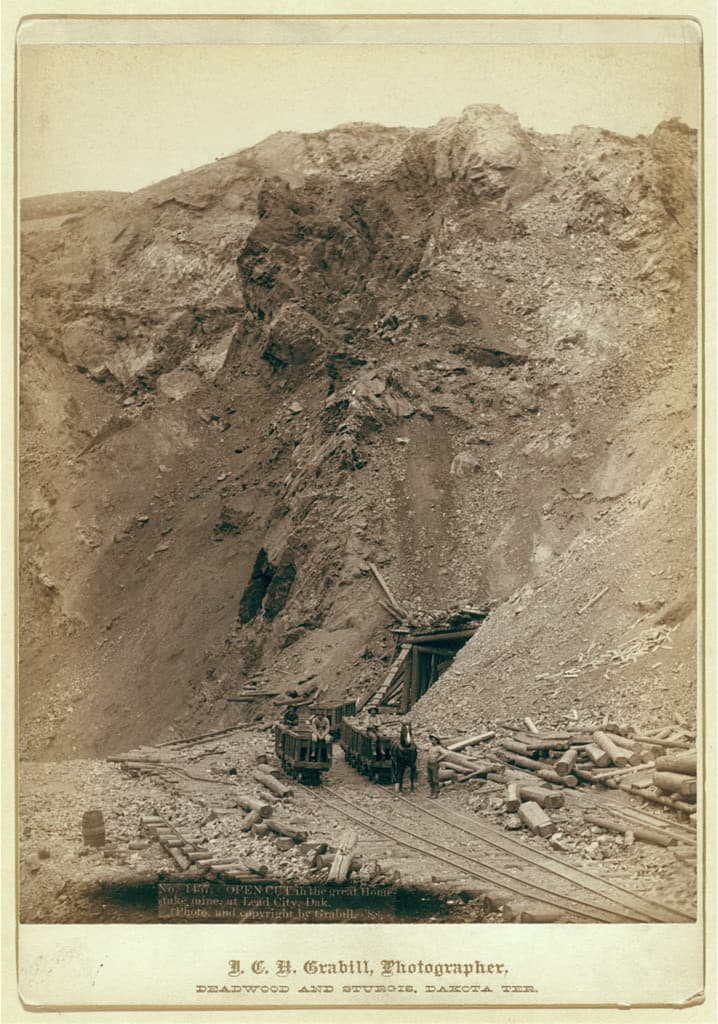
The open cut at the Homestake mine, Lead, Dakota Territory, 1888. John C. H. Grabill. Library of Congress.
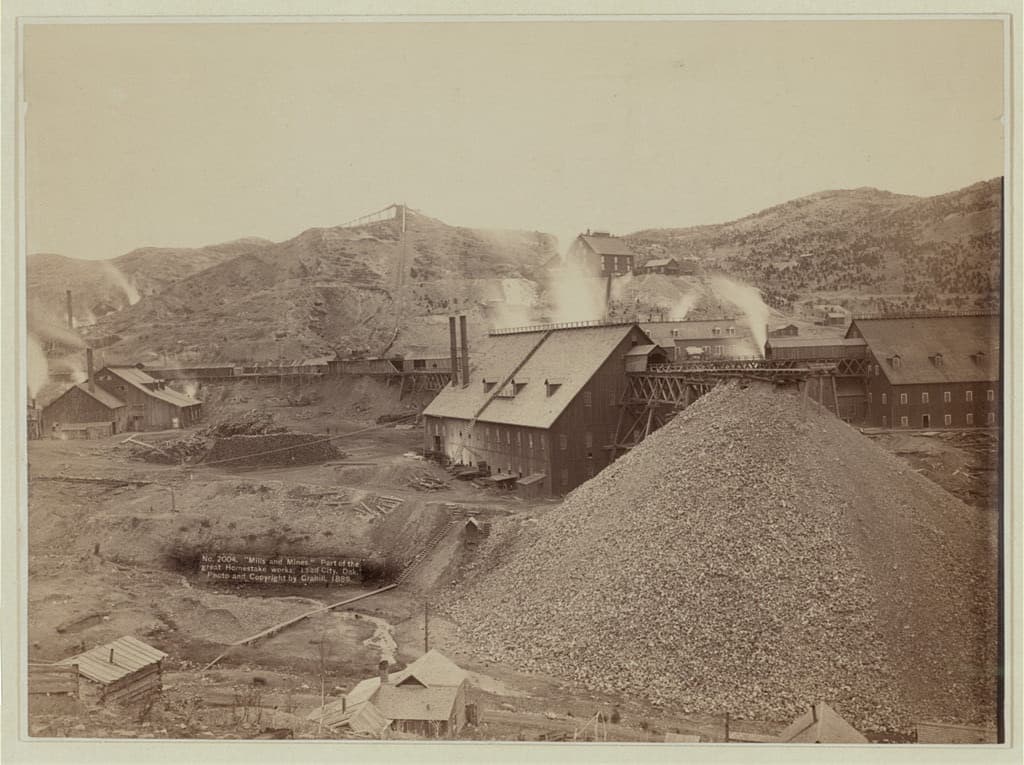
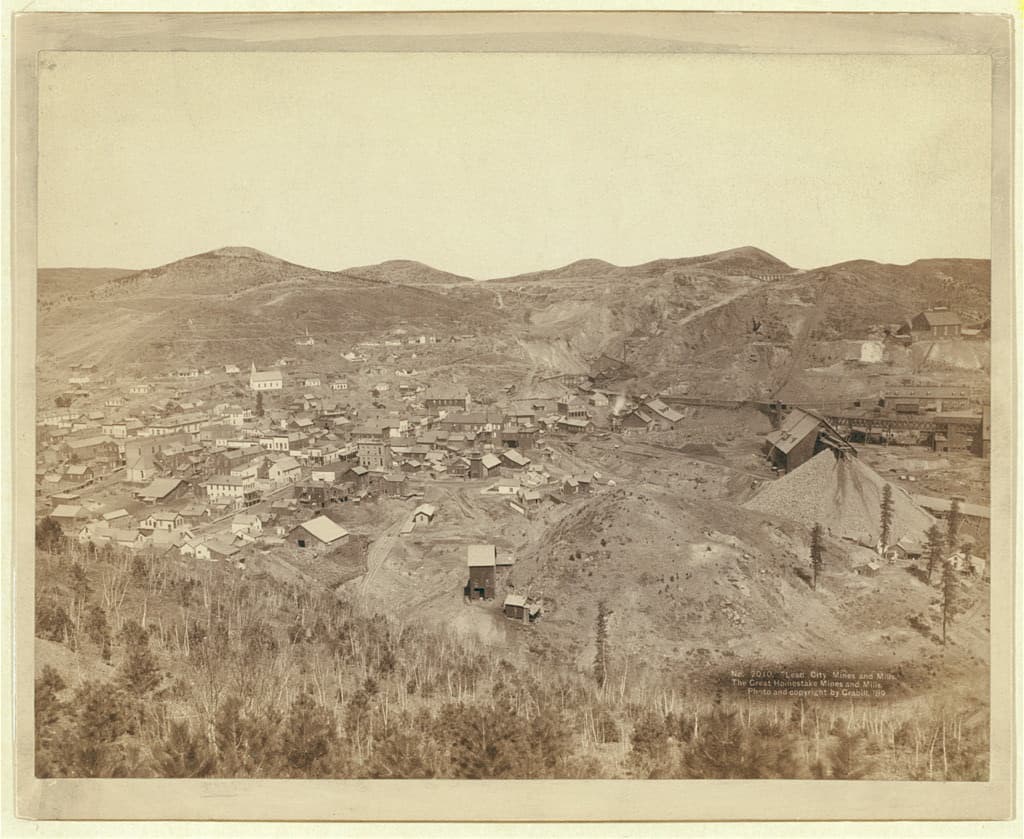
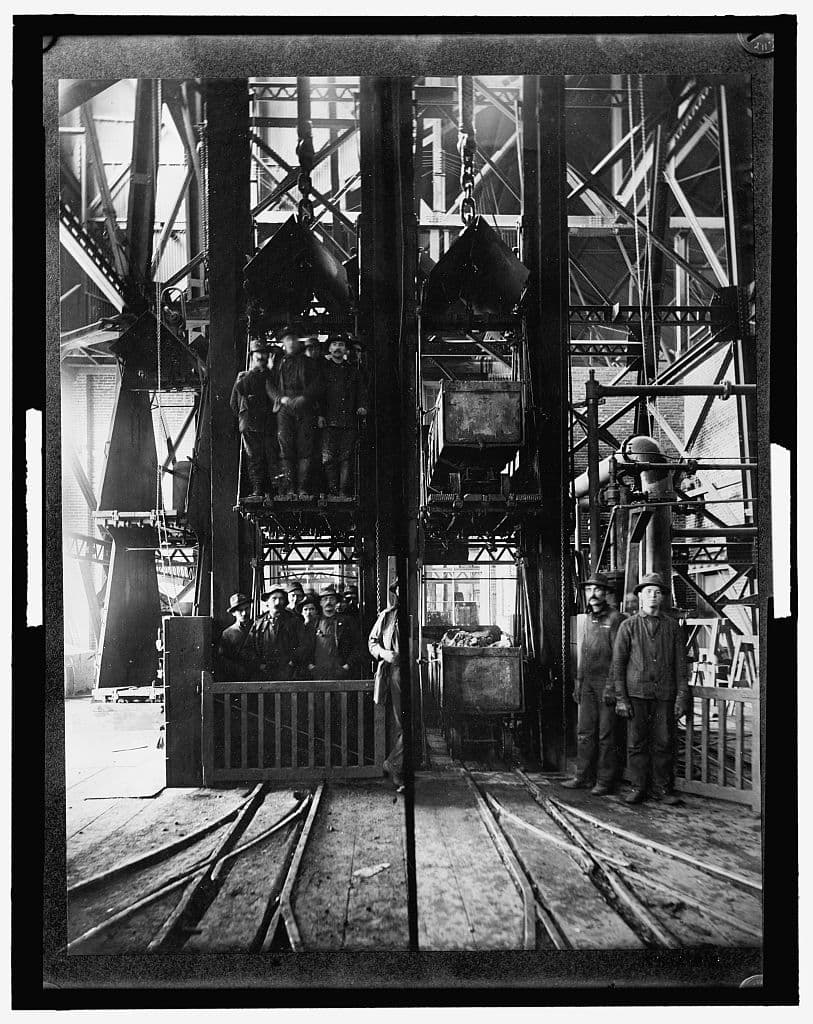
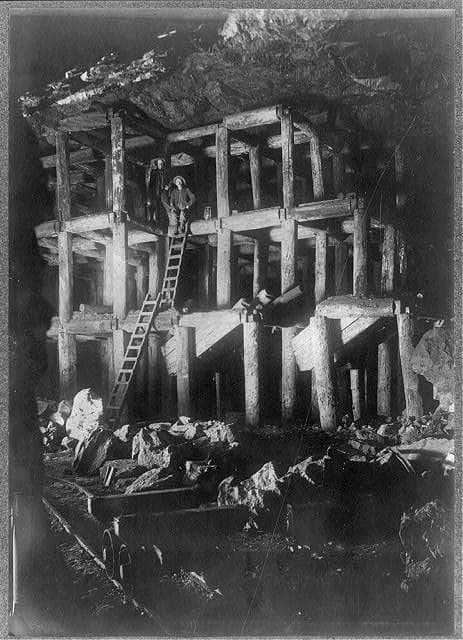
They dug a mile and a half down for gold. Then somebody filled a tank at the bottom with dry-cleaning fluid and started catching neutrinos from the sun. Moses and Fred Manuel and Hank Harney located the claim on 9 April 1876, in the Black Hills, months after the rush began. The name meant what it says: a homestake was enough money to go home on. In 1877 they sold it to a San Francisco syndicate, George Hearst and his partners Lloyd Tevis and James Ben Ali Haggin, for $70,000. The Homestake Mining Company was incorporated on 5 November 1877 and listed on the New York Stock Exchange in January 1879, the first mining stock ever listed there and in the end the longest-listed stock in its history. It ran for a hundred and twenty-five years. How much gold came out is given as 39.8 million troy ounces, as "almost forty million," as "over 40 million," and as about 41 million, depending on who is counting, the last figure from the organisation that occupies the site today. The ore was poor and the scale made up for it: about three tenths of an ounce of gold to the ton, roughly 2,500 tons of rock for a single 400-ounce bar. The workings ran to 370 miles of tunnel, or 400, and reached 8,000 feet. Lead was the second-largest town in South Dakota by 1900, with Cornish, Irish, Italian, Finnish, Slovak, Austrian and Hungarian miners, and a couple of blocks south of Main Street called Slavonian Alley where, in the week between Christmas and New Year, the households kept open house with ham, strudel and wine made from grapes shipped in by ice-packed railcar. The union arrived in 1877 and joined the Western Federation of Miners in 1893. By late 1909 it claimed 98 percent of the workforce. On 17 November that year the superintendent, Thomas Grier, announced that the company would employ only non-union men after the first of January, and on 24 November at six in the evening he locked the mine. To be re-hired a man had to sign a card: "I am not a member of any labor union and in consideration of my being employed by the Homestake Mining Company agree that I will not become such while in its service." About a thousand men renounced their membership by March. The union's charter was cancelled in 1915, and unions did not come back to Black Hills gold until the 1960s. There is a memorial in Lead to Thomas Grier, paid for by Homestake employees. The mine closed at the end of 2001. Gold was cheap, the ore was poor, and keeping the water out was costing a quarter of a million dollars a month. On 10 June 2003 they turned the pumps off and the mine began to fill at about 750 gallons a minute. Here is the turn in the story. In 1965 a chemist named Raymond Davis Jr. had installed a tank on the 4,850-foot level: a hundred thousand gallons, about 615 tonnes of perchloroethylene, ordinary dry-cleaning fluid, chosen because it is full of chlorine. The tank was built in sections, lowered down the Yates shaft and welded back together underground. A mile of rock overhead screened out everything except neutrinos, and very occasionally a neutrino from the core of the sun would turn one of those chlorine atoms into an atom of argon. Davis's job was to find the argon. Theory said about twenty atoms a month. He found roughly a third of that. That shortfall is the solar neutrino problem and it stood for thirty years. Davis was not wrong and the theory was not wrong. Neutrinos change flavour on the way here, and his detector could only see one of the three kinds. Over three decades he captured about two thousand of them, one atom at a time, at the bottom of a gold mine. He was given a share of the 2002 Nobel Prize in Physics at the age of eighty-eight, "for pioneering contributions to astrophysics, in particular for the detection of cosmic neutrinos." The pumps came back on in April 2008. The mine is now the Sanford Underground Research Facility. T. Denny Sanford gave $70 million, the state put in its own money, and the 4,850 level is the deepest laboratory in the United States. They are hunting dark matter down there now, and building a detector for a neutrino beam fired eight hundred miles through the earth from Illinois. A section of Davis's tank stands on Main Street in Lead as a monument. There is another memorial in town to the men and women who died in the mine between 1876 and 2001. We could not find out how many that was. No source we could reach gives a number. If your family worked the Homestake, you know things the markers do not. Put them here. Compiled by MyHistoryStone from the Sanford Underground Research Facility, the Nobel Foundation, South Dakota History (David B. Miller on the lockout of 1909-1910), the Deadwood History archives, and the historical markers at Lead.
Add to this story
Know something about The Homestake Mine? Add it here - a memory, a detail, a correction. What you write appears right away, and the page owner can remove any entry.
Loading messages...