 Home
Home
A Tribute to
Dockery Farms
MyHistoryStone Archive
1895 – 1982
Sunflower County, Mississippi, United States · 87 years
Location
Sunflower County
Worked At
Dockery, Mississippi
In motion
2 photographs
The photographs on this page, brought to life.

Dockery Farms, the sign naming Will Dockery 1895 to 1936 and Joe Rice Dockery after him. The old perfesser, CC BY-SA 3.0, via Wikimedia Commons.
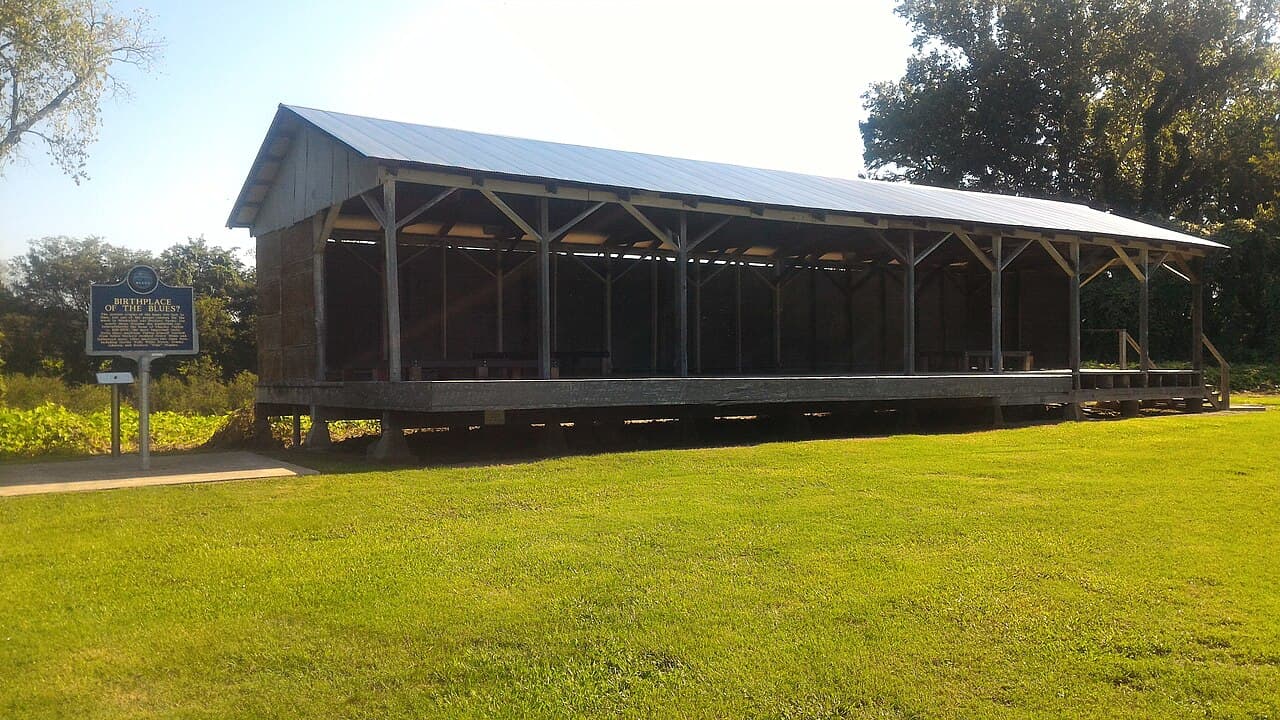
The sign on the seed house says Dockery Farms, Est. 1895. The Mississippi Blues Trail marker in front of it asks a question: Birthplace of the Blues? The question mark is on the marker. That is unusual, and it is the most honest thing about this place. Will Dockery bought thousands of acres on the Sunflower River in 1895 and spent years clearing swamp to grow cotton. How much land is not agreed. The Mississippi Encyclopedia says about ten thousand acres, Wikipedia says 25,600, the National Register nomination says over six thousand, and the farm's own foundation says forty square miles. At its height about four hundred families lived here and something over two thousand people worked it. It was effectively a town. The Blues Trail marker lists what it had: an elementary school, churches, post and telegraph offices, its own currency, a resident doctor, a railroad depot, a ferry, a blacksmith shop, a cotton gin, cemeteries, picnic grounds for the workers, and a commissary selling dry goods, furniture and groceries. The rail spur running west from here was so crooked they called it the Pea Vine, and Charley Patton wrote a song with that name. Whether Dockery treated its people better than its neighbours is asserted by everyone and evidenced by almost nobody. The National Register nomination says the farm "did not rely on sharecropping, but rather paid its laborers," quoting a case summary written to support the listing. The Blues Trail marker calls them four hundred tenant families, which is not the same arrangement at all. Robert Palmer wrote in 1981 that Will Dockery "wasn't interested in tricking them out of their wages." Every version of the claim traces back to Palmer or to the foundation that owns the site. We could find no first-person account from anybody who worked here, and no dissenting assessment whatever. The one hard fact pointing the other way is that Patton was thrown off the place three times, the last in 1930, and sang about being banished by the plantation manager. Charley Patton came here as a boy with his family, in 1897 or by 1902 depending on which source you take, and it was his base for most of his life. His birth year is not settled either. It is usually given as April 1891, but 1881, 1885 and 1887 have all been proposed, and the state's own marker at his birthplace concedes that "debates continue over details of Patton's life, death and music, even the spelling of his name." He learned from another Dockery man, Henry Sloan. He played on the porch of the commissary and at the all-night picnics Will Dockery put on for the residents. He recorded from 1929, for Paramount and then for Vocalion in New York in 1934. He died on 28 April 1934 of a mitral valve disorder and is buried at Holly Ridge. Now the claim on the sign. B. B. King is quoted saying "You might say it all started right here," and the line is real, but the federal nomination that records it also says where he said it: narrating a documentary film in 1978. It was written for him by the film's writers. The scholarship is more careful, and the most striking source is the man who writes the Blues Trail markers himself. Scott Barretta, in the Mississippi Encyclopedia, writes that Mississippi's claim to be the birthplace "derives from the oppressive sociopolitical conditions that shaped the music's development" and from the number of Mississippi-born recording artists, and that "there is scant evidence, however, to support the music's genesis here rather than in other areas of the South." There is a plain chronological problem too. A Harvard archaeologist wrote down blues lyrics near Clarksdale in 1901, and W. C. Handy heard the music at Tutwiler around 1903, while the Dockery marker dates Patton's own influence to "by around 1910." The list of names on the marker does not survive close reading either. Henry Sloan and Charley Patton are documented here by several independent sources. Willie Brown, Tommy Johnson and Pops Staples are documented in the neighbourhood, at Drew, which is next door and is a different claim. Son House met Patton at Lula, after Patton had been thrown off Dockery. The two best sources on Howlin' Wolf put him at the Young and Morrow place near Ruleville, and the official Blues Trail marker for Wolf does not mention Dockery at all. Robert Johnson's only connection to this ground is the crossroads legend. What is left when the legend comes out is still remarkable, and it is enough. This is a place where a documented teaching line ran from one man to another and out into the world, on a farm with its own money and its own railroad, in years when nobody was writing any of it down. The buildings are still standing. The seed house with its eight trap doors, the gin with its original Murray machinery, the service station with its glass counters and its scale, and the concrete porch of the commissary Patton played on. Listed on the National Register in 2006. The foundation puts on concerts in the cotton shed. Four hundred families lived here. Two of their names are on the marker. If you carry one of the others, it belongs here. Compiled by MyHistoryStone from the Mississippi Encyclopedia, the Mississippi Blues Trail, the National Register nomination for the Dockery Farms Historic District (2006), the Dockery Farms Foundation, and Robert Palmer's Deep Blues.
Add to this story
Know something about Dockery Farms? Add it here - a memory, a detail, a correction. What you write appears right away, and the page owner can remove any entry.
Loading messages...