 Home
Home
A Tribute to
The Cherry Mine Disaster
MyHistoryStone Archive
1909
Cherry, Illinois, United States
Final Resting Place
Cherry, Illinois
In motion
3 photographs
The photographs on this page, brought to life.
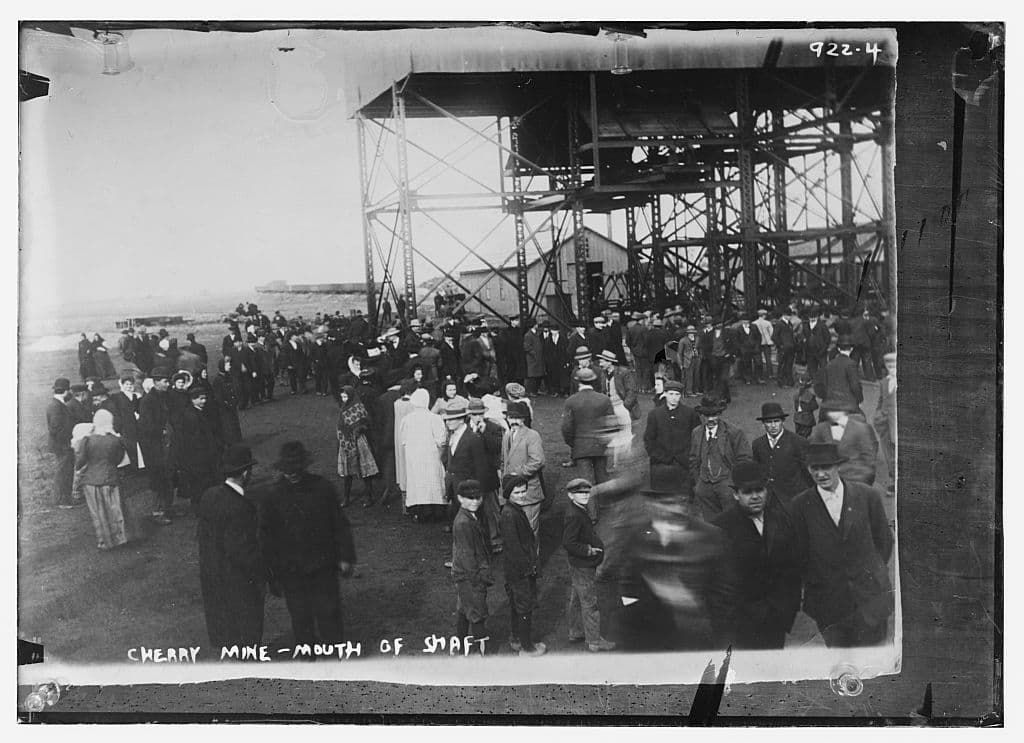
The crowd at the mouth of the shaft. The negative is captioned Cherry Mine. Bain News Service. Library of Congress.
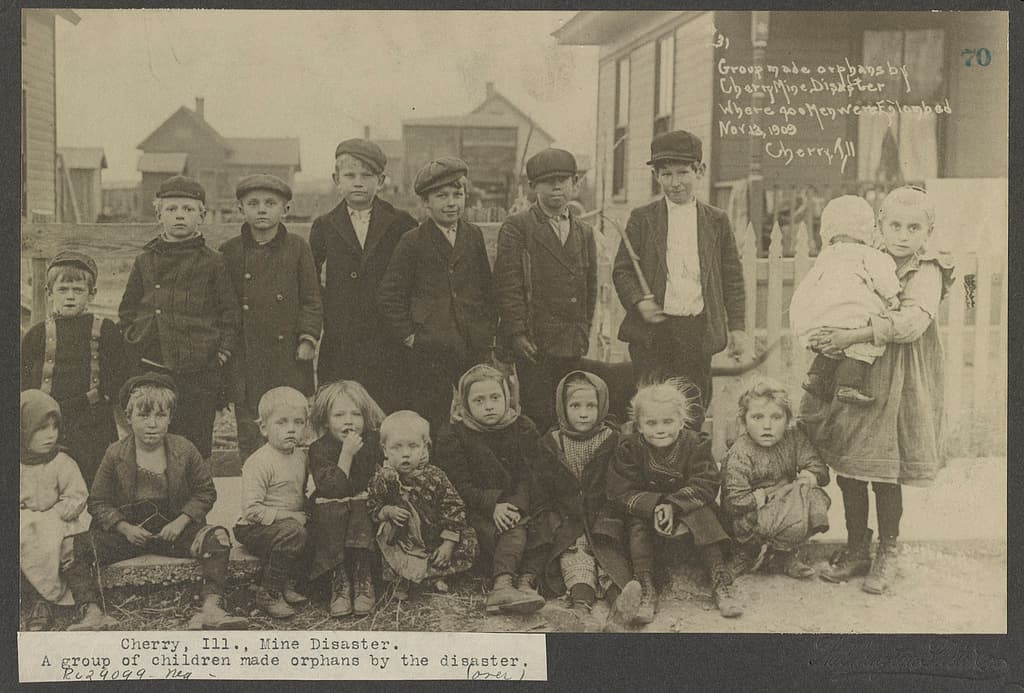
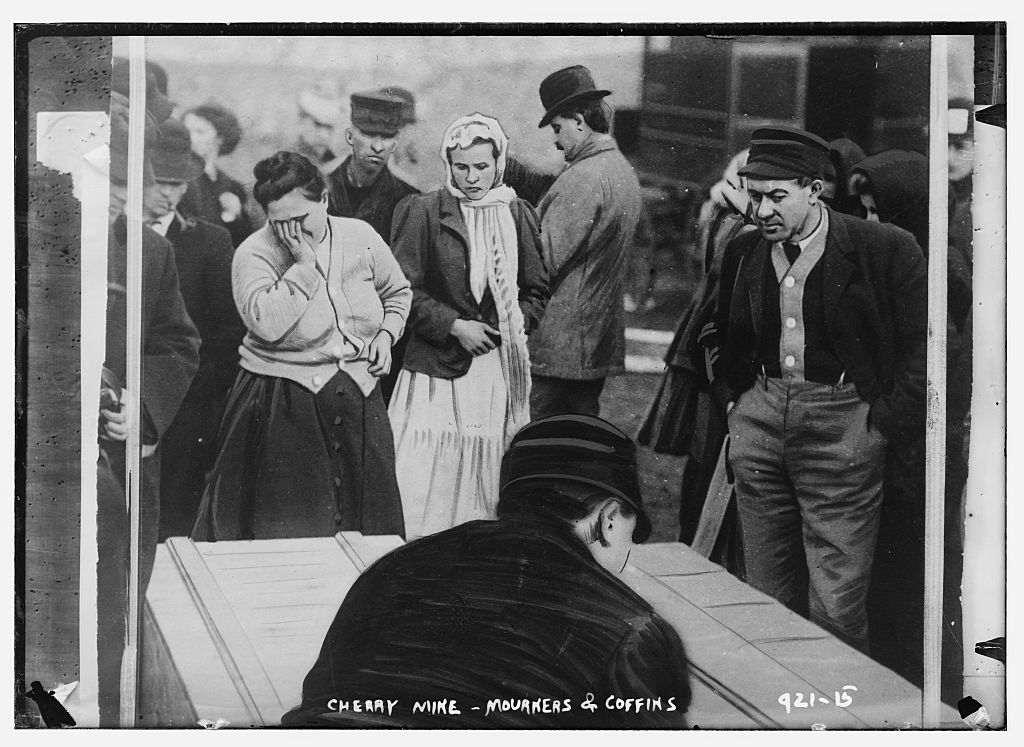
Twelve men rode the cage down seven times. Six times they came back with somebody. The seventh time the engineer waited fifteen minutes for a signal that never came. On Saturday 13 November 1909 the St. Paul Coal Company's mine at Cherry, Illinois had 481 men and boys underground. The electric lighting had failed about a month earlier and the company had gone back to kerosene torches, lengths of two-inch pipe with a cotton wick, wired to the timbers and filled by the cagers. They leaked. Around half past twelve a car carrying six bales of hay for the mule stables was pushed along the third-vein bottom and left standing under Torch No. 1. The state's own report measured the gap. The flame hung five to eight inches below the top of the hay. Some miners noticed the fire at about half past one. It had been burning for three-quarters of an hour to an hour before anyone systematically tried to warn the men at the faces. There was no alarm system in the mine. The only firefighting equipment in the third vein was about twenty feet of hose used for washing mules. The twelve who went back down are named in the 1910 state report under the heading "Twelve Heroes": John Bundy, Andrew McLuckie, Harry Stewart, James Spiers, Mike Suhe, Robert Clark, Alexander Norberg, Isaac Lewis, Dominic Dormento, John Flood, John Sczabrinski and Joseph Robesa. Three of them did not work for the mine at all. Isaac Lewis was a liveryman, John Flood a clothier, Dominic Formento a grocer. They were townsmen who turned up and got on the cage. All three left a widow and children. The report describes the last trip in the flat language of an inquest. Three bells to hoist, four to hoist slowly, four again to hoist slower, then a signal to lower, and then nothing. Fifteen minutes later the rope shook. The engineer, "after long and repeated pleading and begging on the part of many of the men," hoisted. "When the cage was raised eight of them lay on the floor of the cage. Their clothing was still blazing and their arms and hands were in convulsive postures, just as death had seized them and when they had tried to protect their faces from the awful heat. Four of the bodies were lying across the top of the cage." The death toll is 259 everywhere, and the state's own report contains four different numbers. 259 is what it concludes and what the marker says. But the same document carries a company statement to the state mine inspector giving 268; a union figure of 256, being the number of $150 death benefits actually paid; and 251 bodies recovered by August 1910, with "probably eight remaining in the mine." Its own sentence that "161 were married and 97 were single" adds up to 258, while its nationality table on the same page adds up to 259. Twenty-one men walled themselves into a side entry with dirt and stayed there with nothing to eat and very little water. The report says eight days in one sentence and seven in another, about the same men. They were found on the evening of Saturday 20 November. They spent the time writing. John Lorimer wrote to his wife by the light of his cap lamp at one in the morning: "Dear Wife, I am still living yet this is 1 o'clock Sunday morning, but we have poor hope, as the black damp is getting the best of us. There are twenty-one of us all together here. Dear Wife, don't grieve, we will meet again." Joe Pigati wrote, "I am writing in the dark because we have eaten the wax from our lamps." Two brothers left instructions: "We desire bands at our funeral." And they all signed one document together: "We the undersigned do not blame anyone for the accident that happened to pen us in here, and we believe that everybody has done all in their power to relieve us." Deeper in, men who could not reach the shaft built ventilating fans out of one-by-twelve boards, mounted them on mine props and turned them by hand with machine handles. Recovery crews found them on 10 April 1910, five months after the fire. On one of the fan blades somebody had written: "All alive — 2 p. m., 14." The fourteenth was the day after. Sixty-one bodies were found together on 4 March, "huddled together as if they had banded themselves together for mutual protection." The last body came up on 7 July 1910. Six hundred and seven people had depended on the dead. What happened next is the part that outlived them. John E. Williams of Streator, vice-chairman of the relief commission, negotiated a settlement with a railroad that had no legal liability beyond the coal company's assets of roughly $350,000. The company president said, "We acknowledge a moral obligation," and put in $400,000 more. The state report set the outcome against fifty ordinary industrial deaths of the same period. Those fifty families had received $187 apiece. The fifty Cherry families received $1,800 apiece from the company. Their average household income before the fire had been $668 a year. Illinois tightened its mine safety law in 1910 and passed its first workers' compensation act in 1911, the second state in the country to have one. The marker at Cherry says what it was for: a law "making an employer liable even when there is contributory negligence." The mine reopened and ran another ten years. The names are on granite in Cherry now. If one of them is in your family, the story belongs here with him. Compiled by MyHistoryStone from the Report on the Cherry Mine Disaster (Illinois Bureau of Labor Statistics, 1910), the Illinois state historical marker, contemporary newspaper accounts, and the University of Illinois.
Share a memory
Leave a memory or a message for the family. What you write appears right away, and the family can remove any entry.
Loading messages...