 Home
Home
A Tribute to
The Hawks Nest Tunnel
MyHistoryStone Archive
1930 – 1935
Fayette County, West Virginia, United States · 5 years
Location
Gauley Bridge, WV
Worked At
Gauley Mountain
In motion
3 photographs
The photographs on this page, brought to life.
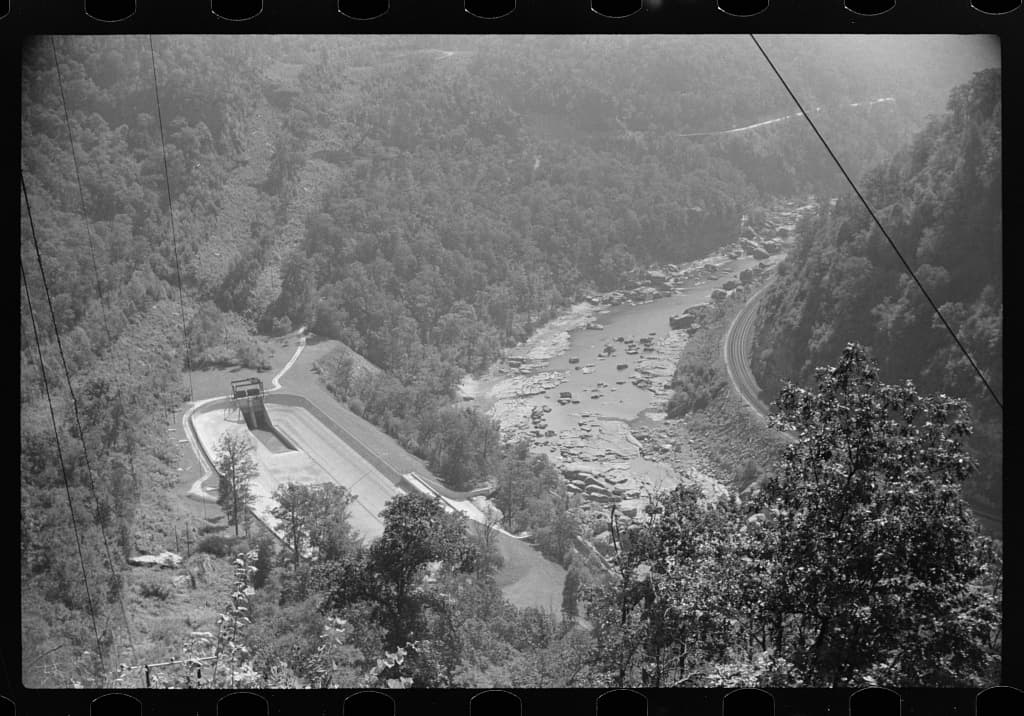
The dam and the New River gorge, September 1938, three years after the work ended. Marion Post Wolcott, Farm Security Administration. Library of Congress.
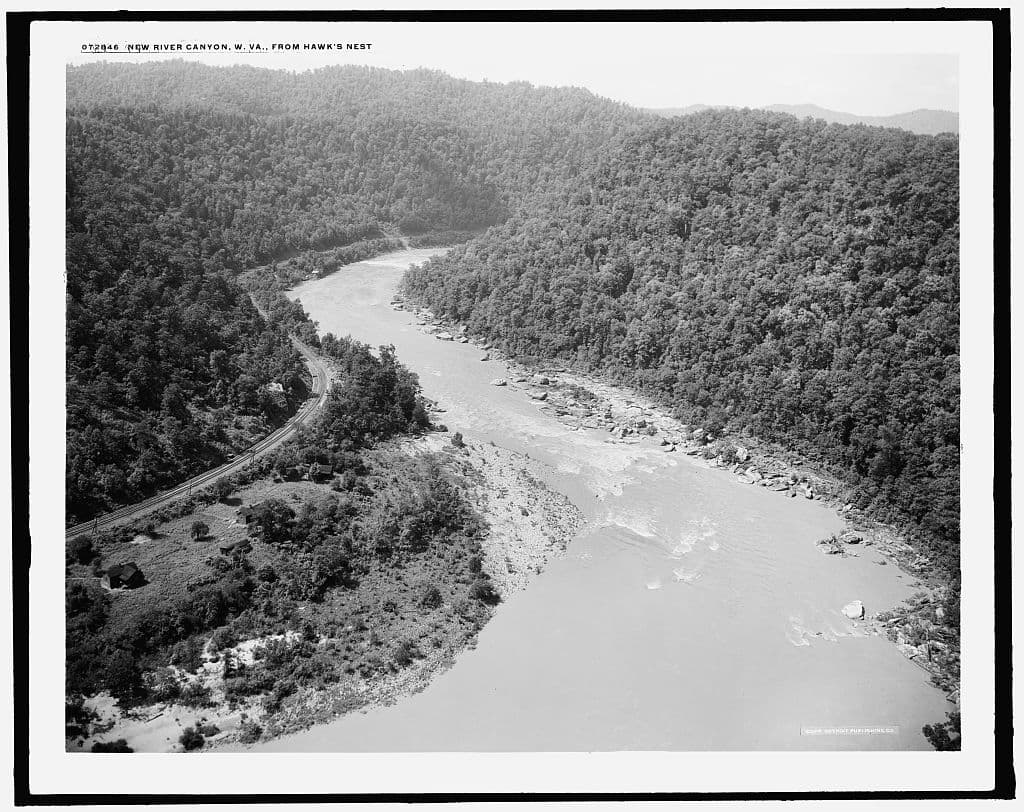
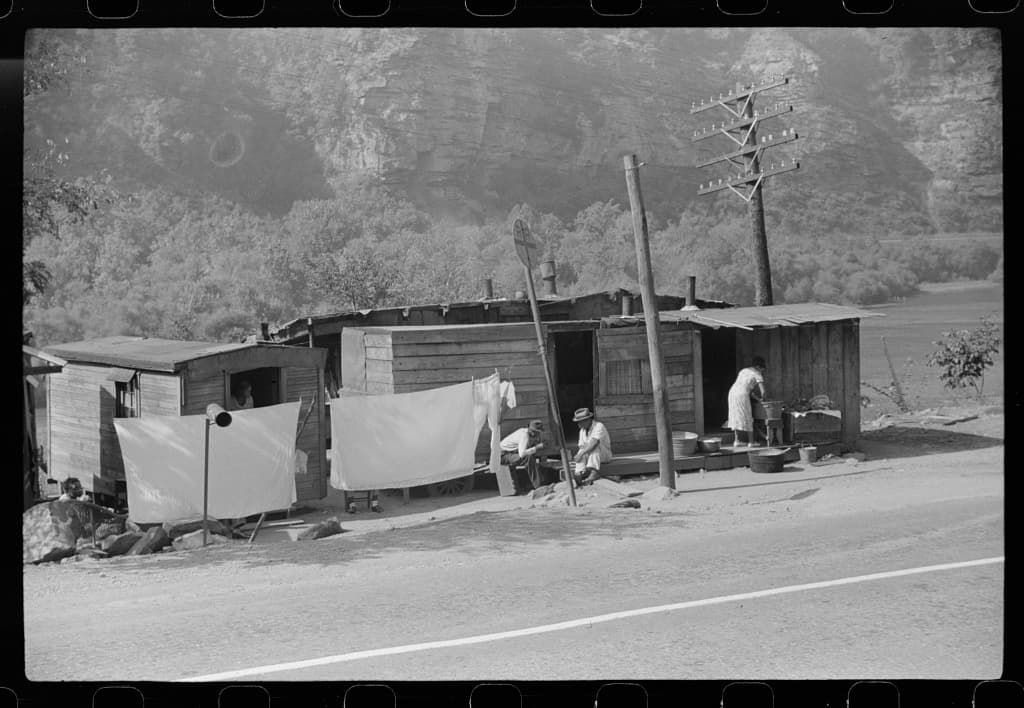
They were told they were digging a tunnel. They were also mining, and nobody told them that. In 1930 Union Carbide, through a subsidiary called the New Kanawha Power Company, hired Rinehart and Dennis of Charlottesville to drive a tunnel through Gauley Mountain in Fayette County, West Virginia. The tunnel would divert the New River to a hydroelectric plant, and the plant would power a Union Carbide metals works downstream. Work started on 31 March 1930, and the two headings met on 6 August 1931 within an inch of the calculated line. The rock was sandstone with a very high silica content. Core samples taken before groundbreaking had already shown that. A congressional subcommittee later found that in most of the tunnel the rock was more than 90 percent silica and in some headings as high as 99 percent, and that this "was known, or by the exercise of ordinary and reasonable care should have been known" to both companies. About a third of the tunnel was widened well beyond what the waterway required, so that the silica could be taken out and sent to the company's own smelter. Silica dust in the lungs causes silicosis. Inhaled at that concentration it kills in months rather than decades. Nearly five thousand men worked the project and roughly three thousand of them worked underground. Around three-quarters were Black, most of them migrants who had come north looking for work in the first years of the Depression. They were paid in scrip while white workers were paid in cash, at a rate a few cents lower, with deductions each week for a company doctor and for coal whether they burned it or not. Only 40 percent lasted more than two months. Two percent were there from the beginning of the job to the end. The 1936 subcommittee's findings are the clearest account anyone has, and they are worth quoting rather than paraphrasing. "That the dust was allowed to collect in such quantities and became so dense that visibility of workmen was lowered to a few feet." "That respirators were not furnished to or used by the employees of Dennis and Rinehart." "That the majority of drills in use were used for dry drilling. That dry drilling is more rapid and effects a large saving in time and labor costs." "That the whole driving of the tunnel was begun, continued, and completed with grave and inhuman disregard of all consideration for the health, lives, and future of the employees." Congressman Griswold added a detail from the testimony. Sixteen drills were working, six of them wet. The rest ran dry because dry was three times faster. And when inspectors were coming, someone rang a buzzer and the dry drilling stopped until they had gone. Company men who went into the tunnel wore masks. The workers asked for them and did not get them. Nobody knows how many died, and the range is not narrow. Engineering News-Record reported 65. The contractor's own 1932 accounting listed 43 by cause, mostly pneumonia. The company president told a reporter in 1936 that among five thousand workmen there had been fewer deaths than you would expect in a town of comparable size. The West Virginia state marker says 109 admitted deaths. A doctor who examined the men said not more than 200. Congressman Marcantonio said 476 dead and 1,500 doomed. A labour paper said 1,500. In 1986 the physician and epidemiologist Martin Cherniack worked through what records survived and concluded that as many as 764 died: of roughly 1,213 men who worked underground two months or more, 63 percent were dead within seven years. A federal review in 2002 put it closer to 1,000. A marker erected in 2021 allows for as many as 2,000. Cherniack's own verdict on all of it was that the death toll cannot be stated with certainty. Part of the reason is that sick men went home to the South to die and were never counted at all. Some of the medical records were destroyed. The dead who had nobody to claim them were buried in a field near Summersville, because there was no cemetery in the county that would take Black bodies. The undertaker said in 1936 that he had buried 27. A congressman said 169. In 1972, when the state widened U.S. Route 19, the remains were dug up, found to be decomposed and incomplete, placed in child-sized coffins and reburied off Whippoorwill Road. There are about 48 small depressions in the ground there. The site had no marker until 2012, when the names that are known were read aloud over it. Five hundred and thirty-eight lawsuits were filed. They settled for somewhere between 130,000 and 200,000 dollars depending on whose figure you take, with individual awards from 30 dollars to 1,600, and a judge set the amounts by race and marital status: 400 dollars for the survivors of an unmarried Black man, 1,000 for a married white one. The largest trial ended in a hung jury with evidence of jury tampering. A company vice-president paid the plaintiffs' lawyers 20,000 dollars personally so they would file no more. Rinehart and Dennis dissolved three years later. Nobody was prosecuted. West Virginia made silicosis a compensable disease in 1935. Between 1936 and 1940, seventy-nine workers in the state received anything for it. The tunnel still runs. It still makes power. The names of most of the men in that field are not known. Some are. If one of them was yours, this is the right place for him. Compiled by MyHistoryStone from the report of the House Labor subcommittee of 5 February 1936 as printed in the Congressional Record, the West Virginia Encyclopedia, the West Virginia Archives and History newspaper collection, the National Park Service, Professional Safety, and the historical markers at Hawks Nest and Whippoorwill.
Add to this story
Know something about The Hawks Nest Tunnel? Add it here - a memory, a detail, a correction. What you write appears right away, and the page owner can remove any entry.
Loading messages...