 Home
Home
A Tribute to
The Winecoff Hotel Fire
MyHistoryStone Archive
December 7, 1946
Atlanta, Georgia, United States
Location
176 Peachtree Street, Atlanta, Georgia
In motion
2 photographs
The photographs on this page, brought to life.
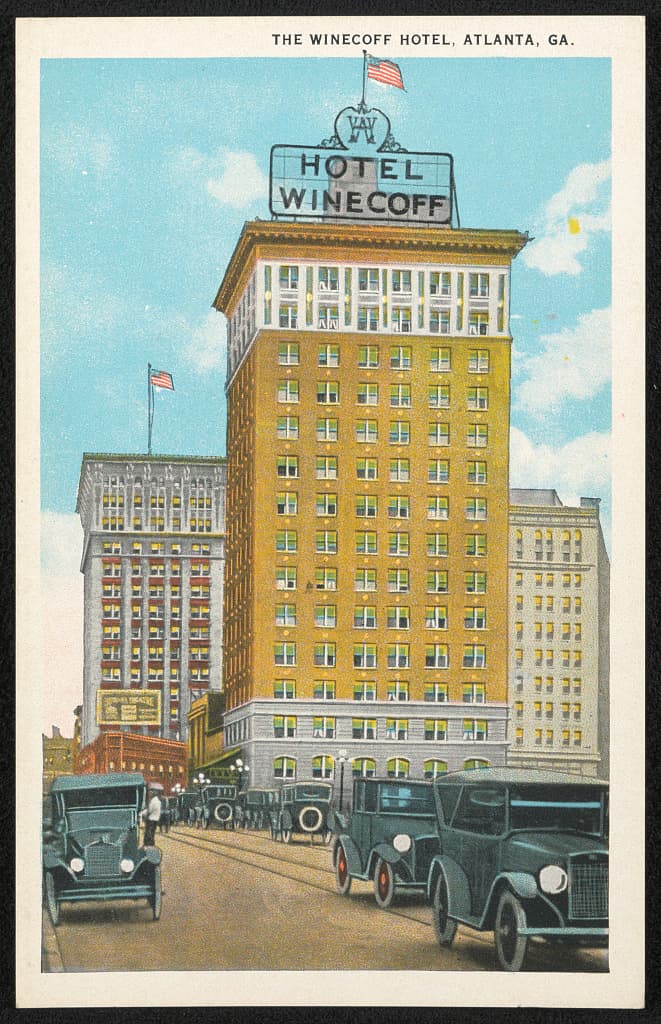
The Winecoff Hotel on a postcard, some years before the fire of December 1946. Imperial Post Card Co. Library of Congress.
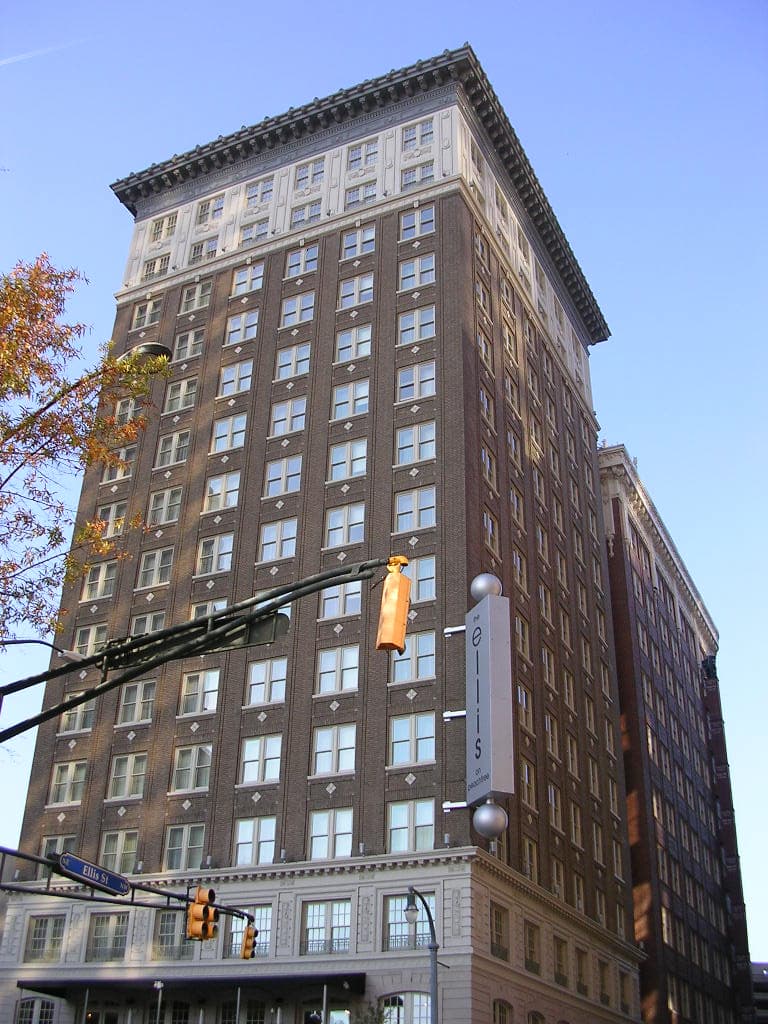
The hotel stationery said absolutely fireproof. It meant the building would survive. Nobody had promised anything about the people inside it. The Winecoff opened on Peachtree Street in October 1913, fifteen floors, built by a local developer named William Fleming Winecoff. It had no sprinklers. It had no fire escapes. It had no fire doors. It had one open stairway serving all fifteen floors, transom panels above every guest-room door, and walls finished in painted burlap under as many as seven layers of wallpaper. Atlanta had passed a code in 1929 requiring two ways out of a building. The Winecoff was exempt. The fire started in a third-floor corridor at about a quarter past three on the morning of the seventh of December 1946. The alarm went in at 3:42. The stairway did what a chimney does. There were 304 guests in the building. A hundred and nineteen of them died. It is still the deadliest hotel fire in American history. Forty high school students were staying there, delegates to the Georgia YMCA's youth assembly at the Capitol. Thirty of them died, along with two of their advisors. They had been put two to a room at the back of the hotel, along the alley, where the windows were covered with louvered shutters for privacy. Above the fifth floor, everyone in a shuttered room died. William Winecoff and his wife, who lived in the building, died too. The ladders reached the eighth floor. The nets could not take a fall of more than about seventy feet. Thirty-two people died jumping, or falling while trying to climb down knotted sheets. Arnold Hardy, a Georgia Tech graduate student walking home from a dance, heard the sirens, phoned the fire department to ask where, and got there with five flashbulbs. He used his last one on a woman falling past the fifth floor and won the Pulitzer Prize with it. Her name was Daisy McCumber, she was forty-one, an Atlanta secretary, and she had jumped from the eleventh floor. She lived. It took seven operations over ten years and she lost a leg, and she worked until she retired and died in 1992 at eighty-seven. The cause was never determined. Investigators first suspected arson because of how fast it moved; the explanation generally given since is a cigarette in a mattress that had been left standing in the corridor. Two authors later argued that a particular man set it deliberately. Nobody was ever charged. What changed is the reason this page exists. President Truman convened a national fire-prevention conference in May 1947. The Building Exits Code was rewritten in 1948 to require more than one protected way out, self-closing fire doors on guest rooms, and no operable transoms; it is now the Life Safety Code, and it is why the hotel room you last slept in was built the way it was. Georgia passed a fire safety act in 1948. Atlanta adopted one of the strictest codes in the country and capped how tall a building could be. The governor said plainly that the public is defrauded when a hotel advertises itself as fireproof. The building is still there. It reopened in 1951, was a hotel until 1967, then housing for the elderly, then empty for twenty-five years. It reopened in 2007 as the Ellis Hotel, and it went on the National Register in 2009 — listed as nationally significant, for fire safety code reform. If you lost someone at the Winecoff, or your family was among the ones who got out, add their names below. Compiled by MyHistoryStone from published reference sources, August 2026. Corrections welcome.
Share a memory
Leave a memory or a message for the family. What you write appears right away, and the family can remove any entry.
Loading messages...